
Pharaoh Psamtik III’s Deadly Encounter With Cambyses II Of Persia Ended The 26th Dynasty Of Egypt
Ellen Lloyd - AncientPages.com - Compassion is not an emotion most associate with ancient Egyptian Pharaohs who could be fearless, harsh, and ruthless rulers.
History judges Pharaohs by looking back at their successes and failures.

Still, one tends to forget that beneath the elaborate makeup and crown, the monarchs of ancient Egypt were flesh and blood individuals with emotions not unlike modern humans. Being a Pharaoh was demanding, and there was no room for self-pity, but if Pharaoh Psamtik III had known what would happen, he would have wished not to be the king.
We possess information about Psamtik III from the Greek historian Herodotus, who documented the Pharaoh's life and disastrous reign.
Troublesome Reign Of Pharaoh Psamtik III
Psamtik III ascended the throne around 526 BC., and he had the great misfortune of dealing with the Persians, who fiercely attacked Egypt at the time. It is said that some days after his coronation, rain fell at Thebes (modern Luxor), which was a rare event that frightened Egyptians, who interpreted this as a bad omen. Psamtik III was doomed to failure, and his reign marked the end of the twenty-sixth dynasty.
Born to Amasis II, also called Ahmose II, Psamtik III married several women, and one of them was Queen Tentkheta, with whom he had a son and a daughter, with names historians do not yet know. Still, these family members were the reason for the Pharaoh's later despair.
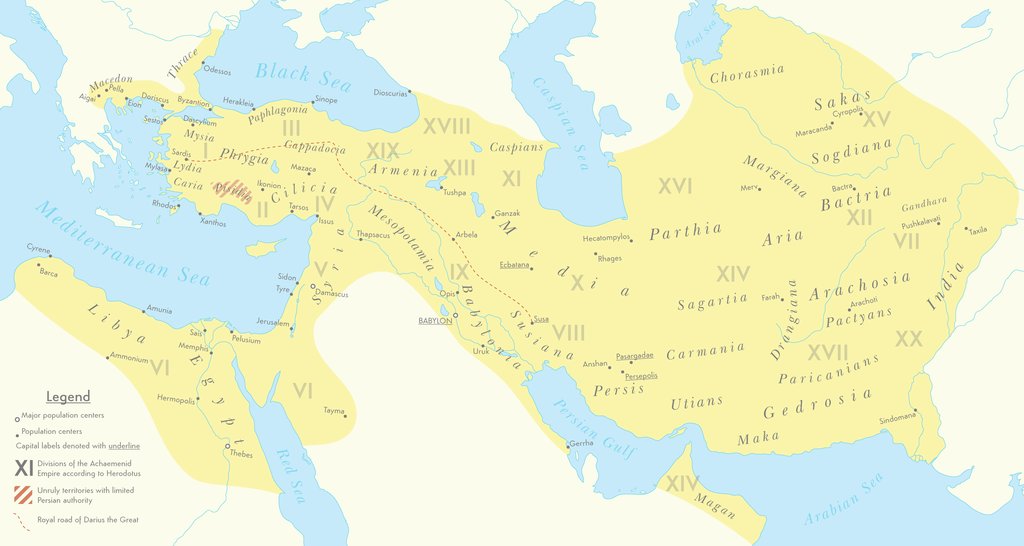
The Achaemenid Empire at its greatest territorial extent, under the rule of Darius I (522 BC to 486 BC). Credit: Cattette - CC BY 4.0
Psamtik III's reign was very brief and lasted only six months. He did all he could to resist Cambyses II's invasion, but his Egyptian army was no match for the Persians. They had already conquered Babylon, Assyria, and other Egyptian former allies.
Cambyses II, the King of the Achaemenid Empire, was the son and successor of Cyrus the Great. Being proud of his father's military accomplishments, Cambyses II was determined to conquer Egypt.
Cyrus the Great (c.575-530 BC) founded the Achaemenid Empire after conquering three great empires: the Medes, Lydians, and Babylonians.
Cyrus the Great "also united most of the ancient Middle East into a single state stretching from India to the Mediterranean Sea, which meant that he possessed the world's largest empire at that time." 1
Still, his empire did "only" reach the borders of Egypt.
Ancient Egyptians must have understood the Persians would move against their land. When Cambyses II inherited the throne after his father's death, the ambitious Persian King completed the series of conquests begun by his father, Cyrus II the Great.
Cambyses II Was Determined To Conquer Egypt
Egypt was now the only land in the region that had not fallen to the Persians. Cambyses II was aware that the Egyptians were still strong, and he understood his army would need help from some indigenous tribes to get into the Pharaoh's land.

Sculpture of Pharaoh Ramses II at Memphis in Cairo, Egypt, an ancient city in which the god Ptah was worshipped. Credit: Adobe Stock - unai
Cambyses II decided his forces would use the Sinai Peninsula to cross to Egypt. The Pharaoh hoped the Greeks, with whom Egyptians had a trading relationship, would support him, but they feared the Persians and were unwilling to offer any military assistance. It was apparent that Psamtik III was on his own. Without any support from neighboring kingdoms, there was not much he could do about the attacking enemy army, and whether he understood it at the time or not, he stood no chance against the Persians.
"Psamtik III organized his men, and he thus joined them, and he was to lead the battle from the frontline and prevent the enemies from advancing in his colony.
They met a place known as Pelusium, where the battle ensued, and the battle thus was called the Pelusium battle. The number of men in the troops that participated in the battle is unknown, but the battle was fierce; from both fronts, the kings acted as the commanders, and it was a matter of time on whose tactics would outshine the other.
The Egyptians could stand their ground against the Persian advancement for a given period. However, the Egyptians started to crumble in their defense, and with no time, they were defeated. It is said that the Persians, having known that the Egyptians were strong enough to be defeated in an open battle, used other ferocious means to defeat them. One account says that the Persians on their shield drew the Egyptian goddess in an iconographic image with the form of a cat and thus devastated the Egyptians, leading to the breakage of their formation.
It was mental torture against the Egyptians, but the Persians' primary purpose was a win, not how they obtained it. Psamtik III - upon seeing what had happened to his people - fled and went to hide in Memphis." 2
The city of Memphis, founded by Pharaoh Aha, was the traditional capital near Cairo. Psamtik III, his family, Egyptians, and their mercenaries withdrew to Memphis. Still, Cambyses II had his eyes on the Egyptian Pharaoh and had no intentions of letting him escape his fate.
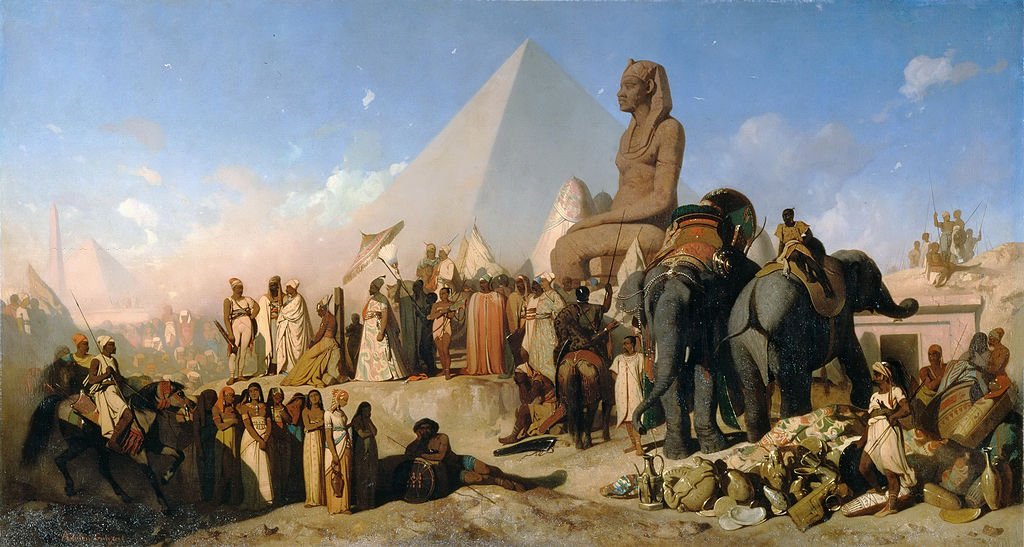
Pharoah Psamtik II's encounter with Cambyses II. Credit: Louvre Museum
The Persian forces attacked Memphis, besieged the city, captured and imprisoned Psamtik III.
Pharaoh Psamtik III was chained and taken to Susa with his son and daughter.
Cambyses II Tested Pharaoh Psamtik III's Reactions
Psamtik III was initially well-treated but was later executed for conspiracy against the Persians. Herodotus related how Pharaoh Psamtik III watched his son and two thousand Egyptians of the same age as him executed by the Persians in retaliation for the murder of Mytilenaeans, the Persian ambassador, and the two hundred crew of his boat.
Cambyses II forced the Pharaoh to witness these horrible events to test his reaction. The Pharaoh stood upright, proud, and emotionless, but he became upset after seeing an older man who had once been the king's friend being brought down to the level of a poor beggar.
According to Herodotus, "even Cambyses himself was touched with pity, and he forthwith gave an order that the son of Psamtik III should be spared from the number of those appointed to die." 3
Unfortunately, the Persian King's order came too late to save the life of the Pharaoh's son, who had been cut into pieces.
The deposed Pharaoh lived but not for long. Once Cambyses II learned Psamtik III attempted to raise a rebellion among the Egyptians, he executed him.
After the Persians' defeat under Cambyses II, Egypt never regained prominence as a world power.
Written by Ellen Lloyd - AncientPages.com
Updated on Oct 3, 2023
Copyright © AncientPages.com All rights reserved. This material may not be published, broadcast, rewritten or redistributed in whole or part without the express written permission of AncientPages.com
Expand for references- Sutherland - Cyrus The Great: Founder Of Achaemenid Empire Who Conquered Medians, Lydians And Babylonians, AncientPages.com
- Hui Wang - The History of Ancient Egypt: The Late Period
- The Histories, by Herodotus
- Brown, Truesdell S. "Herodotus' Portrait of Cambyses." Historia: Zeitschrift Für Alte Geschichte 31, no. 4 (1982): 387-403.
- Brown, Truesdell S. "Herodotus' Portrait of Cambyses." Historia: Zeitschrift Für Alte Geschichte 31, no. 4 (1982): 387-403.
More From Ancient Pages
-
 Omphalos – Mysterious Ancient Sacred Object And Its Meaning
-
 Egypt’s Oldest Tomb Oriented To Winter Solstice Discovered In Aswan
-
 On This Day In History: Ceiling Of The Sistine Chapel, Painted By Michelangelo, Is Shown Publicly For The First Time – On Nov 1, 1512
-
 On This Day In History: Astronomer Johannes Kepler Observes Supernova – On Oct 17, 1604
-
 Bastet: Protector And Punisher – She Was Among The Most Majestic Egyptian Deities
-
 Unusual Parcel With 500-Year-Old Horn Container Discovered In South Africa Sheds Light On Pre-Colonial Khoisan Medicines
-
 New Insight Into The Intriguing Megalithic Carnac Stone Alignment
-
 Beautiful Legend Of La Befana – Witch Who Delivers Gifts To Children In Italy On Epiphany – Twelve Days After Christmas
-
 A 35 Meter-Long Stone Platform Dated To 6,000 BC Discovered In Saudi Arabia
-
 White Temple Of God Anu In Sacred Precinct Of Kullaba At Uruk
-
 Extraordinary Discovery: Clay Vessel With Sour Soup For The Gods Found In Medieval Hut
-
 New Study Reveals Who Destroyed New York’s First Dinosaur Museum
-
 World’s Oldest Shoe Is 5,000-Year-Old
-
 Castro People: Intriguing Life Of The Female-Dominated Society In Ancient Iberia
-
 Advanced Ancient Technology – Talos A Greek Robot Created By The God Of The Forge
-
 Large Collection Of At Least 2,500-Year-Old Cave Paintings Discovered In Indonesia
-
 Another Franklin Expedition Crew Member Identified
-
 Earliest Evidence Of Forest Management Discovered At The La Draga Neolithic Site
-
 Is This The Face Of Queen Nefertiti? 3-D Facial Reconstruction Of Egyptian Queen Sparks Controversy
-
 Divine Shulgi Of Ur: Influential, Long-Ruling King, Conqueror And Native Akkadian Speaker In Five Languages

