
Pharaoh Psusennes I Was Buried In The Silver Coffin Decorated With Gold
A. Sutherland - AncientPages.com - Tanis, an ancient area in Egypt's Nile Delta, was an early subject of the archaeologists' interest. The city's name was already well known as Soan (biblical Zoan).
Among many Tanis tombs, one belonged to Psusennes I, the third Pharaoh of the 21st Dynasty who ruled from Tanis between 1047 – 1001 BC.

Outer sarcophagus of the Egyptian King Psusennes' I. Credit: Jerzy Strzelecki - CC BY-SA 3.0
For more than five centuries, looters have plundered most graves of Egyptian pharaohs. One grave, however, was in some way miraculously omitted and it was the tomb of the so-called Silver Pharaoh enshrined in a silver coffin.
The name Psusennes is the Hellenized version, which in Greek means Pasibkhanu or Egyptian Hor-Pasebakhaenniut ("The Star Appearing in the City"), and his throne name was translated to" Great are the Manifestations of Ra, chosen of Amun." Psusennes I was the third king of the Twenty-first Dynasty and is probably the best known of all this Dynasty's kings.
In February 1939, the French archaeologist Pierre Montet (1885 – 1966) and his workers discovered an underground chamber blocked by a stone. It was a tomb consisting of four decorated limestone chambers containing sarcophagi belonging to Osorkon III and Prince Hornakht and the remnants of Takelot II's and Osorkon I's tombs.
In 1940, Montet and his workers continued the excavations at the ancient capital of Tanis and discovered one complete, undisturbed tomb.

Credit: Public Domain and Cairo Museum, Egypt - Compiled by AncientPages.com
The tomb belonged to the 21st Dynasty king Psusennes I and the tombs of the Pharaohs Osorkon I, Takelot II, Sheshonq III, and others in a royal necropolis atop Tanis.
The doorway of the Pharaoh's tomb was found tightly sealed, and in fact, when Montet discovered it, this took six days to shatter it. Finally, the tomb was entered by archaeologists who saw it was "filled with marvels of 1001 knights". It included both beautiful and valuable objects, but at first, there was no sign of any mummy or casket because they were sealed inside a huge stone sarcophagus.

From Psusennes' treasure: a lapis-lazuli necklace of King Psusennes, a 1,8 kg solid gold bracelet, a 8 kg solid gold necklace of Psusenne. Credit: Cairo Egyptian museum via Global Egyptian Museum
The sarcophagus - huge that it almost took all space in the chamber – was found sculpted and decorated with hieroglyphs. The sarcophagus' lid weighed halftone, and there was also additional stone sarcophagus within it, and it was beautifully carved, too.
The archaeologists worked hard additional six days to locate the inner casket finally. The chamber was opened by moving the door block of granite, and in a narrow room, there was enough space for a decorated coffin made of rose granite. At the feet of the sarcophagus stood a canopic jar, which contained the king's internal organs and vessels in gold and silver.
The king's body was covered with precious amulets and semiprecious stones.
Psusennes' mummy - destroyed due to Lower Egypt's moist location - was placed inside a coffin of silver, which was more valuable than gold as it had to be imported to Egypt.
The jewelry and other grave goods survived in perfect condition. The coffin was then placed in a black granite sarcophagus, which was in turn placed in a red granite outer sarcophagus.
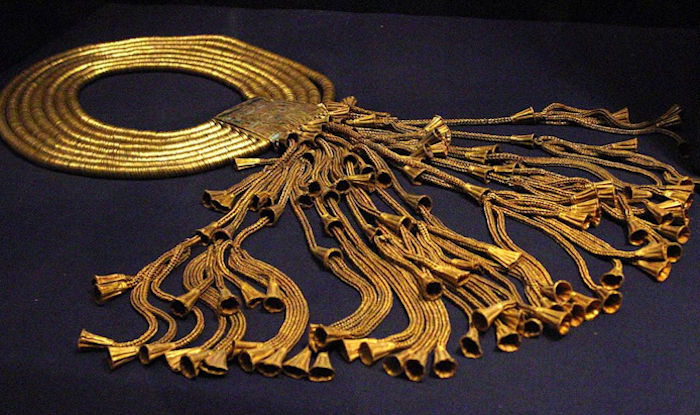
Gold and lapis lazuli collar of Psusennes I, Cairo Museum. Credit: tutincommon (John Campana) - CC BY 2.0
Especially notable amongst the items discovered in the tomb was Psusennes' solid gold mask, which was found completely intact.
The mask – considered one of the treasure masterpieces - was made of gold and lapis lazuli and held inlays of black and white glass for the eyes and eyebrows of the object. It has a maximum width and height of 38 cm and 48 cm, respectively.
Archaeologists discovered that the Pharaoh's "fingers and toes had been encased in gold stalls, and he was buried with gold sandals on his feet. The finger stalls are the most elaborate ever found, with sculpted fingernails. Each finger wore an elaborate ring of gold and lapis lazuli or some other semiprecious stone.
The intact tomb of Pharaoh Psusennes I can only be compared to Tutankhamun's, and it testifies Psusennes I had a rich funeral.
Updated on February 12, 2022
Written by – A. Sutherland AncientPages.com Staff Writer
Copyright © AncientPages.com All rights reserved. This material may not be published, broadcast, rewritten or redistributed in whole or part without the express written permission of AncientPages.com
Expand for referencesMore From Ancient Pages
-
 Radar Discovery Of Unknown Viking Age Stone Ship, Burial Mounds And Houses In The Trondheim Fjord
-
 Celts In Poland: Iron Smelting Furnaces Used By Celts 2,400 Years Ago – Unearthed
-
 Bulgarian Archaeologists Find Nearly 3000 Coins In Clay Pot At Sofia Dig
-
 Megalithic Cemetery With 49-50M Long Tombs Was Accidentally Found In Poland
-
 On This Day In History: World War II – Attack on Pearl Harbor – Dec 7, 1941
-
 DNA Says You’re Related To A Viking, A Medieval German Jew Or A 1700s Enslaved African? What A Genetic Match Really Means
-
 Mysterious Ancient Tomb Reveals ‘Impossible’ Cosmic Connection – Wrong Identity – Part 1
-
 Aboriginal Legends Tell Millennia-Old Stories Of Events In The Sky
-
 Etowah Indian Mounds: A Legacy Of The Ancient Mississippian Culture
-
 Mystery Of The Ancient Reptilian Gods Remains A Complex Subject – Alien Worlds – Part 2
-
 Unknown Rock Inscriptions And Earliest Monumental Hieroglyphs In Egypt Shed New Light On Ancient Writing
-
 Clay Tablets Reveal Sumerian Doctors Treated Disease With Spells Of Magic And Medicine
-
 Ouray In Colorado – Looping Long-Necked Dinosaur Site Reveals Its Secrets
-
 Castro People: Intriguing Life Of The Female-Dominated Society In Ancient Iberia
-
 Two Huge Olmec Reliefs Recovered After Anonymous Tip
-
 Cousin-Marriages Were Uncommon In The Ancient World
-
 Inchbrayock Stone: Pictish Samson Stone Carved With Biblical Symbols And Scenes
-
 The Middle East’s Bronze and Iron Age Cultures Were Dedicated To Wine Production That Shaped Their Societies
-
 Mysterious Underwater Ruins In Canada And America – Evidence Of An Unknown Ancient Civilization?
-
 Secrets Of Ancient Underwater City Pavlopetri Revealed – Travel Back In Time And See What The City Looked Like!

