
Gigantic Kailasa Temple: Engineering Marvel Of India’s Master Builders
A. Sutherland - AncientPages.com - Carved from a rock cliff face, the Kailasa Temple is named in honor of the sacred mountain-dwelling place of the god Shiva.
It is considered one of the most remarkable cave temples in the world.
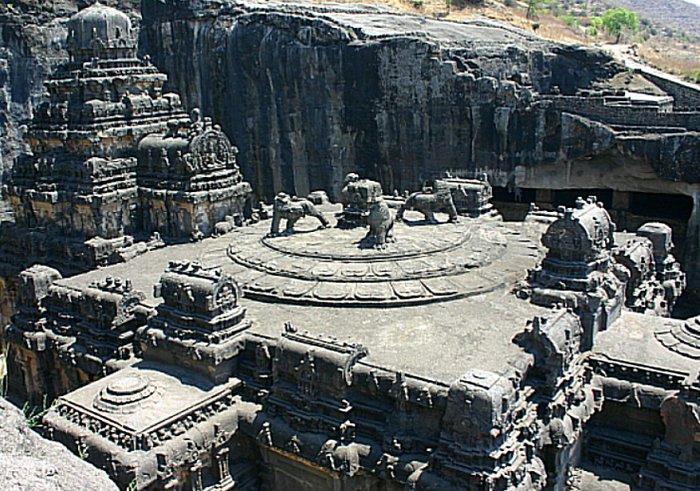
Ellora caves. Cave 16. Kailasanatha Temple. Mandapa roof. Image credit: Y. Shishido - CC BY-SA 3.0
The stunning, rock-cut Kailasa Temple is the best example of the Rashtrakuta Empire style, associated with Rashtrakuta (r. 753 - 982 CE), a royal Indian dynasty that ruled large parts of the Indian subcontinent between the sixth and 10th centuries.
During this time, despite the impressive advancement of stone-built architecture under the Chalukya Empire (636 CE, 740 CE), the Rashtrakuta Empire (753-982 CE) reverted to rock-hewn architecture and brought this style to its most incredible heights in the form of the mighty Kailasa Temple in Ellora.
Kailasa Temple (Sanskrit: Abode of the Blessed) is one of the most famous of the temples in the Ellora Caves. In an area of 45 by 80 meters, a richly ornamented temple has been carved with anterooms, chapels and corridors. A square vestibule leads into the main temple, which has seven side chapels. The temple room itself is 31 meters long and 17 meters wide.
According to standard textbooks, Hindus, Jains, and Buddhists sculpted the temples at Ellora. The earliest ones were carved around 300 BC, but most were in the 4th to 9th centuries AD.
In his book "Ellora," M. K. Dhavalikar, an author and retired Professor of Archaeology and Director of the Deccan College Post-Graduate Research Institute, Pune, India, writes that "all these shrines and the Kailasa were not excavated at the same time, but belong to different periods." ("Ellora," M. K. Dhavalikar, 2003, p. 44).
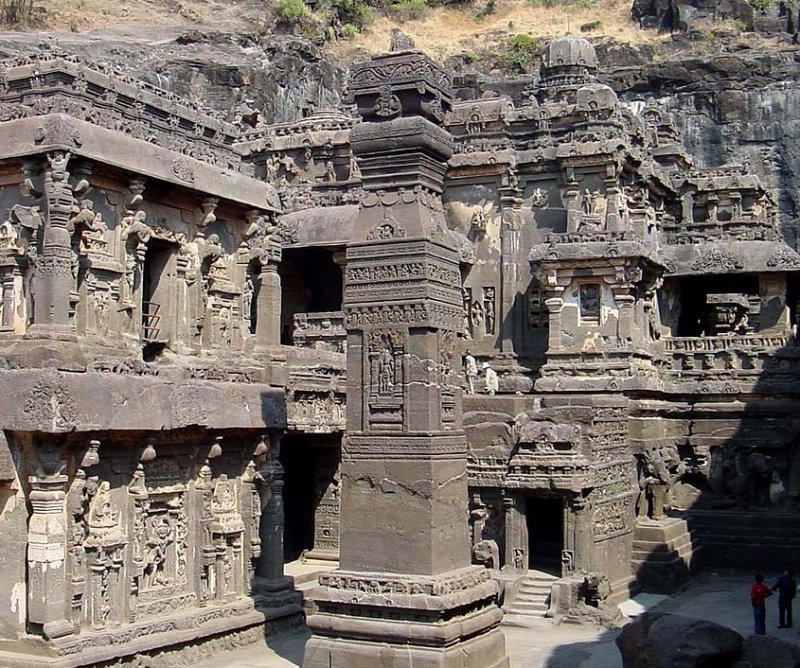
Southwest corner. Kailasanatha Temple, Ellora Looking from southwest to northeast, the Nandi pavilion is photo left, with the south column to the right. Behind them the main bulk of the temple recedes east to the rear of the cliff. The dome-shaped finial of the temple tower can be seen in the background, a bit to the right of the column, just peeping above the temple roof. Image credit: - CC BY-SA 4.0
"There is a perforated window in the west wall [of cave 15, a Hindu cave] over which a Sanskrit inscription in the Brahmi script of the eighth century is engraved. It is, however, incomplete, and much of it has been damaged due to weathering.
It gives the genealogy of the Rashtrakuta dynasty from the founder Dantivarman (c. 600-30) and records the visit of Dantidurga (752-7) to the cave. It can be placed in the middle of the eighth century. "Ellora," pp. 36-7.
It proves that the caves existed in the 8th century and were engraved at that time with this inscription.
Credit: Adobe Stock - saiko3p
Again, "There were inscriptions on pillars [in cave 33, a Jain cave] which are now mostly worn; a few letters that have survived suggest that the cave may have been built around the ninth century" (ibid., p. 96).
The formidable monolithic Kailasa temple lacks a dedicatory inscription, but there is no doubt that a Rashtrakuta ruler commissioned it. Hence, its construction is most commonly attributed to the Rashtrakuta king Krishna I, who ruled 756-773 CE.
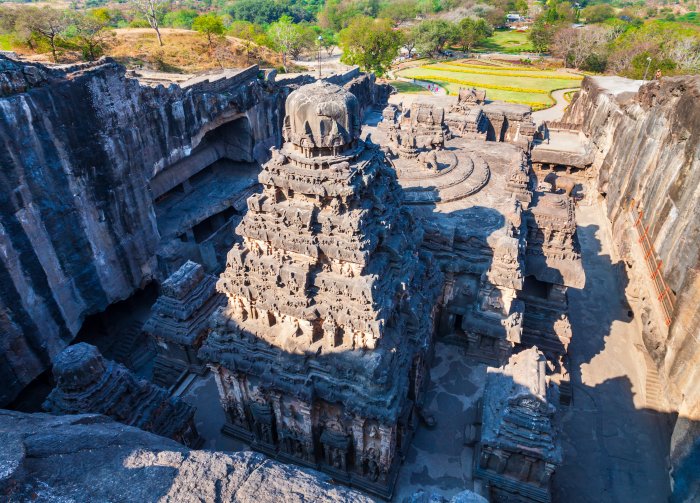
The Kailasa is one of the 34 monasteries and temples, extending over 2 km and dug side by side in the wall of a high basalt cliff in the complex at Ellora Caves, near Aurangabad (Maharashtra), India. It is the largest of the rock-cut Hindu temples built on a single rock. It is 164 feet deep, 109 feet wide, and 98 feet high.
Isn't it the world's most extensive monolithic structure carved from a single rock?
The replica of Shiva's home stands in an open country yard as three separate structures. The main temple rests on a base 25 feet high, which appears to be supported by elephant friezes. This temple measures 150 by 100 feet under a gabled front and a tower in three tiers beneath a dome. An overhead bridge links the three buildings of Kailasa and its outer gateway.
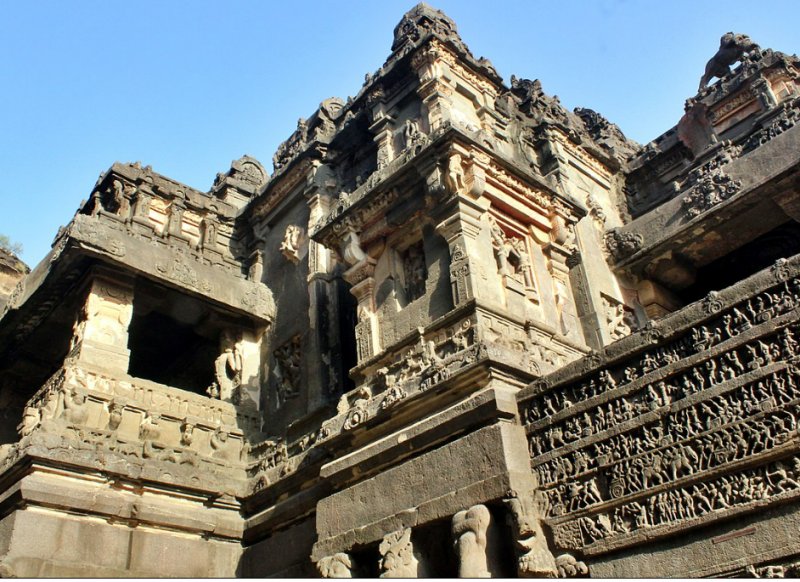 The Brahmanical group of caves (caves 13–29), including the renowned Kailasa temple (cave 16), was excavated between the 7th and 10th centuries. The last phase, between the 9th and 12th centuries, saw the excavation of a group of caves (caves 30–34) reflecting Jaina philosophy. Image credit: - CC BY-SA 4.0
The most impressive feature of Ellora caves is the hand-made rock-cut sculptures created using only a chisel and hammer. Indian artisans and master builders did a tremendous job providing evidence of their efficiency and technological skills.
The Buddhist, Hindu, and Jaina caves coexist harmoniously, sharing the geographical expanse from the southern region to the northern territories. This combination of diverse religious and cultural influences serve as an example of unity and tolerance, transcending individual beliefs and embracing a spirit of coexistence.
The temple represents an interpretation of the cosmic mountain - in this case, the celestial palace of the great god Shiva, who was believed to dwell on Mount Kailasa in the Himalayas.
Completed in 785 AD, the Kailasa Temple is a celestial abode with pillars, corridors, towers, and statuary beautifully decorated with ornamentation.
The temple is not a building - it is a sculpture created on a scale never achieved anywhere else on our planet. Indian craftsmen and master builders did a tremendous job providing evidence of structural efficiency and technological skills.
Percy Brown, a leading authority on Indian Art and Architecture, said:
"The Kailasa is an illustration of one of those rare moments when men's minds, hearts, and hands work in unison towards the consummation of a supreme ideal."
Written by – A. Sutherland AncientPages.com Staff Writer
Updated on May 26, 2024
Copyright © AncientPages.com All rights reserved. This material may not be published, broadcast, rewritten or redistributed in whole or part without the express written permission of AncientPages.com
Expand for referencesMore From Ancient Pages
-
 Has The Mystery Of The Hobbits Finally Been Solved?
-
 Face Of Man From The Lost Medieval Village Of Dzwonowo Reconstructed Using 3D Printing Technology
-
 Ukraine – A Place Where People From Different Cultures Intersected Until About 500 Years Ago
-
 Underwater Rock Carvings Of Ancient Egyptian Pharaohs Discovered Near Aswan
-
 First 5th Century Mosaic Found Near Cirencester Once The Second-Largest Roman-British Town In England
-
 Bronze Celtic Figurine Of Man With Golden Eyes Found In Slovakia
-
 One Of The Biggest Gold Treasures Ever Discovered In Denmark Is 1,500-Year-Old
-
 Social Tensions Among Ancient Pueblo Societies Contributed To Their Downfall – Not Only Drought
-
 Face Of Neanderthal Who Lived 56,000 Years Ago Reconstructed
-
 What Really Happened To Library Of Alexandria Remains A Mystery
-
 Medieval Wooden Stave Churches In Norway Are Older Than Previously Believed
-
 1,500-Year-Old Ancient Lamps Unearthed In Zerzevan Castle In Southeast Turkey
-
 How Individuals With Disabilities Were Treated During The Late Middle Ages – Advanced Techniques Give Answers
-
 Why Did People Start Eating Egyptian Mummies? The Weird And Wild Ways Mummy Fever Swept Through Europe
-
 Legend Of Milky Way’s Celestial Portal And The Star City From The Bowuzhi By Zhang Hua
-
 ‘Skeleton Mosaic’ – 2,400-Year-Old Scenes Depicted On Glass Artwork Found In Turkey
-
 Pazyryk Carpet Found In Scythian Tomb Considered The Oldest Carpet In The World
-
 Sacsayhuamán – Was It Built By ‘Demons’ Or Viracocha The Bearded God?
-
 1,800-Year-Old Military Medal with Medusa Head Unearthed In Ancient City of Perge (Perrhe), Southeastern Turkey
-
 Sumerian Clay Brick With Inscription In Honor Of God Enki Returns To Iraq

