
Ancient City Of Urkesh – Home Of Kumarbi – The Foremost Son Of Anu
A. Sutherland - AncientPages.com - Tell Mozan, the site of the ancient city of Urkesh, holds a significant place in both historical records and myths. This ancient city, nestled in the foothills of the Taurus Mountains in Al-Hasakah Governorate, northeastern Syria, is a treasure trove of historical and archaeological wonders.
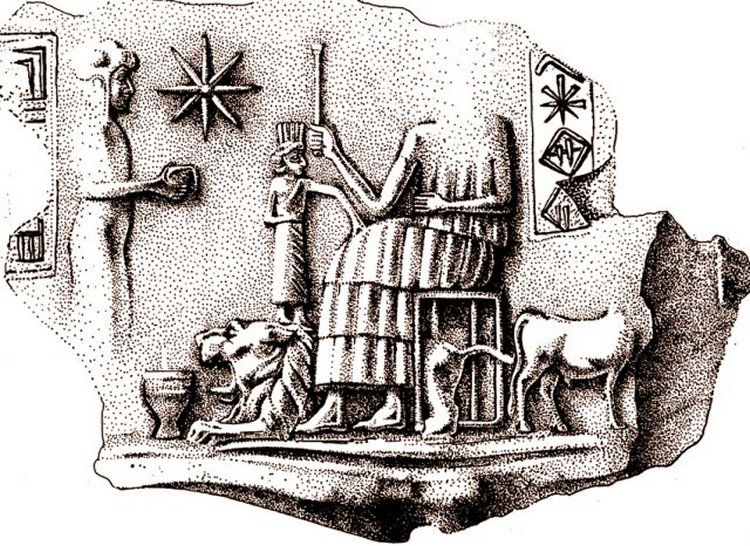 Tupkish, the king of Urkesh. Credits: G. Buccellati, November 2002
It was founded during the fourth millennium BC, possibly by the Hurrians, on a site that appears to have been inhabited previously for a few centuries.
The beginnings of Urkesh are shrouded in mystery, adding to its allure. While the exact origins remain unknown, it is established that Urkesh dates back to at least the early part of the fourth millennium BC. It occupied a vast area, encompassing both the plains and mountainous hinterland in what are now parts of Syria, Iraq, and Turkey.
The discovery of Urkesh has pushed back the earliest evidence for the Hurrians into ¨the third millennium., the civilization - in many ways alternative to that of the Sumerians, the Akkadians, and the Amorites.
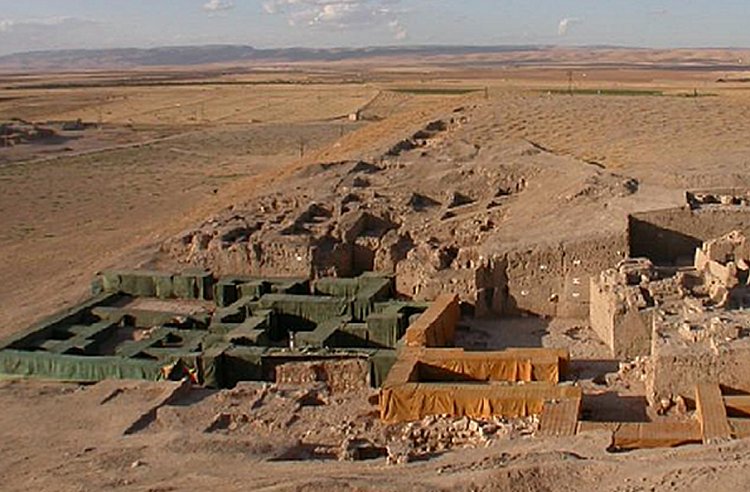 The large royal palace at Urkesh, which was still being excavated in 2010, has yielded written evidence which allowed it to be identified. Photo credits: Urkesh.org
Urkesh was not just a city, but the heart of an enigmatic civilization. The Hurrians, its inhabitants, spoke a language that was unique and unrelated to any other known ancient or living language. The Hurrian texts from Urkesh are among the earliest known, adding to the mystery of this ancient civilization.
It was the main center of the Hurrians, who celebrated it in their countless myths as the home of the father of the gods, Kumarbi - the foremost son of Anu (the sky), identified by the Hurrians with Sumerian Enlil.
Urkesh was also the capital of a kingdom that controlled the highlands immediately to the north, where the supplies of copper were located, a source of wealth that made the city prosperous and influential.
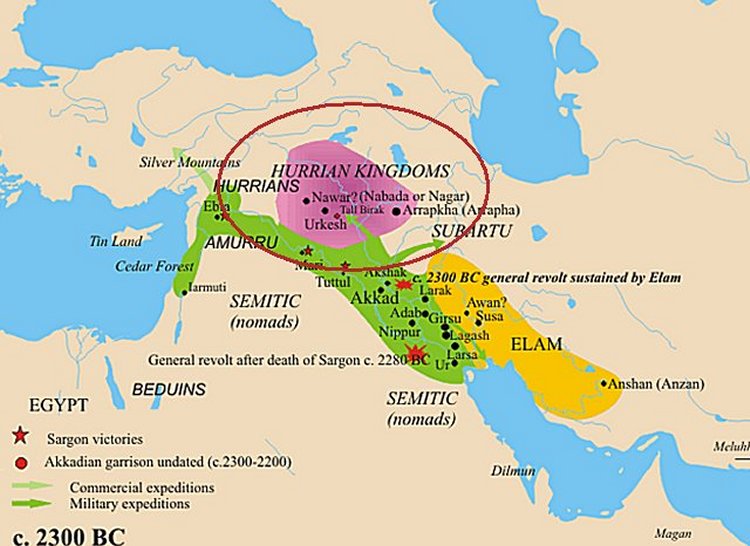 Middle East - c. 2300 BC. Image credit: Nareklm - Wikipedia
The Hurrian population died out thousands of years ago, but the modern inhabitants of the area have not forgotten their ancestors from the ancient past.
For the last 30 years, archaeologists have conducted excavations at Tell Mozan, ancient Urkesh, and these not only placed this ancient site in northeastern Syria but also have brought to light Tell Mozan/Urkesh and their inhabitants - the Hurrians, an enigmatic civilization of the ancient Near East.
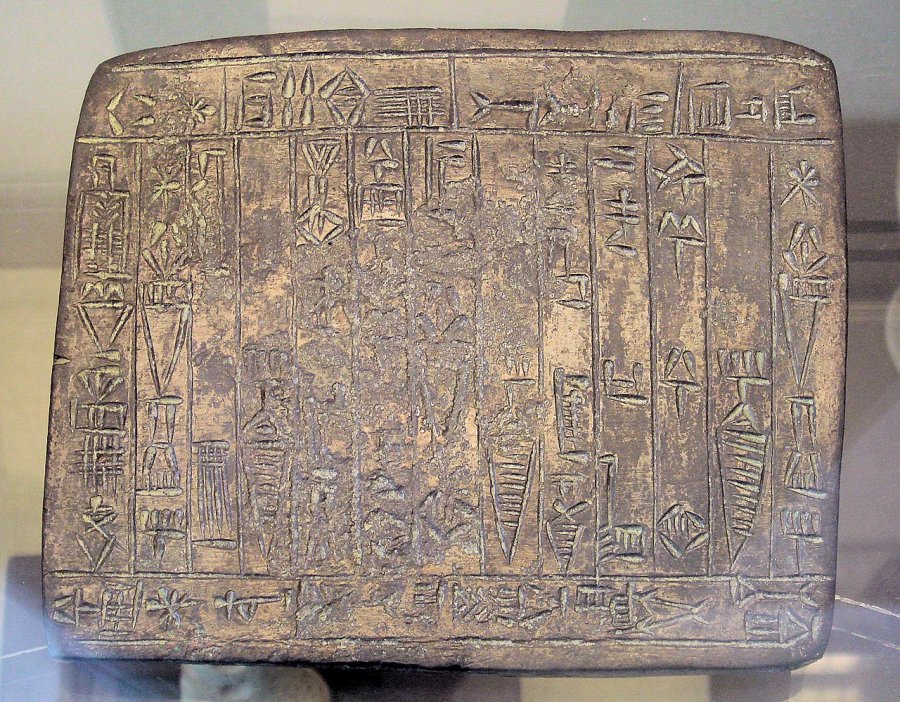
Foundation tablet. Dedication to God Nergal by Hurrian king Atalshen, king of Urkish and Nawar, Habur Bassin, circa 2000 BC. Louvre Museum AO 5678.
"Of Nergal, the lord of Hawalum, Atal-shen, the caring shepherd, the king of Urkesh, and Nawar, the son of Sadar-mat, the king, is the builder of the temple of Nergal, the one who overcomes opposition. Let Shamash and Ishtar destroy the seeds of whoever removes this tablet. Shaum-shen is the craftsman. source
Among the most important finds revealed by the Mozan/Urkesh excavations, was the discovery of a beautiful sculptural image of a horse head dating from the middle of the third Millennium BC.
Also, subsequent findings showed more representations of horses, possibly continuing the same Hurro-Urartian tradition. It is believed that horses were domestic animals, mainly because the diggings revealed several horse figurines from the storeroom inside King Tupkish’s palace (about 2200 BC).
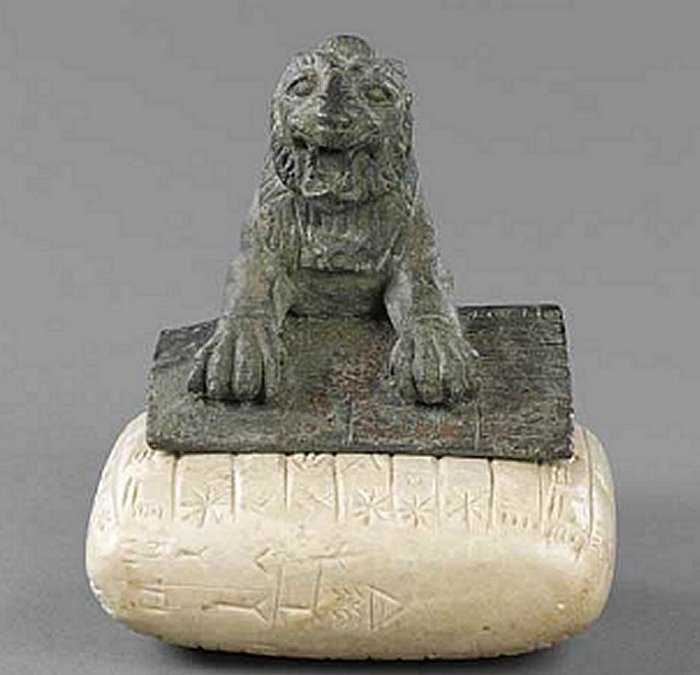 The Louvre lion of Tish-atal and an accompanying stone tablet bearing the earliest known text in Hurrian Photo credit: Louvre
These numerous figurines, which belong to the following period of the history of Urkesh in the last quarter of the 3rd Millennium BC, make it clear that the horse was essential in the life of this ancient society.
Particularly interesting are horse figurines showing the harness, thus documenting the use of horses in transportation. Written documents from the Palace have given us the name of the city and kingdom of Urkesh and its king, Tupkish, and queen, Uqnitum. The powerful witness of writing also tells us that one of the daughters of Naram-Sin, the famous Mesopotamian king, lived in Urkesh.
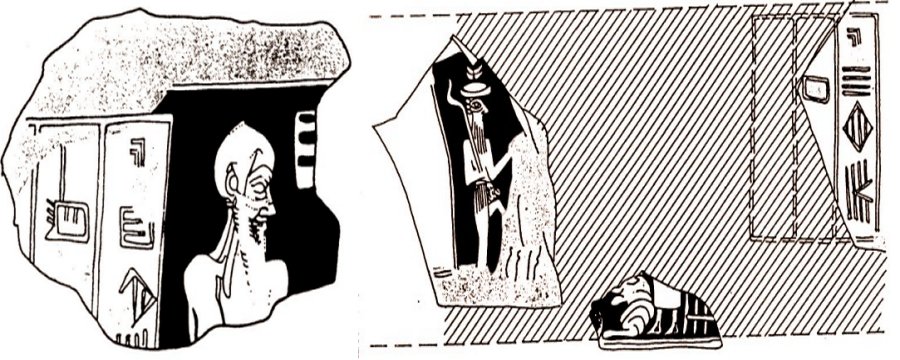 Left: Warrior with a helmet. Urkesh. Credits: G. Buccellati, November 2002. Right: God with a raised foot. Credits: G. Buccellati, November 2002
Next to the Palace, UCLA Georgio Buccellati and Marilyn Kelly-Buccellatia and their team excavated a deep underground shaft that was one of the most awe-filled monuments of the Hurrians – the 'Passage to the Netherworld.'
Further excavations have revealed compelling evidence that the Hurrians not only strongly influenced the language, culture, and religion of later peoples but also may have been present 1,000 years earlier--just as nearby Mesopotamians began to create the first cities.
Kumarbi's temple, one of the most important buildings, was left in ruins from about 2400 BC. The god Kumarbi's temple was probably built by one of the earliest known Hurrian rulers - the king Tish-atal, c. 21st century BC of Urkesh during the Third Dynasty of Ur.
There are many unanswered questions regarding the Hurrians, but one thing is sure: these ancient people were far more than just another wandering tribe in the fractious Middle East.
Written by – A. Sutherland AncientPages.com Staff Writer
Updated on Auust 26, 2024
Copyright © AncientPages.com All rights reserved. This material may not be published, broadcast, rewritten or redistributed in whole or part without the express written permission of AncientPages.com
Expand for referencesMore From Ancient Pages
-
 Archaeologists And Historians Argue With Geneticists Over Controversial Viking DNA Study
-
 Archaeological Evidence Amazon Warrior Women Did Exist Found At Nakhchivan Necropolis, Azerbaijan
-
 Medici Family – Powerful Renaissance Godfathers And Patrons Of Galileo Galilei
-
 A 1,500-Year-Old Basilica Re-Emerged Due To Withdrawal Of Waters From Lake Iznik
-
 Zapotecs’ Magnificent City Of Mitla Was Destroyed By A Seismic Landslide
-
 Mysterious Advanced Underground Civilization And A Secret Society – Technology, History, Language And Goals – Part 2
-
 Ancient DNA Solves The Mystery Of Mitochondrial Eve And Human Evolution?
-
 Sacred Number Four – Perfect Number And Deep Meaning Behind It
-
 What Are The Monumental Uratrian-Era Structures Unearthed At Garibin Tepe In Van?
-
 Mysterious Prehistoric Statues In Bada Valley, Indonesia Surrounded With Countless Legends
-
 Children Of Lir And Aoife’s Curse – Celtic Legend That Inspired The Swan Lake Ballet
-
 Long-Lost Ancient Maya Kingdom Unearthed In Mexico
-
 Tummal Inscription’ – Thirty-Two Lines Of Sumerian Document Popular In Babylonian Schools
-
 Unique Treasure Of 500 Coins Accidentally Found Under Church Floor In Slovakia
-
 15 Precious Ancient Objects Returned To Greece From Switzerland – Antique Dealer Charged With Trafficking
-
 Fascinating Virtual Avatar Of Mysterious Egtved Girl Created – What Is Her Story?
-
 Natural Dyes To Color Clothing Were Used Thousands Of Years Ago – New Study
-
 Hieroglyphs Reveal The Name Of Forgotten Maya Queen Ix Ch’ak Ch’een
-
 On This Day In History: Battle Of San Domingo Was Fought – On February 6, 1806
-
 More Than 27,000 Artifacts Illegally Collected By ‘Expert In Archaeology’ – Seized In France

