
Cnut The Great – England’s Danish King And Ruler Of One Of The Largest Nordic Empires
A. Sutherland - AncientPages.com - Cnut The Great (in Swedish: "Knut den Store") became king over large parts of northern Europe, where commerce and culture flourished in his kingdoms.
But the Viking king had to fight very hard to reach his power.
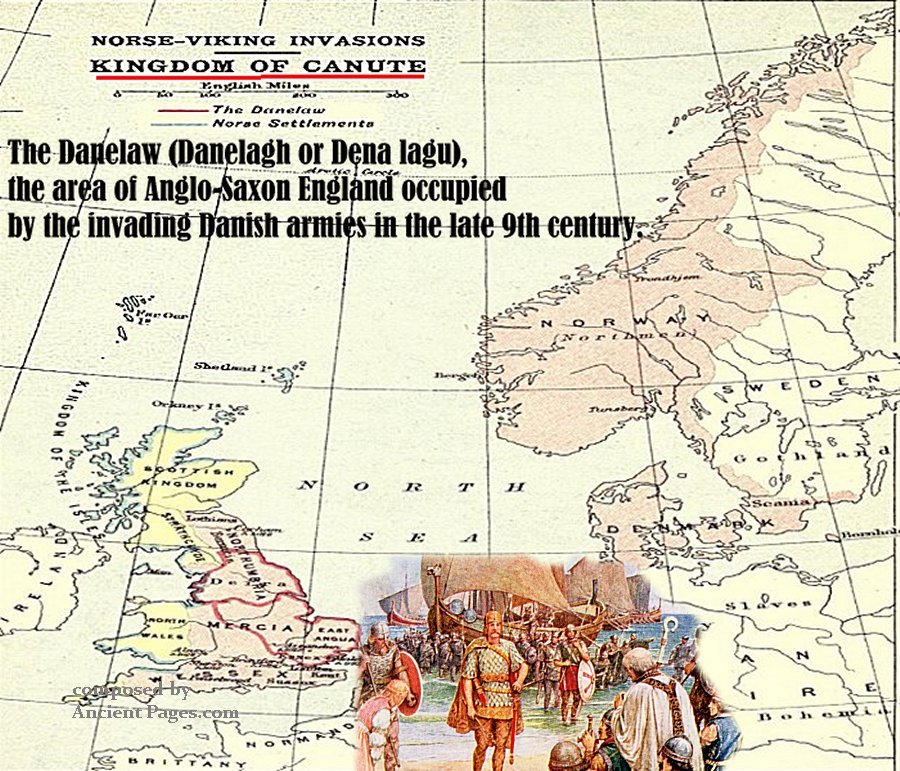
Norse-Viking Invasions - Kingdom of Canute
His father, the Danish Viking King Sven Forkbeard (Sven Tveskäg), son of Harald Bluetooth, sailed with his fleet for England in the summer of 1013. He aimed to overthrow the Anglo-Saxon King Aethelred the Redeless and conquer the islands.
When the Scandinavian fleet landed in northeast England, Aethelred fled to Normandy, France, transferring power to Sven Forkbeard, who had, among others, been joined by his second eldest son, 18-year-old Cnut. Forkbeard sat on the throne just a few months before he died on February 3, 1014.
His eldest son Harald was crowned king of Denmark. The younger brother, Knut, was at that time the head of his dead father's invasion force but was now ready to inherit the throne of England.
The army proclaimed Cnut king, but the English people invited Aethelred back if he promised to rule better than before. Aethelred acted fast; he drove Cnut and his forces out to sea. Cnut decided not to press the point at this stage and withdrew to Denmark.

An 1848 Illustration of the legend of King Canute and the waves. The People’s Gallery of Engravings - source - Public Domain
"I welcome your arrival, dear brother, and am grateful that you visit me. But it's hard to hear what you say about the kingdom split. .."
He contacted his brother, hoping the two brothers would rule Denmark together, but Harald refused.
"I welcome your arrival, dear brother, and am grateful that you visit me. But it's hard to hear what you say about the kingdom split. The inheritance of our father, with your consent, has been given me, I control. It hurts me to hear that you lost your inheritance, which was bigger than this, and I am ready to help you. But my kingdom, I do not share," Harald explained kindly for his brother, according to an ancient source from 1043.
Instead, Harald offered his help; he knew that Cnut needed a solid army to take up the fight against Ethelred. In the summer of 1015, Cnut's fleet of 200 ships and over 10 000 men sailed to England.
"On this big raid was not a single slave. Neither men freed from bondage. None of the call origin, and no one was weak from old age. All were noble and strong men in their best years. All was ready for any form of combat. And they were all so fast that they surpassed the rider's speed, "reads the description of the tribute scripture."
Coin with the image of Cnut the Great (Image in the public domain)
At the battle of Ashingdon in Essex in October 1016, he routed the army of Aethelred and his eldest son Edmund Ironside. He managed to gain control of virtually the whole country, except for the city of London.
The land of England north of the Thames was surrendered to the Danes – a return of the Danelaw (Danelagh or Dena Lagu), the area of Anglo-Saxon England occupied by the invading Danish armies in the late 9th century.
Edmund died shortly afterward, and Cnut assumed control of his territories and was crowned King of England in January 1017. His brother Harald died in 1018, and with a predominantly English force, Cnut returned to Denmark to claim the throne.
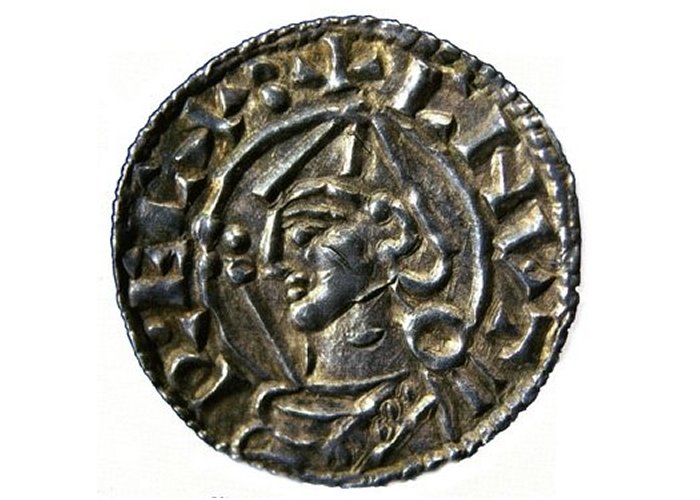 Coin with the image of Cnut the Great. Public domain
After the coronation, Knut traveled back to England. The Norwegian and Swedish kings - Olav Haraldsson and Anund Jacob - tried to take advantage of Knut's absence in Denmark and attacked the country on several occasions.
Even Cnut's commanded deputy was in a coalition with the kings and had serious plans for usurping power, but Knut immediately traveled back to Denmark.
He crushed all resistance and punished the deputy for his questionable loyalty.
An early morning, the deputy received his sentence in a church in Roskilde, on the island of Zealand in eastern Denmark, where Cnut's men killed him.
Knut died on November 12, 1035; he was only 40 years old.
He was buried in England's then capital Winchester. Before he died, he had expanded its already large kingdom so that it also included Iceland and Scotland - and thus, at the same time, gained a place in history as the ruler of one of the largest Nordic empires.
Cnut, commonly known as King Canute, is depicted today as a successful and wise king. With violence and well-chosen alliances, he built up a vast empire; he was the most powerful king in northern Europe in the early eleventh century. He was King of Denmark and England, for a time King of Norway, and possibly lord of parts of Sweden.
He lived long ago; therefore, there is little historical information about him.
A. Sutherland – AncientPages.com Staff Writer
Updated on August 12, 2022
Copyright © MessageToEagle.com This material may not be published, broadcast, rewritten or redistributed in whole or part without the express written permission of AncientPages.com
Expand for referencesReferences:
S. Lagerbring, Swea rikes historia: Rikets öden, ifrån des början till år 1060. (1769)
Skandinavien Under Hedna-Aldern ; Förra Afdelningen
More From Ancient Pages
-
 Legendary Viking Sunstones Did Exist: Viking Sagas Were More Truthful Than We Realized
-
 Ancient Circular Mound Villages Hidden In The Amazon Jungle Represent Native American Cosmos – New LIDAR Discovery
-
 Viking Law And Order Was Based On The Thing System
-
 Unexpected Discovery Of Rare Ancient Roman Carved Wooden Figure In Buckinghamshire
-
 Teutonic Knights – Facts And History About The Christian Military Order
-
 New Study Reveals Rare Mortuary Treatment Of Egyptian Mummy
-
 Huge Mass Grave With Remains Of Pirate Black Sam’s Crew Discovered In North America
-
 Michelangelo Inserted Hidden Pagan Symbols Associated With Female Anatomy In His Works Of Art
-
 Tomb Of Christopher Columbus Finally Found But There Is One Problem With His Body
-
 White Temple Of God Anu In Sacred Precinct Of Kullaba At Uruk
-
 Roman Leather Toy Mouse Found At Vindolanda
-
 Man In Sweden Finds Viking Age Skeleton In His Garden
-
 Pre-Columbian Pachacamac Site Dedicated To God Of Creation, Fire And Earthquakes In Inca Religion
-
 House Of Plantagenet – How Hatred, Revenge And Jealousy Transformed History
-
 Knaresborough Hoard Reveals Its Secrets – Unusual Roman Discovery In The British Isles
-
 Uniquely Well-Preserved Medieval Kitchen Unearthed North of Moravia
-
 Strange Medieval Figurine With A Crown On The Head And A Falcon On The Arm – Is It A King Or A Queen?
-
 Magnificent Ancient Rock-Cut Lycian Tombs Of Myra, Antalya, Turkey
-
 Oldest Evidence Of Mysterious Humans On ‘Hobbit’s’ Island Neighbor – Found
-
 Investigation Of A 2.9-Million-Year-Old Site Reopens Case Of Who Made First Stone Tools

