
Hesperides – Greek Nymphs Who Guarded Fabled Garden With Divine Apples Of Immortality
A. Sutherland - AncientPages.com - The most famous garden in Greek mythology was the Garden of the Hesperides. This legendary aromatic place was full of golden apples, which Gaia (Earth) gave to the goddess Hera and Zeus as a wedding gift.
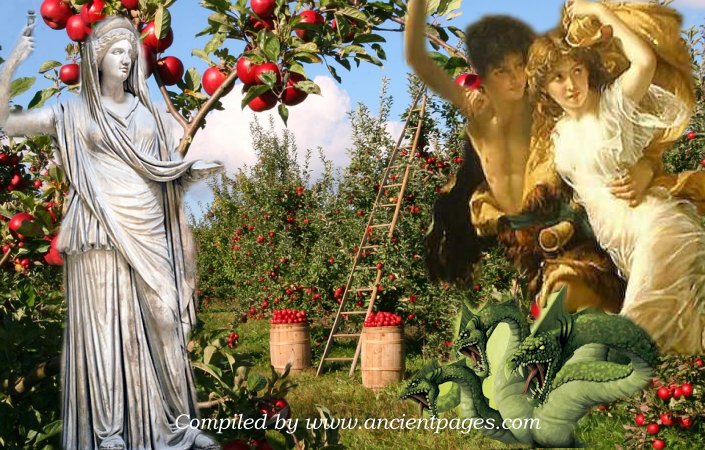
The fabled garden was guarded by the nymphs of the far west, the Hesperides, daughters of the Titan Atlas, who bore the vault of heaven upon his gigantic and robust shoulders.
The land of Hesperides was variously located; eventually, it was placed near North Africa's Atlas Mountains, at the edge of the world ocean, Oceanus.
Three, Four Or More Hesperides Nymphs With Many Names
The parentage of the Hesperides has never been specified. According to the poem Theogony (c. 700 BC) by Hesiod, the Hesperides were daughters of Erebus, one of the first five beings in existence, born of Chaos and the goddess of the night, Nyx. In time, they were also considered to be daughters of Zeus and Themis and most often Atlas and Nyx (or Hesperia). Ancient sources are not specific regarding the number of Hesperides:
Were they three, four, or perhaps even seven of them?
One version of their story prevails and says there were three of them; Apollonius of Rhodes gives their names as Aigle, Erytheis (Erytheia), and Hespera, similar to other triads often encountered in Greek myths.
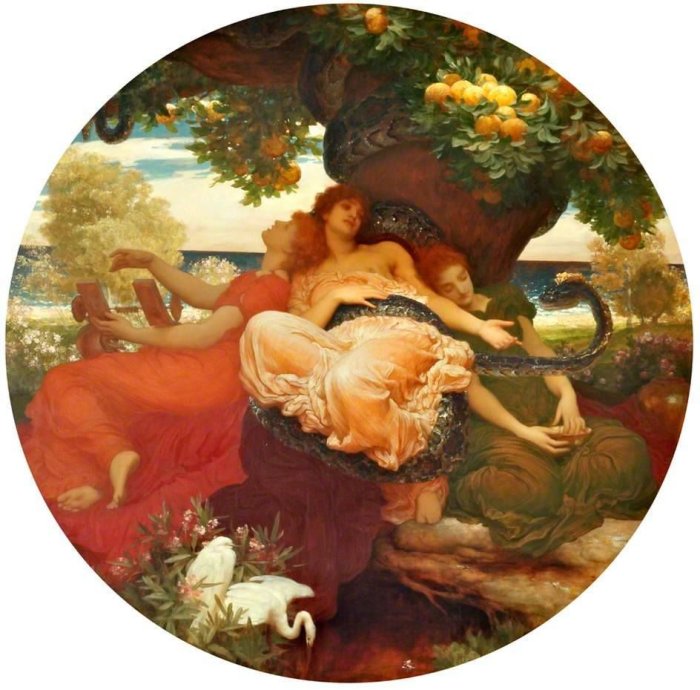
Hesperides Nymphs - The Garden of the Hesperides by Frederick, Lord Leighton, 1892. The Bridgeman Art Library,
The name of these magical ladies originates from Hesperos ('evening'); in Latin, Heperus means the evening star (i.e., the planet Venus). The nymphs of the evening and golden light of sunset have many names, such as the "Daughters of the Evening," "Sunset Ladies," "The Western Women," or "Nymphs of the West."
Untrusted Guardians Of The Golden Apples
The sisters presided over matrimonial pleasures, romance, and the honeymoon night. They could sing wonderfully, but they first guarded divine treasures belonging to the Olympians, including trees with golden apples.
As the sisters were not particularly trusted guardians of the apples (they liked to take apples for themselves), the goddess Hera also appointed an immortal dragon named Ladon as an additional safeguard of the garden.

Heracles in the Garden of the Hesperides. Image credit: Trustees of the British Museum, London
The courageous hundred-headed creature was a very efficient apple tree protector. Ladon never closed his eyes and could fight with many enemies and demons simultaneously. The beast was able to use many different voices and was the offspring of a monster, Echidna "she-viper") a half-woman and half-snake who lived alone in a cave.
She was the mate of the fearsome monster Typhon.
We learn about the garden of the Hesperides from the story of Heracles, the greatest of the legendary Greek heroes and the son of Zeus and Alcmene.
Once driven insane by Hera, Heracles killed his own children in a confused state of mind. As a part of his long punishment, he was forced to carry out twelve arduous labors given to him by his cousin, King Eurystheus.
The twelve labors seemed to be impossible to accomplish.
One of them was to find the Garden of Hesperides and bring (or steal) some golden apples. From Nereus, the Old Man of the Sea, the sea god, and a shapeshifter, Heracles learned about the location of the Hesperides.
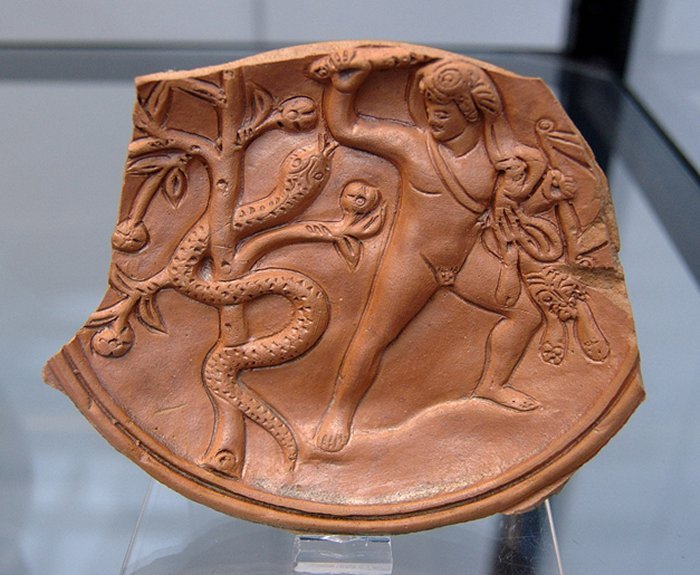
Heracles and Ladon guarding the tree of the golden apples. Credit: Carole Raddato, Germany; Uploaded by Marcus Cyron - CC BY-SA 2.
Usually, myths are remembered in different versions. According to one version, Heracles stole the apples after killing the dragon Ladon. According to another, he did it with the help of Atlas.
Titan Atlas Helps To Get Apples
The most popular version of this story is that Herakles asked for Atlas's help obtaining them and even held up the sky while Atlas was retrieving the apples. After returning with the apples, Atlas surprisingly refused to retake his job as the eternal holder of the heavens. He offered to deliver the apples himself, hoping to regain his freedom. Heracles tricked Atlas, walked away with the apples, and could now give them to Eurystheus.
The king did not want the divine apples of immortality; he understood they belonged to the gods, especially to the goddess Hera, so eventually, the apples returned to the Garden of Hesperides.
Golden Apples – A Popular Motif In Ancient Myths
The Golden Apples of the Hesperides remind us of the Golden Apples we encounter in Norse mythology. The apples protected by Idun grant immortality to the Aesir gods living in Asgard.
However, immortality is only available to the gods and never to ordinary people, even if they are kings and nobles.
Updated on February 25, 2024
Written by – A. Sutherland AncientPages.com Senior Staff Writer
Copyright © AncientPages.com All rights reserved. This material may not be published, broadcast, rewritten or redistributed in whole or part without the express written permission of AncientPages.com
Expand for referencesReferences:
Lamstone, J. Greek Mythology
Evslin, Bernard. Heroes, Gods and Monsters of the Greek Myth
Kirk, S. Greek Myths
More From Ancient Pages
-
 Unique Ancient Half-Mummy Unearthed In Luxor, Egypt Mystifies Archaeologists
-
 Use Of Tobacco Pipes By Hopewell People Tells A New Story
-
 Slaves In The Aztec Empire Had Much Better Rights Than In Any Other Ancient Society
-
 Remarkable And Unexplained Historical Sighting Reported By Multiple Witnesses In Wyoming
-
 Remarkable Neolithic Life-Sized Camel Engravings Discovered In The Nefud Desert
-
 Ancient Trade Routes Between Iran And Mesopotamia – Uncovered
-
 Male-Female Roles 7,000 Years Ago Were Less Traditional Than Previously Thought – New Study Reveals
-
 Roman-era mass grave with 60 bodies found in farmer’s field
-
 Mediterranean Sea Was Hotter 2,000 Years Ago And Contributed To The Fall Of The Roman Empire
-
 Impressive Column Of Emperor Marcus Aurelius – War Monument From Ancient Rome
-
 Mystery Of The Coso Artifact: A Spark Plug Or A Genuine Example Of Advanced Antediluvian Technology?
-
 Massive Ancient Fortifications Reveal Poznan Was Poland’s First Capital
-
 Mystery Of The Marble Lions On The Sacred Island Of Delos Solved?
-
 Denisovan Family Tree: New Branches Revealed In Ancient DNA
-
 Rare Statue With A Ka Symbol And A Dwarf Sphinx Discovered In Egypt
-
 Hird – Viking Warriors And Professional Body Guards Prepared To Die For Their Leader
-
 On This Day In History: Walpurgis Night Celebration In Northern Europe – On Apr 30
-
 2nd Century Inscription Unearthed At Forum Of Ancient City Of Philippopolis, Bulgaria
-
 On This Day In History: Supernova Observed In The Constellation Cassiopeia Was Recorded – On August 4, 1181
-
 Ancient Inventions Of Firefighting Vehicles

