
Did Climate Change End The Akkadian Empire?
AncientPages.com - Gol-e-Zard Cave lies in the shadow of Mount Damavand, which at more than 5,000 metres dominates the landscape of northern Iran. In this cave, stalagmites and stalactites are growing slowly over millennia and preserve in them clues about past climate events. Changes in stalagmite chemistry from this cave have now linked the collapse of the Akkadian Empire to climate changes more than 4,000 years ago.
Akkadia was the world’s first empire. It was established in Mesopotamia around 4,300 years ago after its ruler, Sargon of Akkad, united a series of independent city states. Akkadian influence spanned along the Tigris and Euphrates rivers from what is now southern Iraq, through to Syria and Turkey. The north-south extent of the empire meant that it covered regions with different climates, ranging from fertile lands in the north which were highly dependent on rainfall (one of Asia’s “bread baskets”), to the irrigation-fed alluvial plains to the south.
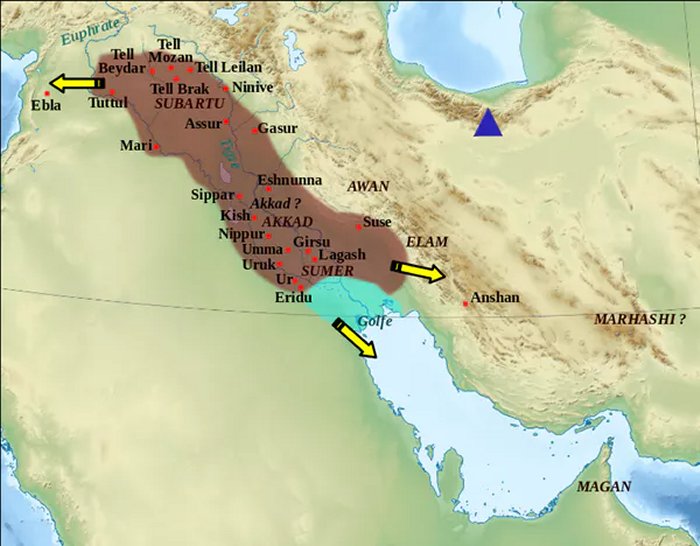
The Akkad empire during the reign of Narâm-Sîn (2254-2218 BC). Mount Damavand is labelled in blue. Zunkir / Semhir / wiki, CC BY-SA
It appears that the empire became increasingly dependent on the productivity of the northern lands and used the grains sourced from this region to feed the army and redistribute the food supplies to key supporters. Then, about a century after its formation, the Akkadian Empire suddenly collapsed, followed by mass migration and conflicts. The anguish of the era is perfectly captured in the ancient Curse of Akkad text, which describes a period of turmoil with water and food shortages: … the large arable tracts yielded no grain, the inundated fields yielded no fish, the irrigated orchards yielded no syrup or wine, the thick clouds did not rain.
Drought and dust
The reason for this collapse is still debated by historians, archaeologists and scientists. One of the most prominent views, championed by Yale archaeologist Harvey Weiss (who built on earlier ideas by Ellsworth Huntington), is that it was caused by an abrupt onset of drought conditions which severely affected the productive northern regions of the empire.
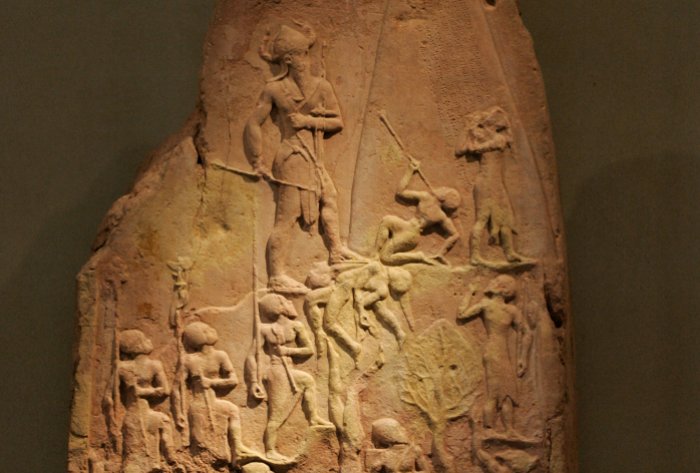
Victory Stele of Naram-Sin,celebrating victory against the Lullubi from Zagros 2260 BC. He is wearing a horned helmet, a symbol of divinity, and is also portrayed in a larger scale in comparison to others to emphasize his superiority. Brought back from Sippar to Susa as war prize in the 12th century BC. Credit: Public Domain
Weiss and his colleagues discovered evidence in northern Syria that this once prosperous region was suddenly abandoned around 4,200 years ago, as indicated by a lack of pottery and other archaeological remains. Instead, the rich soils of earlier periods were replaced by large amounts of wind-blown dust and sand, suggesting the onset of drought conditions. Subsequently, marine cores from the Gulf of Oman and the Red Sea which linked the input of dust into the sea to distant sources in Mesopotamia, provided further evidence of a regional drought at the time.
Many other researchers viewed Weiss’s interpretation with scepticism, however. Some argued, for example, that the archaeological and marine evidence was not accurate enough to demonstrate a robust correlation between drought and societal change in Mesopotamia.
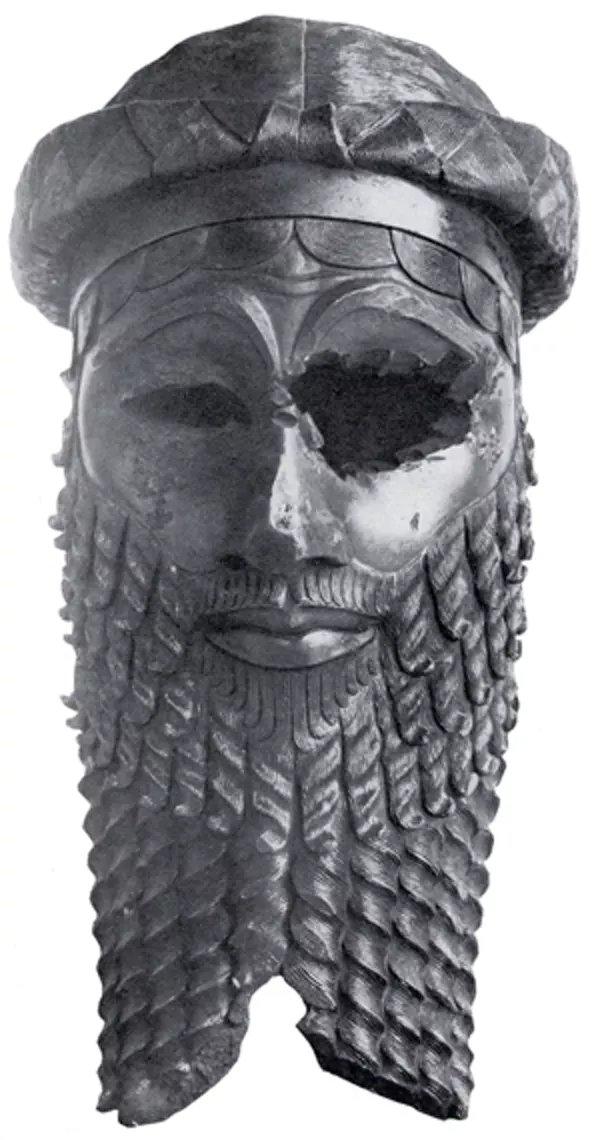
Sargon of Akkad – or maybe his son, Naram-Sin. Iraqi Directorate General of Antiquities / wiki
A new detailed climate record
Now, stalagmite data from Iran sheds new light on the controversy. In a study published in the journal PNAS, led by Oxford palaeoclimatologist Stacy Carolin, colleagues and I provide a very well dated and high resolution record of dust activity between 5,200 and 3,700 years ago. And cave dust from Iran can tell us a surprising amount about climate history elsewhere.
Gol-e-Zard Cave might be several hundred miles to the east of the former Akkadian Empire, but it is directly downwind. As a result, around 90% of the region’s dust originates in the deserts of Syria and Iraq.
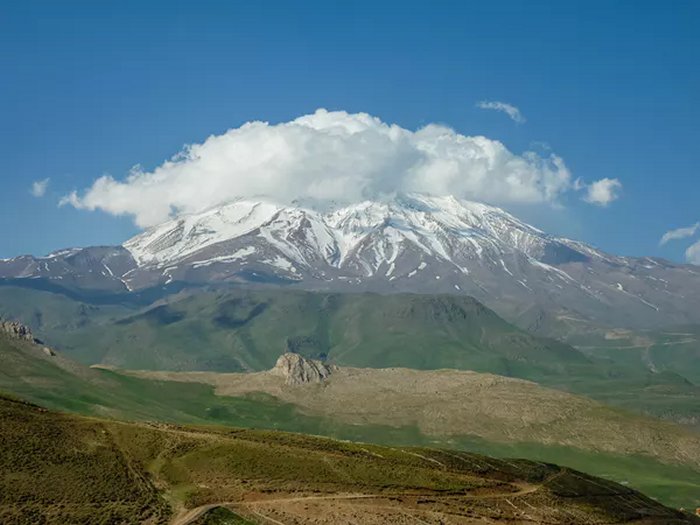
Mount Damavand is a ‘potentially active’ volcano, and the highest peak in Iran. Gol-e-Zard Cave is nearby. Vasile Ersek, Author provided
That desert dust has a higher concentration of magnesium than the local limestone which forms most of Gol-e-Zard’s stalagmites (the ones which grow upwards from the cave floor). Therefore, the amount of magnesium in the Gol-e-Zard stalagmites can be used as an indicator of dustiness at the surface, with higher magnesium concentrations indicating dustier periods, and by extension drier conditions.
See also:
Sargon Of Akkad – Prominent Leader Who Rose Out Of Obscurity
Urukagina: Ruler Of Sumerian City Of Lagash And His Reforms To Combat Corruption
Nippur – Holy City Of God Enlil And One Of The Oldest Cities Of Sumer
The stalagmites have the additional advantage that they can be dated very precisely using uranium-thorium chronology. Combining these methods, our new study provides a detailed history of dustiness in the area, and identifies two major drought periods which started 4,510 and 4,260 years ago, and lasted 110 and 290 years respectively. The latter event occurs precisely at the time of the Akkadian Empire’s collapse and provides a strong argument that climate change was at least in part responsible.
The collapse was followed by mass migration from north to south which was met with resistance by the local populations. A 180km wall – the “Repeller of the Amorites” – was even built between the Tigris and Euphrates in an effort to control immigration, not unlike some strategies proposed today. The stories of abrupt climate change in the Middle East therefore echo over millennia to the present day.
Written by Vasile Ersek - Senior Lecturer in Physical Geography, Northumbria University, Newcastle
This article is republished from The Conversation under a Creative Commons license. Read the original article.
More From Ancient Pages
-
 Gotu Kola – Extraordinary Ancient Herb That Increases Longevity And Improves Cognitive Abilities
-
 Trialeti Culture: Ancient Caucasian People Who Still Hold Their Secrets
-
 Evidence Of Lost Advanced Ancient Technology In Babylon
-
 Untold Story Of The Glencoe Massacre In 1692 Revealed By Archaeologists In Scotland
-
 On This Day In History: Samuel Morey Patents The Internal Combustion Engine – On April 1, 1826
-
 2,000-Year-Old Poorly Preserved Mummies Unearthed Near Saqqara’s Pyramid of Djoser
-
 On This Day In History: Battle Of San Domingo Was Fought – On February 6, 1806
-
 Remarkable Early Medieval ‘Govan Warrior’ Stone Discovered In Glasgow, Scotland
-
 Vikings’ Legacy Is Still Alive In Ireland – DNA, Ancient Ruins And Modern Cites Reveal
-
 Mysterious 2,800-Year-Old Channel Installation Discovered In The City Of David, Jerusalem
-
 Early Twelfth-Century Castle Walls Unearthed Outside Gloucester, England
-
 Young Warrior’s Grave Dated To A Sixth Century Unearthed At Langobard Necropolis In Czech Republic
-
 Why Was Pharaoh Khafre Almost Wiped Out From Historical Records?
-
 Dragon Empress Wu Zetian Challenged Confucian Beliefs Against Female Rulers
-
 More Greek Gods’ Heads And A Life-Sized Statue Of A Man Unearthed In The Ancient City Of Aizanoi
-
 Yakhchals: Ingenious Ancient ‘Refrigerators’ Could Store Ice In The Hot Desert
-
 Who Was “Shimon”, Whose Name Appears On A 2,000-Year-old Hebrew Inscription?
-
 Unusual Relic That Mysteriously Disappeared From The Vatican
-
 What Female Jobs Could Lead To Being Accused Of Witchcraft In Early Modern England?
-
 Lejre Viking Hall And Beowulf – What Is The Connection?

