
Ancient Chinese Tai Chu Calendar Was Defined By Emperor Han Wu
Conny Waters - AncientPages.com - Have you ever wondered what the current Chinese calendar is called?
In ancient China, there were many different calendars. The current Chinese calendar was defined by Emperor Wu of the Han Dynasty in 104 BC. It was called the Tai Chu calendar.
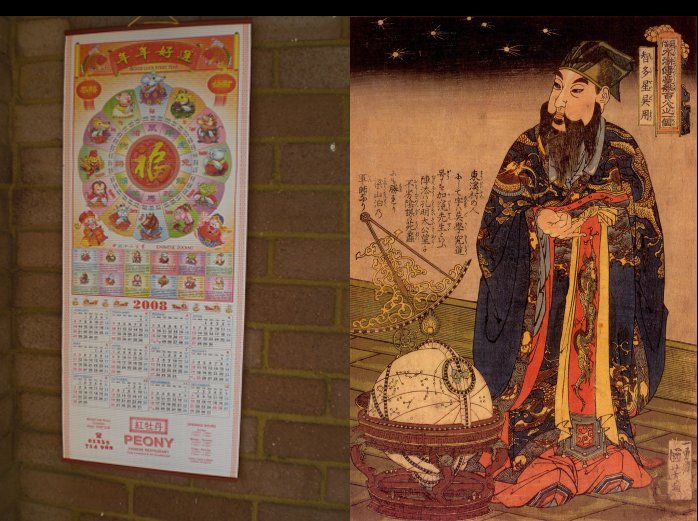
The traditional Chinese calendar is a combination of a solar calendar, based on the “position” of the Sun and the resultant seasonal phenomena, and a lunar calendar that follows the lunar phases.
Like in other ancient cultures, Chinese calendars were used to determine days of festivities or natural events, like solar eclipses, and to prognosticate auspicious or non-auspicious days.
The Chinese calendar cycles through 12 animals: the rat, ox, tiger, rabbit, dragon, snake, horse, sheep, monkey, rooster, dog, and pig. There is also an element associated with each year of the Chinese calendar. These elements are wood, fire, earth, metal, and water.
According to the new calendar, a year had 365.2502 days and a month 29.53086 days. The Tai Chu calendar started the New Year in January rather than October. Besides, the new calendar adopted the 24 solar terms, which were useful for the farming season. Based on the results from celestial measurement and records by court astronomers, the Tai Chu Calendar also worked out the cycle of solar eclipse - 135 months.
The first relatively complete calendar in China, the Tai Chu Calendar was also the most advanced of its kind in the world at its time and was used for a period of 189 years after its inception.
Written by Conny Waters – AncientPages.com Staff Writer
Copyright © AncientPages.com All rights reserved. This material may not be published, broadcast, rewritten or redistributed in whole or part without the express written permission of AncientPages.com
More From Ancient Pages
-
 Osiris Statuette Discovered During Restorations Of The King Djoser Step Pyramid In Saqqara, Egypt
-
 Medieval Criminals Could Avoid Persecution By Claiming Sanctuary In Churches
-
 Ancient Trade Routes Between Iran And Mesopotamia – Uncovered
-
 What Was Humor Like In The 13th Century?
-
 Rare Ancient Human Footprints Found On Gower Peninsula, Wales Are 7,000 Years Old
-
 A Baffling 100-Year-Old ‘Alien’ Puzzle – Shocking Cosmic Secrets
-
 Carbonized Herculaneum Papyrus Begins Revealing Its Ancient And Historical Secrets
-
 Thousands Unknown Ancient Structures Seen From Space: Puzzling Aerial Archaeology In The Middle East
-
 Underground Civilizations – Secret Subterranean Corridors And Strange People – Part 2
-
 Where Is The Grave Of Queen Boudica?
-
 People Who Carry Neanderthal Gene Variants Have Greater Pain Sensitivity
-
 Surprise! ‘Viking Ship’ Found On The Seabed Is Not What We Previously Thought And Rewrites Scandinavian Maritime History, Scientists Say
-
 Older Than Dracula: In Search Of The English Vampire
-
 Huge Medieval Ship Ciutadella I Found Underground In Barcelona, Spain
-
 Early Human Settlement Unearthed In Tajikistan’s Zeravshan Valley Gives New Insights Into Human Expansion
-
 Kommagene Civilization And The Ancient City Of Perge
-
 ‘Impossible’ Ancient Traces Of Humans – No, We Are Not The First
-
 Archaeologists Discover Long-Lost Scottish Monastery Of Deer And Solve An Old Manuscript Mystery
-
 Secret Dwelling Place Of Reptilian And Dragon-Like Creatures In Europe
-
 Invasion Of Mysterious Sea People – Enigmatic 3,200-Year-Old Luwian Hieroglyphic Inscription Sheds New Light On Ancient Puzzle

