
Alexander The Great’s Biblical Connection
David Tee - AncientPages.com - Throughout his life, it is very apparent that Alexander did not know what role he was fulfilling in history and biblical prophecy. His young life and military pursuits did not grant him a lot of time to become aware of the religious writings of other nations nor his role in history.
 Alexander the Great. source
During his childhood, it is unlikely that while he was training for future military and royal duties, his teacher Aristotle would add additional information to his already full educational life.
Alexander’s conquering of the untamed horse, Bucephalus can be seen as evidence where his training and talent lay. He would ride Bucephalus for the rest of his life.
Humbleness Was Not His Strong Suit
Given the right to rule and command at the age of 16, while his father was away invading Thrace, Alexander showed his military might with the defeat of the rebellious Maedi. With the capture of the Maedi stronghold, Alexander quickly renamed it after himself.
Alexander called it Alexandropolis or the city of Alexander. Later he would create a new Egyptian city and call it Alexandria. He certainly was not shy about using his own name to make sure he remained firmly tied to history and remembered for his exploits.
Upon the assassination of his father, Alexander assumed the throne and military leadership of Macedonia. This assumption of power was the next step in Alexander’s ties to the Bible.
Alexander And Israel
One of the first connections Alexander has to Israel is when he decided to take on the Persians in war. The Persians controlled the Levant, Egypt, and other neighboring nations and were seen as a threat to Macedonia’s existence.
Josephus (37 – 100 AD), a first-century Romano-Jewish historian, briefly records Alexander’s triumph in his Book 12 of the Antiquities of the Jews. He provides a very simple and concise statement concerning Alexander’s triumph over his and most other nation’s Persian enemy.
The book reads, “Now when Alexander, king of Macedon, had put an end to the dominion of the Persians and had settled the affairs of Judea.”
 Alexander the Great in the Temple of Jerusalem. source
Of course, Alexander’s victory enabled the Jewish people to learn the ancient Greek language which resulted in most ancient biblical manuscripts being written in ancient Greek.
This influence actually reached wherever Alexander established his Greek cities throughout his conquered territory. Greek became the language of both literature and commerce throughout his empire.
Alexander And Daniel
It may be that a lot of people may not know the connection the prophet Daniel has with Alexander the Great. Writing 250 years before the great general, Daniel received 4 prophecies from God concerning the actions and influence this future warrior would have on the world.
Daniel spoke of Alexander once in chapter 7 verse 6 of his Old Testament book, twice in chapter 8 verses 5 to 7 and one last time chapter 11, verse 4. In each Alexander was described as a leopard, a goat, a great horn, and a great king.
In each of the prophecies, Daniel also mentions that this great kingdom would be divided into four smaller empires, something that did happen to Alexander’s empire. The Ptolemy’s are the most famous branch of that division.
The prophecy was fulfilled when Alexander died an untimely death before he could see more fulfillment of his dreams.
Alexander, The Maccabees And Esther
The Book of Daniel was not the only mention of Alexander in Israeli literature. 1 Maccabees in its first chapter and first 7 verses provide an excellent but brief description of Alexander’s life and military accomplishments.
The passage also confirms what history has said about Alexander when he found out that there were no more nations to conquer. It says that he went to the ends of the earth and conquered many nations.
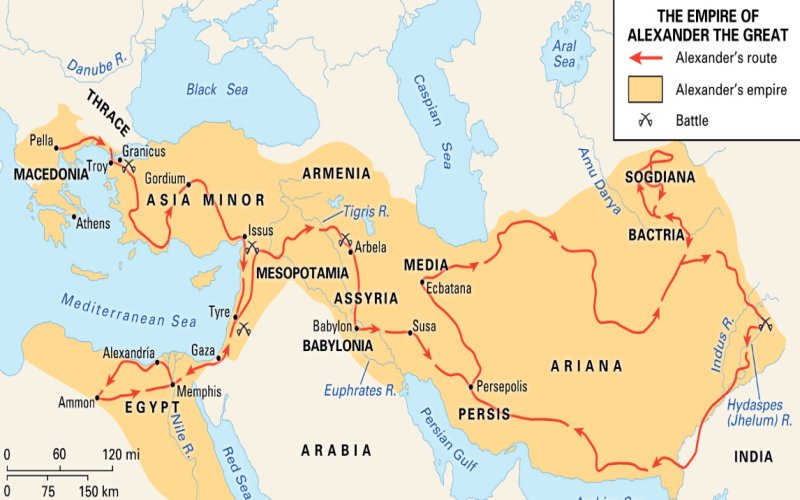 Alexander the Great's Empire. source
In Esther, there is not so much a mention of Alexander as there is a reference that may point to the Macedonians in general and their presence in Persia. In the Septuagint translation of the Old Testament, the Book of Esther refers to Haman as an Agagite, chapter 16, verses 10-14.
The word Agagite is thought by scholars to refer to the primitive Macedonians who had entered the different lands. It is debatable as to if the author of Esther was actually referring to a Macedonian or not, but the possibility is there.
Not so much as to the King himself, but to the Egyptian city, Alexander founded when he ruled physically in that country. Alexandria is mentioned three times in the book of Acts- 28:11; 18:24; & 27:6.
Also, the Greek people are mentioned numerous times throughout the Bible. Of the 14 times the Greeks are mentioned, only one is found in the Old Testament. That book is written by another prophet other than Daniel - Zechariah 9:13.
One New Testament mention has a Greek woman seeking relief from the demon who possessed her body.
After Alexander Died Many Problems Appeared
The inclusion in biblical prophecy and other books of the Bible did not protect Alexander's empire from trouble. After Alexander died, problems arose quickly. The Lamian War (323–322 BC took its toll on the empire as did the various murders of loyal Greek officers who served Alexander faithfully.
As predicted in the Bible, Alexander’s empire was eventually divided into four different parts each with its own ruler: Seleucus got Asia, Ptolemy received Egypt, Lysimachus took over Thrace, and Antipater's son Cassander was able to win both Macedonia and Greece.
Alexander’s empire was no more, although Macedonia would rise once again for a brief time when the Roman Empire split. The Macedonians ruled the Eastern Empire for roughly 200 years and their rule became known as the golden age of the empire.
Since that time, Alexander’s homeland never did maintain its former glory.
A majority of its land is held by both Greece and Bulgaria. Macedonia did gain a form of independence in 1991 but it had to be content with only about 37% of its former ancestral land.
Written by – David Tee AncientPages.com Staff Writer
Copyright © AncientPages.com All rights reserved. This material may not be published, broadcast, rewritten or redistributed in whole or part without the express written permission of AncientPages.com
Expand for referencesReferences:
Hartog, P. A. (2016). Macedonia
Josephus, F., & Whiston, The works of Josephus: complete and unabridged
International Standard Bible Encyclopedia, Vol. 1, page 331.
Alexander The Great Was Crowned Pharaoh And Declared Son Of God Amun
More From Ancient Pages
-
 First Egyptian Middle Kingdom Tomb Unearthed In South Asasif Necropolis In Luxor
-
 Discovered – Large Mysterious Structure Hidden Under The Sand In The Sahara Desert – A New Pyramid Or Something Else?
-
 11 Ancient Sacred Indian Symbols Explained
-
 Secret Ancient Knowledge Of Portals Leading To Unknown Realms – Mysteries Of The Past And Present – Part 2
-
 Ancient Adobe Throne Found At Aslantepe, An Acient Hittite Site, Turkey
-
 The Oseberg Tapestry And Other Artifacts Show Intense Colors Were A Viking Symbol Of Status And Wealth
-
 Pharaoh Ramses Was Not One Of History’s Greatest Generals – New Study Ruins His Formidable Reputation
-
 Quest For The Magical Healing Flower In The Garden Of Bakavali Led To A Love Story
-
 Rare Ancient Precious Artifacts Found In Rusovce, Slovakia
-
 Mysterious Balochistan Sphinx Has An Ancient Story To Tell – But Is An Advanced Ancient Civilization Or Mother Nature Hiding Behind The Story?
-
 Why Were Swords So Important To Ancient Vikings?
-
 Archaeologists Unearthed The Lost Ancient City Of Peñico, Which Was Home To One Of America’s Oldest Civilization
-
 Oil Lamps, Spearheads And Skulls: Was The Te’omim Cave Used By Practitioners Of Necromancy?
-
 Tombs With Sarcophagi Of High Priests Including One Dedicated To Sky God Horus Unearthed In Egypt
-
 Central Asia Identified As A Key Region For Human Ancestors
-
 Iron Ingots Probably From Ancient Mines Found In Large Quantity At The Bottom Of The River In Bosnia
-
 Origin Of The Genetic Code – Study
-
 Major Puzzle In Mammal Skull Shape Evolution Solved
-
 Ancient Cosmic Secrets – Mystery Of The ‘Four Sons Of Horus’ And Their Connection To Stars In The Ursa Major Constellation
-
 2000-Years Old Road Was Discovered In Manisa Province,Turkey

