
Tusayan Pueblo Ruins And Split Twig Figurines Tell Story Of People Who Once Inhabited The Grand Canyon
A. Sutherland - AncientPages.com - People have continuously occupied the Grand Canyon for at least the past 4,000 years, and they have lived in the region for the past 12,000 years. As many as 4,800 archaeological sites have already been documented, but many more still remain to be cataloged.
Over the centuries people have come and gone in and around the Grand Canyon area, occupying it for extended periods of time or staying there only briefly.

Tusayan Gray Ware. Credits: American Southwest Virtual Museum
The Ancestral Puebloans, who are believed to be relatives of the modern-day Zuni, Hopi, and other Puebloan tribes, established roots at the Grand Canyon.
The Tusayan Ruins (also known as ‘Tusayan Pueblo’) are the remains of a small 12th century Ancestral Puebloan village site located within Grand Canyon National Park, Arizona. It is one of the best-documented archaeological sites of the region.
The ruins are considered to be one of the major archeological sites in Arizona.

Anasazi food storage building ruins at Tusayan Pueblo — Grand Canyon area/Large kiva Image via Wikipedia
Both the ruins of the village and the local Tusayan Museum that displays pottery, seashell bracelets, corncobs, arrowheads along with original split-twig figurines, give us an insight into the lives of a thriving Anasazi community with a rich history.
Historians believe that the Tusayan settlement numbered only about 30 people and was in occupation for only a quarter of a century.
They made their own tools, whether for cooking or hunting, from stone, bone, and antler. Stone grinders were used by them to grind corn and stone arrowheads were used as weapons.
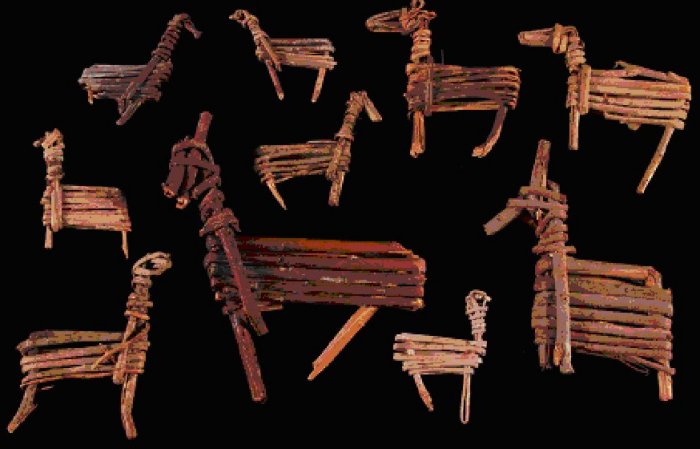
Split twig figurines – an important part of the Desert Culture – represent the oldest record of human occupancy of the Grand Canyon, some dating back to at least 4,000 years. Researchers believe that the small effigies depict several animals very common in the Grand Canyon even today.
It is believed that the effigies were made as part of a ritual ceremony that was carried out before a hunt, to ask for the blessings of the animal’s spirits before taking their lives.
The so-called split twig figurines (image above) date back 2,000 to 4,000 years. They were not found at Tusayan Ruin itself, however, these artifacts were discovered in many other caves in the Grand Canyon. They provide proof of the long human presence at the Grand Canyon and its use by Native Americans.
The ‘Tusayan Pueblo’ settlement consisted of a central plaza surrounded by living quarters, kivas, and storage rooms. The plaza faced south to catch the sun during cooler seasons.
The living quarters consisted of a single story of rock, adobe, and wood with about 3 or four main rooms. Storage rooms held food that was dried to preserve it during harsh winter months.
The only source of transportation for these Anasazi people was on foot. Everything that these people ate had to be gathered, harvested, or killed by them.

The walls of ancient rooms where villagers stored food and other items can still be seen along the Tusayan Ruin trail near the Tusayan Museum. Photo: Sarah Bohl. via ASU
Among ruins there are still preserved ceremonial structures, that modern Puebloans use even today in diverse festivals and religious ceremonies. The structures are believed to represent the Sipapuni, a geological feature on the floor of the Grand Canyon that many Hopi believe is the place where they entered into this world.
These people lived during the Pueblo II Period (900 AD to 1150 AD), which was the second pueblo period of the Ancestral Puebloans of the Four Corners region of the American southwest. They managed to survive into the Pueblo III era, an important period in the development of Puebloan communities, which gradually began to build multi-storied pueblo or cliff-side talus house communities and lived in large cliff-dwellings.
Written by – A. Sutherland - AncientPages.com Senior Staff Writer
Copyright © AncientPages.com All rights reserved. This material may not be published, broadcast, rewritten or redistributed in whole or part without the express written permission of AncientPages.com
Expand for referencesMore From Ancient Pages
-
 Spectacular Olduvai Gorge And Early Hominid Fossils Found In East Africa
-
 The Strange Story Of The Grave Of Copernicus
-
 Hidden Ancient Underground Tomb Discovered In Petra May Solve The Mystery Of The Nabataean Kingdom
-
 Dwarf Alvis (‘All-Wise’) Who Was Tricked By God Thor And Turned Into Stone
-
 Cats In The Middle Ages: What Medieval Manuscripts Teach Us About Our Ancestors’ Pets
-
 Headless Statue Of Life-Size Ancient Mayan Warrior Discovered In Mexico
-
 Is The Tomb Of Genghis Khan Hidden And Protected In The Khentii Mountains Because Some Fear It’s Cursed?
-
 Unusual Grave Of The Trzciniec Culture Is An Archaeological Puzzle
-
 King Tabnit’s Sarcophagus And Its Surprising Forever-Lost Secret
-
 Famous Viking Ragnar Lodbrok – Legendary Fearless Sea-King Of The North
-
 Intact 2,700-Year-Old Pacopampa Tomb Found in Northern Peru
-
 Search For The Elusive Tomb Of The Maccabees – Has The Tomb Finally Been Found?
-
 Unsolved Ancient Mystery Of Hand Of Prêles – Unique Discovery Of Ancient Bronze Hand Puzzles Scientists
-
 Tool Patterns Reveal What Caused The Neanderthals’ Extinction In The Iberian Peninsula
-
 Mysterious Disappearance Of King Aegeus Of Athens After His Wedding
-
 Seven 1,600-Year-Old Arjai Grottoes With Frescoes – Restored
-
 Controversial Theory Suggests Ancient Egyptians Were Founders Of Chinese Civilization
-
 Secrets Of A Lake That Could Re-Write Ancient History Of America – Interesting Artifacts And Buildings – Part 2
-
 Viking Artifacts Discovered In Canada Are More Mysterious Than First Thought
-
 Controversial 5,500-Year-Old Sumerian Star Map Of Ancient Nineveh Reveals Observation Of Köfels’ Impact Event

