
Ancient Suda: Massive Anonymous Byzantine-Greek Lexicon Dated To 10th Century
A. Sutherland - AncientPages.com - An anonymous Byzantine Greek lexicon dated to the 10th century is known as “Suda” (from the Byzantine Greek word souda, meaning "fortress" or "stronghold."
The Suda is an enormous historical work, arranged alphabetically and dedicated to the ancient Mediterranean world, which covers the whole of Greek and Roman antiquity.
It also includes Biblical and Christian material written in Greek.
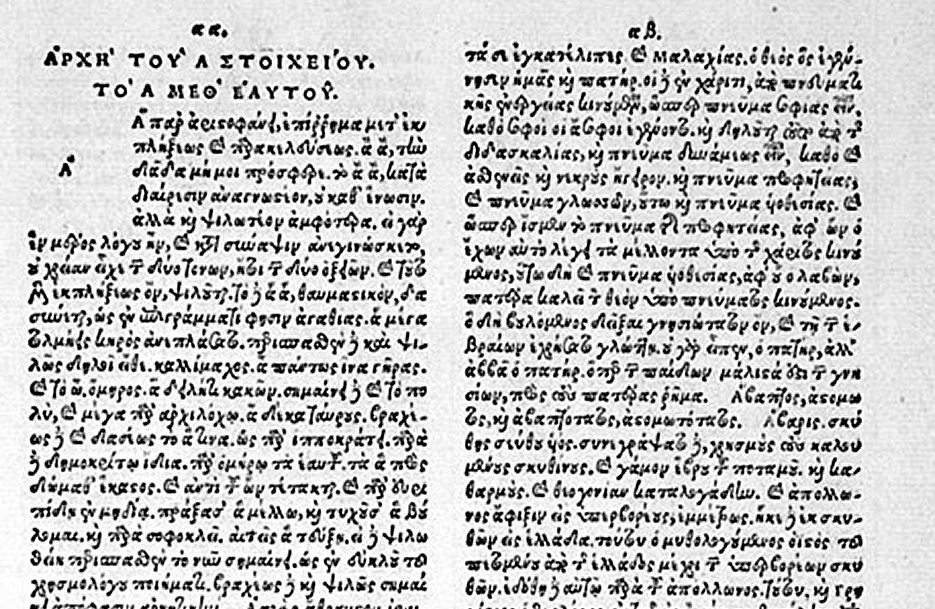
The Suda, which contains much useful information on ancient history and life, it also deals with a variety of biblical and pagan subjects, too.
The Suda (or The Book of Suda) quoted frequently under the Latin title 'Liber Suda' covers 30,000 slogans, of which about 900 are material articles, mostly historical and literary. In the absence of ancient sources, the book is invaluable and in many cases the only source of historical information.
Justus Lipsius, a Flemish historian, and philosopher called this encyclopedia "ram with a golden rune".
Preserved in several medieval manuscripts, this literary masterpiece has been edited and published several times since the end of the 14th century in traditional hard-copy scholarly editions.
The Suda contains a lot of classical knowledge and a great variety of drawings from ancient sources that have since been lost, and often derived from medieval Christian compilers. It is an ancient book of a very special kind (something between a modern encyclopedia and a grammatical dictionary) about Greek and Roman science and medicine.
For those who don't want to be too scientific, there is a lot of information about Apollo, and how he prevented the oracles of the Chaldean Sibyl from being understood by the so-called 'hoi polloi'.

You can learn about, Philoxenos, the tune-bender, who was considered the most courageous literary critic in history. You can find biographies, chronicles, and the best quotations from many ancient writers, historians, and dramatists, such as Homer, Sophocles, and Aristophanes.
The English astronomer Edmund Halley (1656-1742) also studied the Byzantine lexicon "Suda" and
in 1691, he introduced to astronomy an important term 'saros', which defines a whole
series of subsequent eclipses, which divides the 18 years and 8 hours mentioned for 18 years.
The lexicon is arranged alphabetically with only some slight deviations from common vowel order and placed in the Greek alphabet.
The Suda, which contains much useful information on ancient history and life, it also deals with a variety of biblical and pagan subjects, too.
Many scholars and their collaborative work over 16 years finally resulted in the first English translation of the entire Suda lexicon, a massive 10th-century Byzantine encyclopedia.
The Suda is considered “a stronghold of information”.
Written by – A. Sutherland - AncientPages.com Senior Staff Writer
Copyright © AncientPages.com All rights reserved. This material may not be published, broadcast, rewritten or redistributed in whole or part without the express written permission of AncientPages.com
More From Ancient Pages
-
 Mystery Of The Ancient Reptilian Gods Remains A Complex Subject – Memories Of The Past – Part 1
-
 Oldest DNA From Domesticated American Horse Solves An Legendary Shipwreck Mystery
-
 Ancient Ruins Of Quilmes: Largest Pre-Colombian Settlement In Argentina
-
 New Method Reveals Falsified And Original Manuscripts Of Famous Robert Burns
-
 Shepherd’s Monument Mystery: Yet Another Undeciphered Inscription
-
 ‘Giants’ Discovered In Ancient Grave In China
-
 Enigma Of Ancient Bell-Shaped Metal Vase Found In Solid Sedimentary Rock
-
 Bronze Age Human Remains Uncovered In Dorset During Excavation Of Iron Age Settlement
-
 Museum Classifies Roman Emperor Elagabalus As Trans – But Modern Labels Oversimplify Ancient Gender Identities
-
 Jade Emperor – Supreme Ruler Of Heaven In Chinese Mythology
-
 ChatGPT Is Confronting, But Humans Have Always Adapted To New Technology – Ask The Mesopotamians, Who Invented Writing
-
 Lost Astronomical Treatise By Claudius Ptolemy Discovered
-
 Oldest Recently Discovered Fossil of Bird ‘Archaeopteryx’ That Lived 150 Million Years Ago
-
 Neanderthals’ History Retrieved From Cave Sediments In Siberia And Spain – New Method
-
 Bulgaria’s Aquae Calidae Spa Complex: More 40 Coins Dated To 4th Century CE – Found
-
 Roman Herculaneum: Men And Women Had Different Diets – New Study
-
 Who Were Persian ‘Sparabara’?
-
 Concept Of Fate In The Eyes Of Slavic People
-
 Researchers Find An Elusive European Ancestor Of Lager Yeast In Ireland
-
 Secrets Of Ancient Mound Builders In Louisiana Revealed

