
Kofun: Megalithic Keyhole-Shaped Tombs That Belonged To High Status People In Japan
A. Sutherland - AncientPages.com - The largest keyhole-shaped tomb in Japan - Daisenryo Kofun – is located in the city of Sakai in Osaka Prefecture, Japan.
Kofun ("ancient grave") are megalithic tombs or tumuli in Japan, constructed between the early 3rd century and the early 7th century AD. The kofun ancient graves (from the Kofun period ca 300-710 AD) have been built in various shapes throughout history.
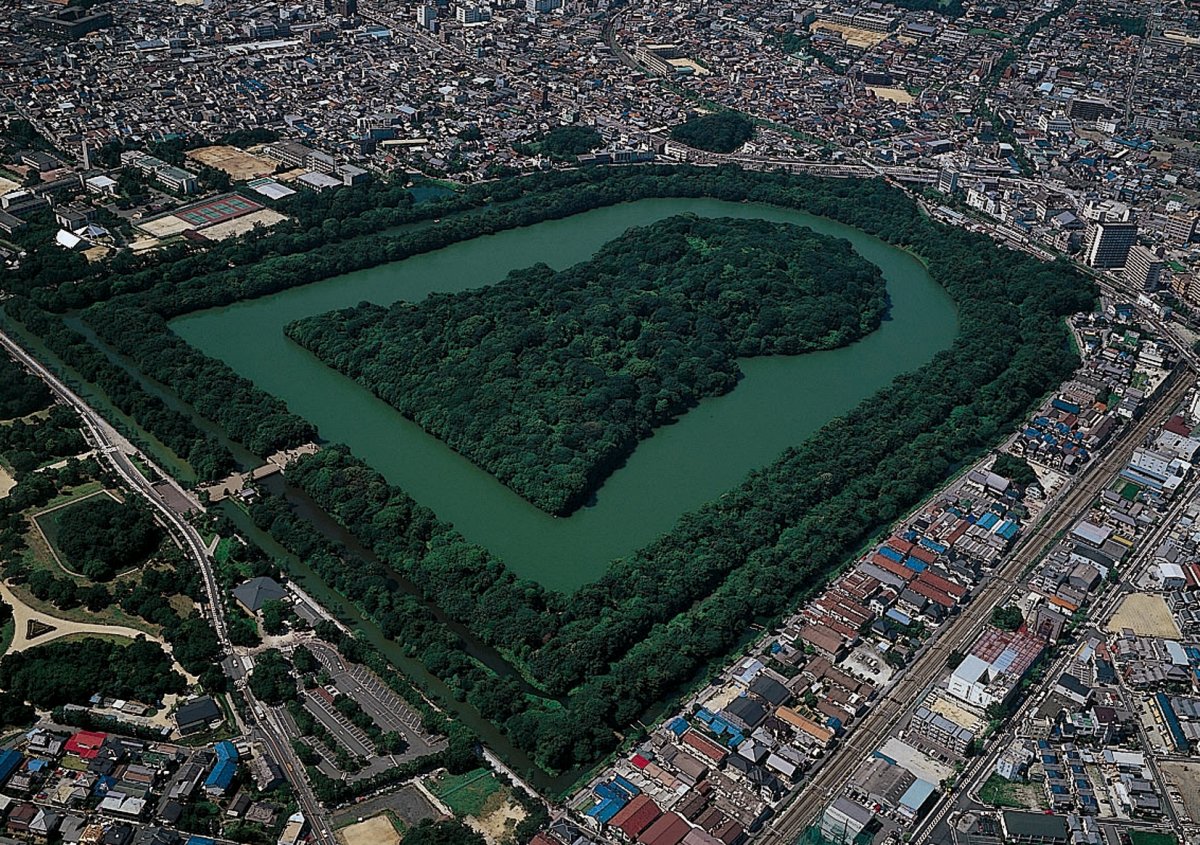
Daisen Kofun, the largest of all kofun, one of many tumuli in the Mozu kofungun, Sakai, Osaka Prefecture (5th century) Image via Osaka.info/wikipedia
These structures can be circular- and square-shaped, and their dimensions also vary from several meters to over 400m.
When viewed from above, the most common type of kofun is shaped like a keyhole (a zempo-koen-fun), having one square end and one circular end.
The Daisen Kofun in Osaka Prefecture, which belongs to Japan's Emperor Nintoku, the 16th emperor, measures about 500 meters (1,640 feet) in length, 249 meters in diameter, 35 meters in height for the back circular mound, 305 meters in width, and 33 meters in height for the front mound. The mound is built with three distinct levels and a space for religious ceremonies, on either side of the narrowest part of the tomb and surrounded by three trenches.
There is about 2.8 kilometer-long walkway encircling the tomb, which takes an hour to walk around.
This colossal tomb is located in the middle of a cluster known as the Mozu Tumuli, which consists of 92 large and small kofun lying within an area of roughly 16 square kilometers (6.2 square miles).

Emperor Nintoku (Woodblock print). Image via wikipedia
Another group of mounds, located about 10 kilometers (6.2 mi) away from the Mozu cluster, is known as the Furuichi cluster. It has the Ojin-tenno-ryo Kofun of 425 meters (1,394 ft) length, which is the second-largest in the country. This group also has 11 more huge massive rounded "keyhole-shaped kofun" with a mound length of 200 meters (660 ft) or more.
Thousands of kofun burial mounds have been discovered and identified; these date back from the late third to late seventh centuries.
In Japan, there was a common ancient custom to bury people of high social status in kofun tombs covered with large mounds of earth.
The kofun funerary mounds were not only used to bury people but also items made of iron, swords, weapons such as arrowheads, hoe and spade tips, fine armor, glass pots, dishes, and many other similar items.
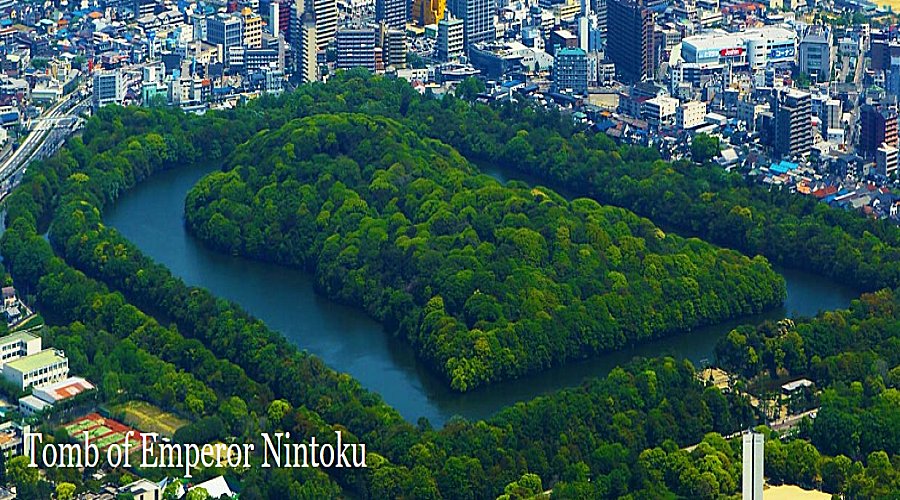
Daisen Kofun, the largest of all kofun, one of many tumuli in the Mozu kofungun, Sakai, Osaka Prefecture (5th century) Image via Osaka.info/wikipedia
Antiquities made of gilded bronze such as horse tacks and sash buckles have also been found in these mounds.
Keyhole-shaped kofun graves disappeared in the late 6th century AD, and are related to the introduction of Buddhism during this era, according to "The Chronicles of Japan" ("Nihon Shoki"), Japan's first national history book.
Recently, archaeologists began to doubt whether this enormous tomb really belonged to Emperor Nintoku.
They have namely, found in the toms, the so-called Sue ware pots, represent making techniques and kilns, which were introduced to Japan from Korea, in the 5th century and these pots were the first high temperature stoneware pots produced in ancient Japan.
Updated on January 20, 2022
Written by – A. Sutherland - AncientPages.com Senior Staff Writer
Copyright © AncientPages.com All rights reserved. This material may not be published, broadcast, rewritten or redistributed in whole or part without the express written permission of AncientPages.com
Expand for referencesMore From Ancient Pages
-
 On This Day In History: Seismologist Charles Richter Was Born – On Apr 26, 1900
-
 Horrifying Flying Head That Terrorized The Iroquois
-
 Large Bronze Age Stone May Be Europe’s Oldest 3D Map
-
 Huldra: Seductive Female Creature Living In Forest Or Mountains In Norse Beliefs
-
 Stonehenge’s Monumental Altar Stone Came From Scotland – Not Wales As Previously Thought
-
 Pasargadae: Capital Of Achaemenid Empire Destroyed By Alexander The Great
-
 Levänluhta People Could Survive Fimbulwinter Thanks To Their Diverse Livelihoods
-
 Islands Of The Tropical Pacific Ocean Were Settled Much Earlier Than Previously Thought – New Theory
-
 Mysterious Sumerian Queen Puabi And Her Magnificent Underground Burial Complex – Many Followed Her To Afterlife
-
 New DNA Study Reveals How The Black Rat Colonized Europe In The Roman And Medieval Periods
-
 Lacrosse Was Invented By Native American Indians
-
 Mystery Of The Ancient Forgotten Mizoram Civilization And Lost City Of Vangchhia
-
 Rio Tinto Bosses Quit Over Destruction Of One Of The Earliest Aboriginal Sites
-
 Yungang Grottoes: Marvellous Example Of Ancient Buddhist Rock-Cut Architecture
-
 Mysterious Nine Worlds Of Yggdrasil – The Sacred Tree Of Life In Norse Mythology
-
 Unique Life-Sized Camel Carvings In Northern Arabia Are Much Older Than Previously Thought
-
 Resourceful Neanderthals Could Dive 13ft If Necessary To Collect Shells
-
 5,000-Year-Old Stone Paint Palette Unearthed In Küllüoba Mound
-
 Carbon-12 – A Critical Gateway To The Birth Of Life Is Produced In Stars – Did Life Come From Cosmos?
-
 Secrets Of Ancient Ivory Manikins Revealed

