
Unsolved Prehistoric Enigma Of Sophisticated Spiro People And Their Mysterious Mounds
A. Sutherland - AncientPages.com - One of the most important archaeological discoveries in Oklahoma and the entire North America was the Spiro Mounds Site. The people of Spiro Mounds once ruled most of present-day America.

The site, which lies near the Arkansas River seven miles north of the town of Spiro, was occupied by various groups of people who camped on or near the Spiro area for at least 8000 years.
From 850 to 1450 AD, the location was permanently inhabited by Caddoan speaking Indians (the modern Kichai Wichita, Arikara Caddo, and Pawnee.).
The settlement began as a small farming village and became the intriguing, important and famous seat of the ancient Mississippian culture, in what later became the United States.

Craig Mound Biface. Image via lithiccastinglab.com
These people developed horticulture, elaborate ceremonies, mound-building and an iconographic writing system with over 60 different tribes, stretching from the Rockies to the Virginia Coast and from the Gulf Coast to the Great Lakes.
Spiro’s trading network was vast. According to Mississippian settlements like Cahokia and Spiro contributed to a vast trading network that covered the eastern half of what is now the U.S. and parts of what is now the Western U.S. as well.
See also:
Buhl Woman Of Idaho: One Of The Oldest Skeletons In North America
Etowah Indian Mounds: A Legacy Of The Ancient Mississippian Culture
Bighorn Medicine Wheel: Sacred Site And Ancient Solar Observatory
They built large, complex earthworks, which included eleven platform mounds and one burial mound in an 80-acre (0.32 km2) area on the south bank of the Arkansas River. The central part of the site were the nine mounds surrounding an oval, large and leveled central ceremonial plaza, which was used for important religious rituals.
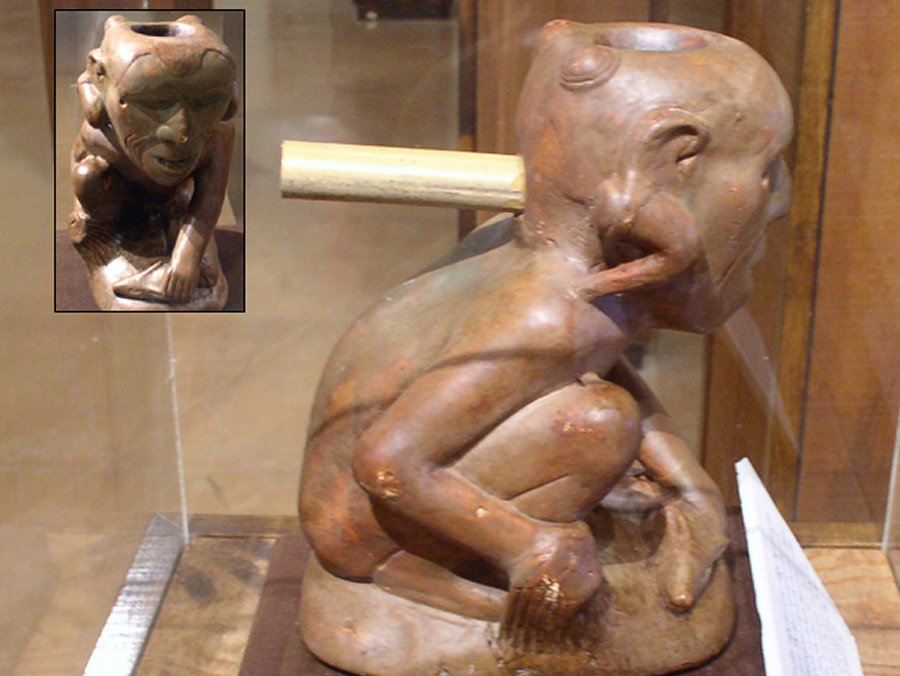
Some of the most beautiful stone effigy pipes found at Spiro, including the famous "Grizzly Man" or "Kneeling Rattler" pipe, have shown they came from Cahokia, based on the material from which they were made. Image via Wikipedia
The largest platform mound - Brown Mound – served as a place of complex rituals, associated with the deaths and burials of Spiro's rulers. The Spiro inhabitants lived in a village closed to the ceremonial plaza and additionally, more than twenty similar villages were situated within five miles distance from the Spiro center and many other village sites – all representing the same culture – were found within a radius of 100 miles (160 km) away.
They created an important religious and political center of about 10,000 people that thrived along the Mississippi River and influenced the entire Southeast. The Spiro Mound center declined and was eventually abandoned by 1450 AD, although the city was continuously occupied for about 150 years.
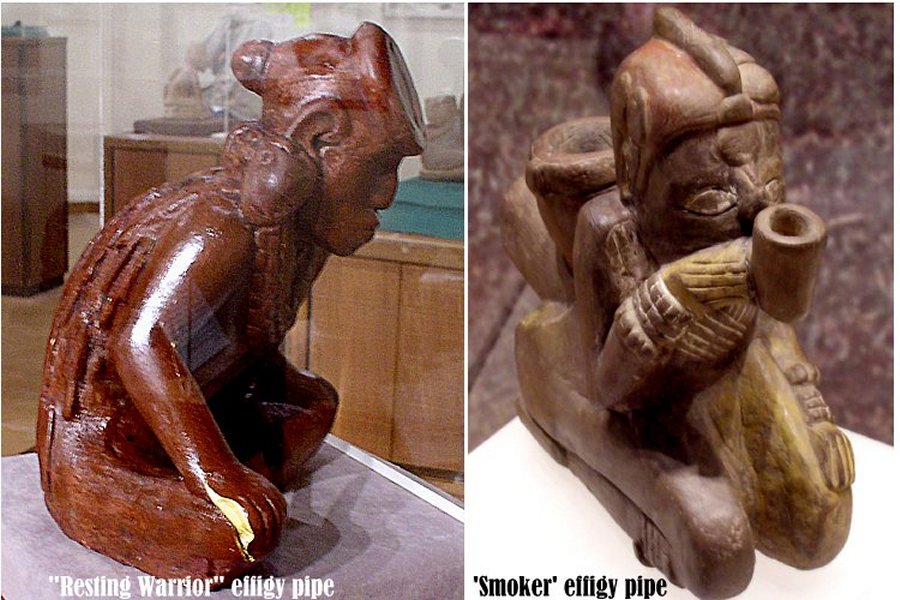
Effigy pipes from Spiro Mounds Area. Image via wikipedia
The site remained unoccupied from A.D. 1600 until 1832.
In 1936, archeologists from the University of Oklahoma were able to excavate as much as possible from the Spiro site, which was exposed to major damage due to the looting of its artifacts.
In a cavity of the Craig Mound ("The Spiro Mound"), the only burial mound of the Spiro site, archaeologists excavated many artifacts made of wood, conch shell, and copper, including basketry, vegetal and animal fibers, woven fabric of lace, fur, and feathers.
The Spiro Mounds site has revealed many secrets; however, the reasons for the decline of the Spiro culture and abandonment of the site still remain a mystery.
Written by – A. Sutherland - AncientPages.com Senior Staff Writer
Copyright © AncientPages.com All rights reserved. This material may not be published, broadcast, rewritten or redistributed in whole or part without the express written permission of AncientPages.com
Expand for referencesMore From Ancient Pages
-
 Unexplained Disappearance Of East Balkan Civilizations – Discovery Of Unusual Mini Artifacts – Part 1
-
 The Golden Apple Myth And Norse Goddess Idun
-
 290-Million-Year-Old Bird-Like Footprints Left By Unknown Animals Found In Africa
-
 Horrifying Flying Head That Terrorized The Iroquois
-
 Unknown Ancient History Of Antarctica And It’s Lost Civilization – Secrets Beneath The Ice
-
 Unique Medieval Cog Shipwrecks And Artifacts Found In Sweden
-
 Curse Of The Scottish Fyvie Castle That Survived Generations
-
 Ancient Secrets Of Sacred Towers And Stone Circles In Colorado Where Spirits Of Native Americans Still Live
-
 Impressive Gaulcross Hoard Reveals Secrets Of Mysterious Picts
-
 Perplexing Accounts Of Ancient People Who Demonstrated Incredible Powers Of The Human Mind
-
 World’s Oldest Domesticated Fava Beans Were Grown In The Galilee Millennia Ago
-
 Copper: First Metal Used By Ancient Man More Than 10,000 Years Ago
-
 Indigenous Communities Used The Caribbean Sea As An Aquatic Highway
-
 Ancient Clay Tablets Reveal Mesopotamians Experienced Emotions In Their Bodies Differently Than Modern Humans
-
 European Dogs Doubled In Size From 8,000 To 2,000 Years Ago – New Study Shows
-
 88 Ice Age Human Footprints In Utah Desert Shed New Light On Ancient Americans
-
 Smallest Arm Bone In Human Fossil Record Illuminates Homo Floresiensis Origin
-
 Can This Ancient Underwater Graveyard Solve The Mystery Of The Great Flood And Noah’s Ark?
-
 Remarkable Ancient Treasure Found By Man In Ohio Who Refuses To Reveal The Location
-
 Is A Viking Settlement And Even Older Church Hidden Under St. Clement’s Church In Norway?

