
Etowah Indian Mounds: A Legacy Of The Ancient Mississippian Culture
A. Sutherland - AncientPages.com - Etowah Indian Mounds are a remarkable legacy of the ancient Mississippian culture. The mounds can be found near the juncture of the Etowah River and Pumpkinvine Creek at what today is called the Etowah Indian Mounds State Park.

Artists conception of the Etowah site (9 BR 1), a Mississippian culture archaeological site located on the banks of the Etowah River in Bartow County, Georgia. Built and occupied in three phases, from 1000–1550 CE. All rights held by the artist, Herb Roe © 2016.
Etowah River is a 164-mile-long (264 km) waterway that rises northwest of Dahlonega, Georgia, north of Atlanta.
Ancient Mississippian Culture Was More Advanced Than Previously Thought
Ancient artifacts discovered in burials within the Etowah site indicate that the ancient mound builders developed an artistically and technically advanced culture.

Chief Mound (Mound A) - Image credit: - CC0
In the 19th century, European-American settlers mistakenly believed that the mounds had been built by the Cherokee, who then occupied the region. However, the Iroquoian-speaking tribe did not reach this part of Georgia until the late 18th century and could not have built the mounds. Later examinations revealed the mounds were created by the Mississippian culture that arrived at the Etowah Indian Mounds site about 950 AD. The place was home to several thousand Native Americans.
The site - scattered across an area of 54-acre - contains six earthen mounds, a plaza, a village site, borrow pits, and a defensive ditch.
Only nine percent of this site has been excavated, so we still don't know much about the ancient Mississippian culture and its traditions, customs, and beliefs.
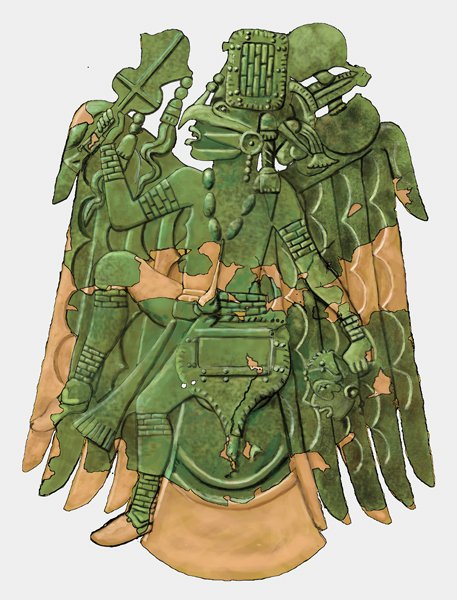
Illustration of a Rogan Plate a repoussé copper plate falcon dancer found at Etowah but believed to have been fabricated at Cahokia in the 13th century. Image credit: Herb Roe - CC BY-SA 3.0
Discovered artifacts show natives decorated themselves with shell beads, paint, complicated hairdos, feathers, and copper ear ornaments. Hand-carved stone effigies weighing 125 pounds still bear some original pigments. Numerous copper tools, weapons, and decorative copper plates accompanied the burials of Etowah's elite class members.
Numerous clay figurines and ten Mississippian stone statues have been found through the years in the vicinity of Etowah.
Many are paired statues portraying a man sitting cross-legged and a woman kneeling. The female figures wear wrap-around skirts, and males are usually portrayed without visible clothing, although both typically have elaborate hairstyles.
Etowah had three central platform mounds and three lesser mounds. There were wars, and rituals were often practiced.

Marble effigies from the Etowah Mound C, ca. 1250–1375: kneeling woman on left, and man on right. Image credit: Heironymous Rowe - CC BY-SA 3.0
Towering over the community, the 63-foot Temple Mound was likely used as a platform for the home of the priest-chief. On another mound, the nobility was buried in elaborate costumes accompanied by items they would need in their afterlives.
Mississippian Culture In Decline
In 1540, Hernando de Soto led 600 Spanish soldiers, business people, entrepreneurs, and priests on a journey through Georgia and the Southeast. The group searched for gold and other wealth they could claim for themselves and their fellow Spaniards. Along the journey, de Soto often took shelter with American Indians. At the area of present-day Carter's Lake de Soto visited a capital city of the Georiga Moundbuilders.
By the time Hernando de Soto arrived in 1540, archaeologists generally agreed that the Mississippian culture was in decline, and the Etowah Mounds site was abandoned. Control may have passed to a Mound Builder city northeast of Etowah Mounds near present-day Carters, Georgia.
Updated on July 11, 2022
Written by – A. Sutherland AncientPages.com Senior Staff Writer
Copyright © AncientPages.com All rights reserved. This material may not be published, broadcast, rewritten or redistributed in whole or part without the express written permission of AncientPages.com
Expand for references References: King A. Etowah: The Political History of a Chiefdom Capital
More From Ancient Pages
-
 Stunning Reconstructions Shows What Colchester Looked Like During Roman Times
-
 Norse Kingdom Of Dublin Was Founded By The Vikings In 839 A.D.
-
 Mysterious 210,000-Year-Old Apidima Skull Could Re-Write Human History
-
 Fragment Of Unique Ancient Greek Terracotta Statue Uncovered In Underwater Diggings
-
 Race Against Time: Crucial Expedition To Delve Into Bouldnor Cliff, Europe’s Mesolithic Underwater Stone Age Site
-
 On This Day In History: Battle Of Gaugamela – Alexander The Great Defeats Darius III Of Persia – On Oct 1, 331 BC
-
 Curse Of The Dancer – Mysterious 1,500-Year-Old Tablet Finally Deciphered
-
 Earliest Systematic Coal Exploitation For Fuel Goes Back To ~3600 B.P.
-
 Extraordinary Collection Of Ivory Plaques Dated To The First Temple Period Unearthed In Jerusalem
-
 Raven: Uncommonly Intelligent Bird, Symbol Of Providence, Wisdom And Prophecy
-
 Mystery Of The Proto-Elamite Tablets – Cracking The World’s Oldest Undeciphered Writing
-
 Why Didn’t Pythagoras And His Followers Eat Beans?
-
 Remarkably Well-Preserved 2,500-Year-Old Canoe Discovered In Swiss Lake
-
 Mystery Of An Edinburgh Crypt – Secrets Of Warriors Of Dark Ages In Scotland – Revealed
-
 Controversial Davenport And Pontotoc Stele Reveal Ancient Egyptians And Black Africans Visited North America
-
 Amazing Photos Of Ancient Ruins Hidden Under Thessaloniki Metro Revealed By Archaeologists
-
 Science Unravels Some Secrets Of Mysterious Shipwreck Gribshunden
-
 Unique Statue Of Mayan God K’awiil Associated With Lightning, Serpents, Fertility, Maize, Royal Lineage Found On Maya Train Route
-
 Unusual Stone Carvings And Medieval ‘Witching’ Marks To Ward Off Evil Spirits Discovered In England
-
 Don’t Underestimate The Rishis – Ancient Sages Were ‘Probably Great Scientists’

