
Mysterious And Sacred Intihuatana Stone Of The Inca Was More Than Just An Astronomy Calendar
Ellen Lloyd - AncientPages.com - The magnificent Inca Machu Picchu ruins fascinate people of the modern world. Standing on the highest elevation within the Inca citadel is the Intihuatana stone. The four sides of the Intihuatana stone represent the 4 cardinal points.
Most tourists who visit the site, think the remarkable Intihuatana stone is an astronomy calendar or clock, but to the Inca, the stone was much more than just an astronomical tool.
As people of the Sun, the Inca deliberately picked this particular place to erect the sacred Intihuatana stone.

Left: Viracocha, is the creator god in Inca mythology. Right: Intihuatana stone.
Carved from a huge slab of rock, the Intihuatana stone was designed to "hitch" the Sun at the two equinoxes, on March 21st and September 21st. On those days, the Sun stands directly above the Intihuatana, creating no shadow because the rock has an inclination of around 13 degrees. The Intihuatana stone testifies to the Incas’ astronomical skills.
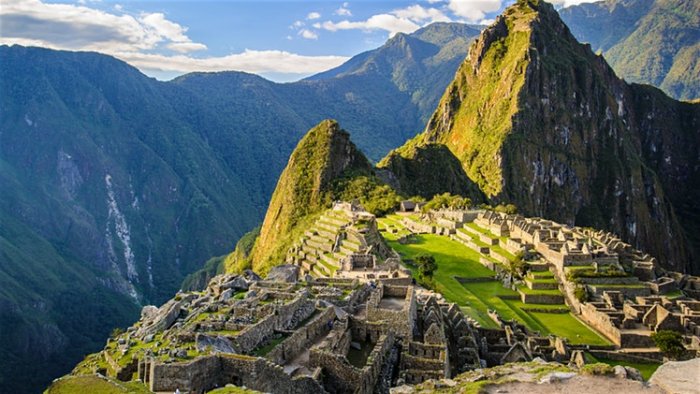
Machu Picchu, Peru
There is no doubt that the Intihuatana stone was an important astronomical device, similar to a sun dial, but it was also a sacred, ritual stone. Its name is derived from the local Quechua language and can be translated as “place to tie up the sun”, with inti being the word for sun, wata being the verb root for “to tie” or “to hitch”, and –na a suffix indicating tools or places. In English, the Inca rock is often referred to as "The Hitching Post of the Sun".
See also:
Puzzling Huge Ancient Sayhuite Monolith In Peru Remains An Unsolved Mystery
Manco Capac: Legendary Founder Of The Inca Dynasty Of Peru
Story Of Atahualpa: The Last Emperor Of The Inca Empire
The Inca believed the Intihuatana stone held the Sun in place. By holding rituals around the sacred stone, they hoped the world would never turn up-side-down. Ceremonies on the two equinoxes’ dates ensured good harvest and prosperity.
It is often said that Intihuatana stone serves as a portal to another world. By touching the sacred stone or placing one's forehand against it, a sensitive person can open a vision to the spiritual world.
Some years ago, the Ministry of Tourism in Peru, roped off the sacred Inca stone and people are no longer allowed to touch it.
The Inca believed that if the Intihuatana stone was damaged or destroyed, their civilization would perish. The sacred Intihuatna stone was damaged on December 8, 2000 when a 1,000-pound crane used to film a beer commercial toppled over and chipped off a piece of the stone’s granite.
The Intihuanta is sometimes referred to as Saywa or Sukhanka stone.

Credit: Peru Explorer
Saywas were astronomic markers, aligned with relevant dates in the Inca calendar. Such ancient astronomical markers could be erected on important mountain tops for the rise and decline of celestial bodies in their ecliptic, but Saywas could also be placed in the middle of the desert, like researchers recently discovered when they identified an Inca calendar in the Atacama Desert.
The Intihuatana stone shouldn’t be associated with the Inti Raymi, Inca’s Sun Festival traditionally celebrated at Cuzco on June 24, which marks the winter solstice, the shortest day of the year - the Inca New Year (in regions south of the equator the Gregorian months, June and July are winter months).
Written by - Ellen Lloyd – AncientPages.com
Copyright © AncientPages.com All rights reserved. This material may not be published, broadcast, rewritten or redistributed in whole or part without the express written permission of AncientPages.com
More From Ancient Pages
-
 Extraordinary Collection Of Ivory Plaques Dated To The First Temple Period Unearthed In Jerusalem
-
 Ancient History Of Chinese Swords
-
 One Of The Biggest Bronze Age Settlements On Orkney – Discovered
-
 New Light On The Complex Evolution Of Our Feet
-
 Fragment Of A Fine Marble Statuette Of Heracles Found In Jezreel Valley, Israel
-
 Headless Statue Of Life-Size Ancient Mayan Warrior Discovered In Mexico
-
 New Macedonian-Era Tomb With Four Chambers Was Discovered In Pella
-
 Oldest case of leukemia found on 7,000-Year-old skeleton
-
 Researchers reconstructed face of oldest pharaonic mummy ‘Kent’
-
 Unique Ancient Roman Winery With Marble Tiling And Fountains Of Grape Juice Unearthed In Rome
-
 A 4.4 Million-Year-Old Hand Of ‘Ardi’ Has Some Clues On Humans’ Upright Walking
-
 Nobel Prize: Svante Pääbo’s Ancient DNA Discoveries Offer Clues As To What Makes Us Human
-
 Mysterious Railway Car Discovered Under An Old Fortress In Antwerp, Belgium
-
 Pompeii Region IX: Roman Advanced Construction Techniques In New Light
-
 “Touchstones” For Social Belonging: How Did Ancient Pastoralists In South Arabia Adapt To Climate Change?
-
 Unusual Secret May Be Hidden In A Mysterious Valley In The American Southwest
-
 The Ancient ‘Flying Machines’ Of Icarus and Daedalus
-
 10 Remarkable Jain Temples – Marvelous Ancient Architecture And Stone Carvings
-
 Birka: Major Trading Center During The Viking Age
-
 Discovery Of Ancient Sarcophagus And 14 Stone Pillars Covered With Inscriptions In Eastern Mongolia

