
Secrets Of Viking Crystal Sunstones Revealed By Modern Science
Conny Waters - AncientPages.com - Mysterious crystal sunstones are mentioned in many Icelandic Sagas. Long considered mythological objects, there is reason to believe that legendary Viking Sunstones did exist and Viking Sagas were more truthful than we realized.
A special crystal discovered with the wreckage of the Alderney, an Elizabethan warship that sank near the Channel Islands in 1592, suggests legendary Viking sunstones did exists in reality.
According to these sagas, the Vikings used whales, swells, birds, the stars and the wind as clues to aid in navigation.
Crystal “sunstones” could have helped Viking sailors to navigate even when cloud or fog hid the sun.
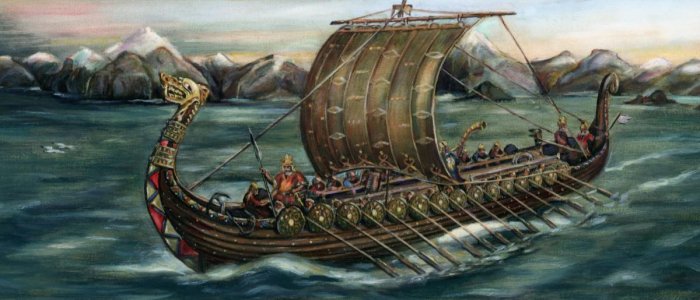
The longships gave the Vikings several advantages when they went to war or raids.
Researchers with ELTE Eötvös Loránd University in Hungary have run computer simulations with the goal to unravel the secrets of Viking sunstones and how they could have been used for navigation.
“The team simulated 3600 voyages taken during the spring equinox, the presumed start of the open seas travel season, and the summer solstice, the longest day of the northern year. Otherwise, the simulations varied only by three factors: The amount of cloud coverage (which varied over the course of the day), the type of crystal used as the sunstone, and how often mariners consulted them. Each time a navigator made reference to a sunstone, the simulated ship adjusted its course if needed,” Science Magazine reports.

Crystals of calcite, like this one, may have been the “sunstones” of Viking legend that enabled these seafarers to successfully navigate lengthy voyages. Credit: Public Domain
According to the scientists, “the sky-polarimetric navigation is surprisingly successful on both days of the spring equinox and summer solstice even under cloudy conditions if the navigator determined the north direction periodically at least once in every 3 h, independently of the type of sunstone used for the analysis of sky polarization. This explains why the Vikings could rule the Atlantic Ocean for 300 years and could reach North America without a magnetic compass.”
See also:
Vikings: Facts And History About The Tough Norse Seafaring People
Why Were Viking Raids So Successful?
Viking Longships: Fearless Dragonships Daring The Oceans And Seas
Secrets Of Legendary Viking Crystal Sunstones And The Mysterious Uunartoq Artifact Unraveled
“We showed that this navigation method can function well under cloudy skies on a voyage with varying cloudiness if the navigation periodicity is small enough and is distributed symmetrically before and after the time point of the real noon,” the study concludes.
“Nobody knows whether the Vikings really used this method. However, if they did, they could navigate with it precisely.”
Written by Conny Waters - AncientPages.com Staff Writer
More From Ancient Pages
-
 Men And Women Had Equal Access To Resources 6,000 Years Ago
-
 16 Meters Long Ancient Papyrus With Spells From The Book Of The Dead Found In Saqqara
-
 Collection Of 59 Well-Preserved 26th Dynasty Coffins Unearthed In Saqqara Necropolis, Egypt
-
 Leonardo da Vinci’s Paradox Cracked
-
 1,800-Year-Old Statue Of A Water Nymph Found Underground In The Ancient City Of Amastris
-
 Rare Well-Preserved Viking Artifacts Lost On Mountain Pass – Revealed By Retreating Glaciers
-
 Ilopango Volcanic Eruption In Maya World 1590 Years Ago – New Study
-
 Controversial ‘Anomaly’ Discovered On Mount Ebal Could Be Biblical Joshua’s Altar
-
 3,000-Year-Old Settlement Studied By Archaeologists In Cyprus
-
 Incredible Trove Of 100,000 Ancient Coins Tied Together In Bundles Uncovered In Japan
-
 Ancient Genomes Suggest Farming In Africa Was Ignited By Oversea-Migrants From Iberia 7,400 Years Ago
-
 4,000-Year-Old Teeth Show The Earliest Evidence Of Chewing Psychoactive Betel Nuts
-
 Pharaonic Water Wells Discovered For The First Time Near ‘Horus Road’ In Sinai, Egypt
-
 The Ancient World Of The Veneti People: Rare Inscriptions And A Large Pre-Roman Sanctuary Unearthed In Ponso, Italy
-
 Roman Theater Unearthed After 1,700 Years Near Western Wall In Jerusalem
-
 Ancient Maya Lessons On Surviving Drought – Examined By Scientists
-
 Neanderthals Weaned And Raised Their Children Similarly To Modern Humans
-
 Ancient Egyptian Visual Depiction Of The Milky Way Discovered
-
 Māori Connections To Antarctica May Go As Far Back As 7th Century
-
 Anglo-Saxon Harpole Treasure Reveals More Secrets – Unique Medieval Silver Cross Found

