
Lady Cao – Moche Queen Who Re-Wrote Ancient History
Ellen Lloyd - AncientPages.com - Lady Cao was not just one of many mummies archaeologists have unearthed in various parts of the world. Discoveries of her remains re-wrote ancient history and gave us a much better understanding of the Moche culture.
The Moche flourished and ruled the northern coast of Peru before the Incas, between the first and eighth centuries, at the same time the Mayas thrived in Mexico and Central America. They dominated the desert through a complex irrigation system, built adobe pyramids, and, like many ancient cultures, used religion to unify society.

In 2006, archaeologists discovered a female Moche mummy at the archeological site El Brujo, which is located about 45 km north of Trujillo in the La Libertad Region of Peru. She became known as lady Cao. It was one of the most significant archeological discoveries relating to the Moche.
The discovery of her splendid burial shattered scientists’ notions about the Moche, which until recently had been perceived as a society ruled by male warriors.
Examinations of the ancient mummy revealed Lady Cao was in her mid-twenties when she died about 450 CE. The cause of her death was most likely complications due to pregnancy or childbirth.
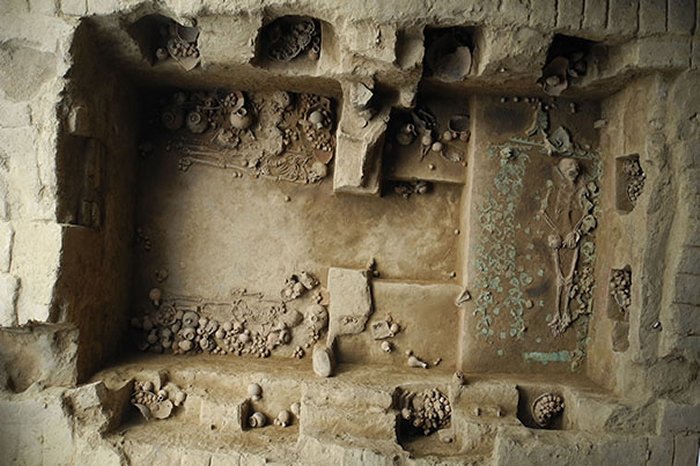
This royal tomb, the eighth discovered in 25 years, is believed to have belonged to a Moche priestess buried 1,200 years ago. The great number of artifacts and the complexity of the burial reveal the power and influence this woman wielded in life. Courtesy of Luis Castillo
Her burial site contained valuable artifacts and weapons. It soon obvious that Lady Cao was a woman of great importance. Lady Cao was buried with valuable metal items and wooden scepters wrapped in copper that symbolized the power she wielded when she was alive.
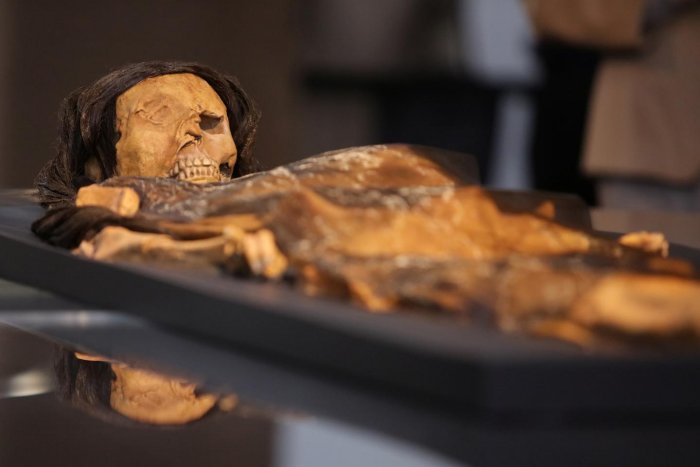
The Lady of Cao's mummy, which was found at the archaeological site Huaca El Brujo, a grand pyramid of the ancient Moche pre-hispanic culture, is seen at the Ministry of Culture in Lima, Peru July 4, 2017.
GUADALUPE PARDO/REUTERS
She had a diadem of gold on her head and wore a large V-shaped crown with the image of a puma in the center and a necklace with large beads, each bearing the same feline face. She had several symbolic tattoos.
See also:
Face Of Queen Lady Cao Reconstructed – Unique Look At The First Known Female Ruler In Peru
Ancient Tomb Of Peru’s Moche Priestesses Unearthed
1,700-Year-Old Moche Culture Ceremonial Banquet Hall Discovered In Peru
On her arms and feet, scientists discovered snake and animal tattoos. Other tattoos on her body included spiders, the tree of life, star-like figures, all of which were considered sacred elements and which also appear on the friezes of the larger temples in the El Brujo archaeological complex.
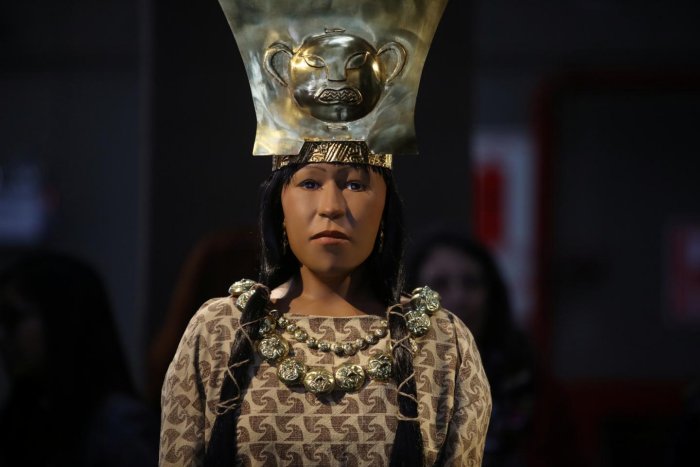
A replica of The Lady of Cao face, a female mummy found at the archaeological site Huaca El Brujo, a grand pyramid of the ancient Moche pre-hispanic culture, is seen at the Ministry of Culture in Lima, Peru July 4, 2017.
Image credit: Guadalupe Pardo/Reuters
Using sophisticated 3D technology, scientists later reconstructed her face and by doing so she became more alive.
Today, most scientists think that Lady Cao could have been a priestess or even a Moche ruler who has governed in the Chicama Valley.
Until recently, it was believed that the Moche had been as a society ruled by male warriors, but this assumption turned out to be completely wrong.
The discovery of Lady Cao showed that women held a high rank in the Moche culture. The Moche civilization had no written language and the silent remains of Lady Cao spoke to us, revealing what her society really was like.
Sometimes it’s enough with just one discovery to re-write our history books.
Written by Ellen Lloyd – AncientPages.com
Copyright © AncientPages.com & Ellen Lloyd All rights reserved. This material may not be published, broadcast, rewritten or redistributed in whole or part without the express written permission of AncientPages.com and Ellen Lloyd
More From Ancient Pages
-
 What Did Houses For Ordinary People In Sumer Look Like?
-
 Why Did Students Turn Medieval Oxford Into A Murder Capital?
-
 Unique Artifacts Reveal The Ancient City Of Troy Is Much Older Than Previously Thought
-
 Biblical Cherubim – Sweet Angels Or Dangerous Creatures With A Hidden Agenda?
-
 Earth’s First Animals Had Particular Taste In Real Estate
-
 On This Day In History: Battle of Tsushima Was Fought – On May 27, 1905
-
 Mansehra Rock Edicts – Last Words Of Emperor Ashoka
-
 DNA Study Of Remains At Delaware Site Find Kinship Among European Settlers, African Slaves
-
 Mysterious Ancient Fortified City Of Djado On Dangerous Journey Across Sahara
-
 Gona, Ethiopia Discovery: Smallest ‘Homo Erectus’ Cranium In Africa And Stone Tools – Unearthed
-
 New Trove Of Treasures, Funerary Temple, 50 Sarcophagi Unearthed In Saqqara, Cairo
-
 Fearsome Sekhmet: Lion-Headed Egyptian Goddess And Sister Of Ptah
-
 Ancient Monuments The World Is Not Allowed To See – Forbidden Zone – Part 2
-
 Denisovans In The Altai Mountains: A Hominin Group That Interbred With Modern Humans
-
 Strange Underwater Mini-Pyramid Older Than Stonehenge With Unknown Purpose – Who Built It?
-
 Idol Of Pachacamac Inca God Reveals Its Colors
-
 On This Day In History: David I Becomes King Of Scots – On Apr 27, 1124
-
 Unexplained Ancient Case Of Missing Time And Mysterious Disappearance Into An Underground World
-
 Were Owl-Shaped Plaques Children’s Toys In Copper Age?
-
 Was Aztec And Mixtec Turquoise Mined In the American Southwest?

