
Viking Children Were Buried With Extremely Sharp Knives – Afterlife Tools To Be Used In Valhalla?
Ellen Lloyd - AncientPages.com - Like many other ancient civilizations, Vikings had very several interesting burial customs.
Some Vikings' burial traditions are understood, but there are also certain aspects of the Norse culture we don’t yet fully comprehend.

Left: Credit: Imdb - Right: Gordito1869 - CC BY-SA 4.0
There is archaeological evidence Vikings used to bury their children with extremely large and sharp knives. The purpose of placing these artifacts in the tombs is not entirely clear, but one possibility is that the knives should help the little ones in their afterlife.
Nevertheless, this discovery is surprising to archaeologists, but it confirms the theory that the line between childhood and adulthood was very thin during the Viking Age.
The graves of the Viking children were found at Langeland and Lejre in Denmark. Scientists were able to determine the buried children are between 4 to 6-year-old and the graves are dated to the period from 800 to 1050 A.D. Examination of the artifacts discovered inside the tombs reveal the knives are made of steel and are very sharp. They seem almost too large to be used by small children, and yet they were placed there alongside these small bodies.
Life for ancient Viking children was different. Viking children did not have much time to enjoy their childhood. Work, learning, duties, and responsibility started at a very early age and there was not much time for playing games, but this does not mean it was boring to be a Viking child.

Based on the findings of these knives, researchers think that very young children used to walk around carrying a knife attached to their leather belts.
Associate Professor of Archaeology at the University of Copenhagen is convinced the knives were not toys, but tools. To the Vikings, the knife played an important part in daily life, and this also applied to the children. The knives in the children's graves also show that the knife has been something that followed people from childbirth and throughout life, says the archaeologist.
Unfortunately, our knowledge about Viking children is very limited because few child graves have been unearthed so far. Children are also not mentioned often in Norse Sagas.
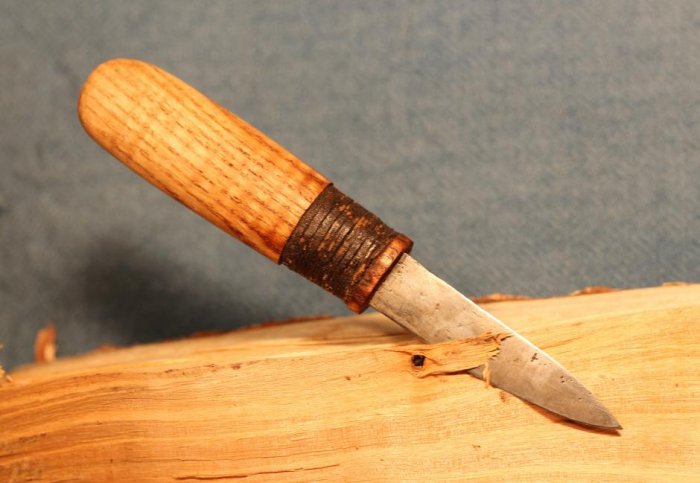
Image credit: Michael Nielsen
One reason why we haven’t found many ancient graves containing children could be because only children from the upper Viking class received a proper burial.
Perhaps Vikings buried their children with knives because they thought it was an indispensable tool that one must carry when entering Valhalla. Located in Asgard, Valhalla was the home of the fallen Vikings who died in battle and the kingdom of the Norse god Odin.
Ancient Viking funeral traditions and rituals were very complex. Many relics in ancient tombs reveal that the type of burial a Viking received depended on his importance in society. Before the age of Christianity, when Vikings still worshipped pagan gods it was common to bury a Viking along with his belongings, often lying in a boat or a wagon to make the journey to the next world easier. People believed the deceased person would need certain objects in the afterlife.
Based on discovered archaeological evidence it seems that the funeral boat or wagon was a practice that was reserved for the wealthy.
Another option was that the Vikings were burned and cremation was rather common during the early Viking Age. Ashes were later spread over the waters. The vast majority of the major burial finds throughout the Viking world are cremations. Ship burial was reserved for great Viking warriors.
Over the years, researchers have also learned about some rather unusual Viking burial traditions. Did you for example know that Vikings burned and buried their longhouses?
Updated on June 22, 2022
Written by Ellen Lloyd – AncientPages.com
Copyright © AncientPages.com All rights reserved. This material may not be published, broadcast, rewritten or redistributed in whole or part without the express written permission of AncientPages.com
Expand for referencesScandinavian books and magazines
More From Ancient Pages
-
 Evidence Of Sangam Age Settlement Unearthed At Nangur, Tamil Nadu
-
 Controversial Hollow Earth Theory – Questions And Answers – Part 3
-
 Archaeologists Survey Bronze Age Konar Sandal Site In Southeast Iran
-
 Kingdom Of Judah: Government Complex And 120 Seal Impressions Stamped On Jars – Unearthed
-
 Terahertz Imaging Reveals Hidden Inscription On Early Modern Funerary Cross
-
 A 2,000-Year-Old Tomb Of A Roman Physician And His Medical Instruments Found In Hungary
-
 New Fossil Of 145-Million-Year-Old Pterosaur Nicknamed Elvis
-
 On This Day In History: Battle Of Naulochus Was Fought Off The Coast Of Sicily – On Sep 3, 36 BC
-
 On This Day In History: World War II – Attack on Pearl Harbor – Dec 7, 1941
-
 Huge Jars Unearthed In Kultepe, Turkey
-
 Fascinating Discovery – First Female Viking Grave Discovered In Swedish Mountains
-
 Unique Ancient Half-Mummy Unearthed In Luxor, Egypt Mystifies Archaeologists
-
 Qijia Culture – Its Disappearance Remains An Ancient Mystery
-
 Ancient Statue Of Makara, Legendary Sea-Creature Found In Cambodia
-
 Symbol of Immortality: Honey Offering In A 2,500-Year-Old Shrine – Identified
-
 Controversial Story And Secret Knowledge Of Li Ching-Yuen Who Lived For 256 Years
-
 Controversial Tunnel Plan Near Stonehenge Gets U.K. Government Approval – Shocked And Angry Opponents Will Challenge The Decision In High Court
-
 Evidence Of Lost Advanced Ancient Technology In Babylon
-
 Large Statue Of Ancient Guardian Discovered At Angkor Wat
-
 On This Day In History: William I ‘The Lion’ Was Crowned At Scone – On Dec 24, 1165

