
Louhi – Witch Goddess Of The North And The Magical Artifact Sampo In Finnish Mythology
Ellen Lloyd - AncientPages.com - The Kalevala is one of the most significant works of Finnish literature. It's a book full of beautiful stories about heroes, villains, remarkable creatures, and wonderful adventures.
Compiled from Finnish and Karelian folklore in the 19th century, the book deeply impacted the young J.R.R. Tolkien and inspired his future books.
In the Kalevala, we encounter many complex and intriguing personalities, such as Lemminkainen, a war hero who is a prominent figure in Finnish mythology. There are many versions of the original Lemminkainen story because his complex character is a mix of traits originating from several other personalities of Finnish oral poetry.
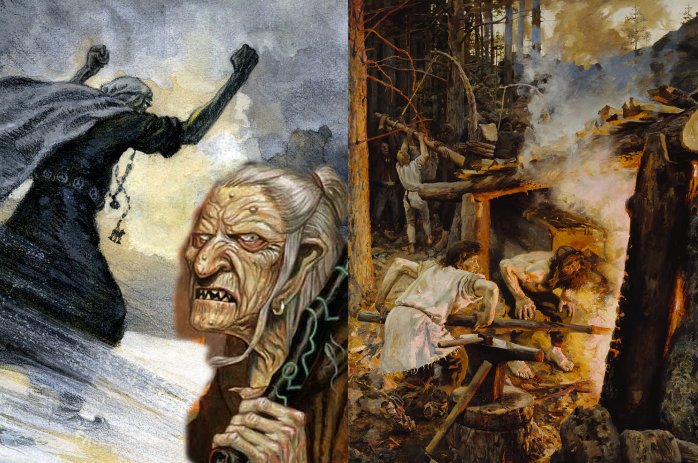
The original Lemminkäinen in mythology is a shamanistic figure, but his roles and experiences frequently change in many different stories.
Another interesting figure mentioned in the Kalevala is Louhi, who is considered to be a witch and goddess of the North.
As a leader of Pohjola, the people of the North, her powers are great, and her daughters avidly sought after. Louhi possesses the power of magic, and at one point, she steals the Sun and Moon and locks them away.
Louhi is described as an evil witch and it's very likely she an alter-ego of the goddess Loviatar, a blind daughter of Tuoni, the god of death in Finnish mythology, and Tuonetar, the god of death in Finnish mythology underworld queen.
The Sampo – A Magical Artifact Which Louhi Tried To Steal
In Finnish mythology, the Sampo (or Sammas) was a magical artifact that many tried to steal, and one of them was Louhi.
The nature of the Sampo still remains shrouded in mystery, and scholars have attempted to explain the origin and purpose of the artifact.
The Sampo has been interpreted in many ways. It could have been a world pillar or world tree, a compass or astrolabe, a chest containing a treasure, a Byzantine coin die, a decorated Vendel period shield, a Christian relic, or something entirely different.

The Defense of the Sampo, shows Väinämöinen as he fights Louhi in the form of a winged monster carrying deformed Pohjola warriors on her back. Image credit: Akseli Gallen-Kallela
Some theories proposed that the Sampo was a world pillar, and it as such, it referred to the precession of the equinox. Though we do not know exactly what the Sampo was, it's clear from the stories in the Kalevala that it was a precious and "magical" object made of several magical ingredients, including a barley grain, a swan's quill tip, a barren cow's milk, and the wool of one ewe.

The Forging of the Sampo - Credit: Akseli Gallen-Kallela (1893) - Public Domain
The witch Louhi was the main opponent of Väinämöinen, an old hero with a magical voice and his group in the battle for the magical artifact Sampo in the Kalevala.
Louhi, who has many beautiful daughters, comes up with a cunning idea.
From one story, we learn that Louhi suggests that she will give her daughter's hand in marriage if the sage accomplishes the task of securing the Sampo.
When the smith Ilmarinen refuses to go to Pohjola, the heedless Väinämöinen forces him to comply —he too is eager to see the dream made real.
In the North, the reluctant Ilmarinen builds the Sampo, creating endless wealth for the northern people. Everything goes wrong, and soon the people of Kaleva and those of Pohjola are fighting over the Sampo. Eventually, the magic mill is destroyed in the battle, and the pieces sink to the bottom of the sea.
Updated on March 11, 2022
Written by - Ellen Lloyd – AncientPages.com
Copyright © AncientPages.com All rights reserved. This material may not be published, broadcast, rewritten or redistributed in whole or part without the express written permission of AncientPages.com
Expand for referencesMore From Ancient Pages
-
 Incredible 5,000-Year-Old Temple Complex In Orkney Could Re-Write History Of Scotland
-
 Edfu Texts Reveal Secrets Of Predynastic Egypt And Zep Tepi
-
 Puzzling McClelland Sherd – Undeciphered Inscription Could Be Early Bronze Age Writing
-
 Dwarfie Stane: Mysterious 5,000-Year-Old Rock-Cut Tomb On Dark Enchanted Island Of Hoy, Scotland
-
 Katana ‘Soul Of The Samurai’ – Most Famous Japanese Sword With Long Tradition
-
 Ancient Scriptures With Lost Languages Discovered Inside Saint Catherine’s Monastery On The Sinai Peninsula
-
 Oldest Carving Of A Penis Discovered On Ancient Mongolian Pendant
-
 Children’s Toys Among Roman-Era Artifacts Unearthed At Ancient City Of Beçin Turkey
-
 Mystery In Abydos: Carved Rock Chambers Discovered Inside Sacred Mountain
-
 Where Does The Expression ‘Saved By A Bell’ Come From?
-
 On This Day In History: Most Notorious Roman Emperor Nero Committed Suicide – On June 9, 68 AD
-
 Underwater Archaeologists Retrieve Over 100 Magnificent Glass Objects at Chengene Skele Bay, Bulgaria
-
 Archaeological Evidence Of Human Presence In America 250,000 Years Ago?
-
 Controversial Ancient History: Did Humans Evolve From Reptilians? The Serpent Connection From Ancient Myths To Modern Science
-
 African Stonehenge – Extraordinary Stone Circles Of Senegambia – Who Were The Unknown Builders?
-
 Archaeologists Investigate The Mysterious Disappearance Of Human Skeletons In England And Wales During The 5th Century
-
 Jars With 2,600-Year-Old Vanilla Remnants Discovered In The City Of David
-
 First Scandinavian farmers were far more advanced than previously thought
-
 Drones Find Evidence Roman Siege Of Masada Lasted Much Shorter Than Previously Thought
-
 Giant Hrungnir Who Lost The Race And Engaged In A Deadly Duel With Mighty Thor In Norse Mythology

