
Astonishing Lunar And Solar Calendars Created 30,000 B.C.
Ellen Lloyd - AncientPages.com - At first glance, these ancient artifacts may look like ordinary bones covered with insignificant dots. That is not the case, however.
Closer examination of carved-engraved bone plates discovered in France has revealed people created astonishing lunar and solar calendars 30,000 B.C.
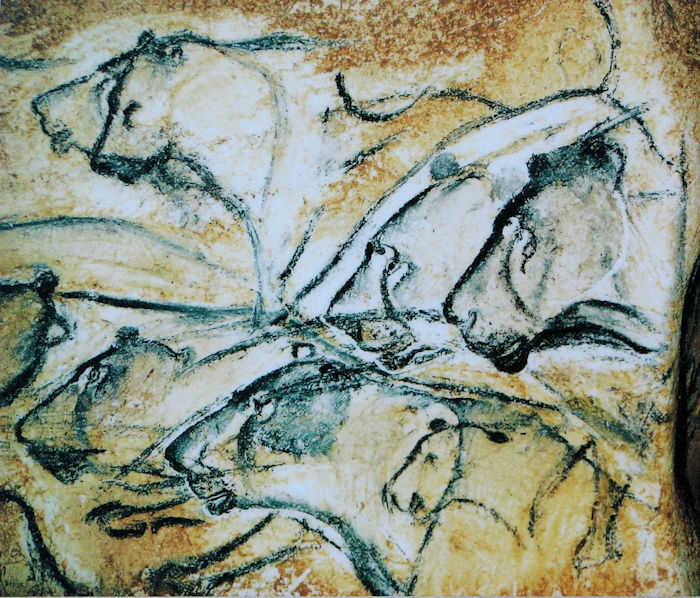
Chauvet-Pont d'Arc cave replica, the lions "fresco". Credit: HTO - Public Domain
For as long as anyone can remember, people have been fascinated with the night skies. There are many examples of how our ancestors’ profound interest in astronomy.
Observations of celestial objects took place in many prehistoric societies. Today, we can admit that ancient astronomers possessed advanced knowledge about the Sun, the Moon, asteroids, various solar planets, and interesting cosmic events. When and where people started to study the heavens and celestial objects is impossible to say, but if we turn our attention to Europe, we discover something quite extraordinary.
European Paleolithic works of art can be dated to approximately 30 000 BC. and are considered one of the achievements of the Upper Paleolithic cognitive revolution. The earliest cave paintings in La Grotte Chauvet-Pont-d’Arc, France were created about 31 000 years ago. Not only are the images a great example of prehistoric art, but they have also motivated researchers to attempt to “decipher” the meaning and purpose behind some of the ancient symbols.
While examining Paleolithic cave art scientists discovered that Paleolithic people had a great interest in astronomy.
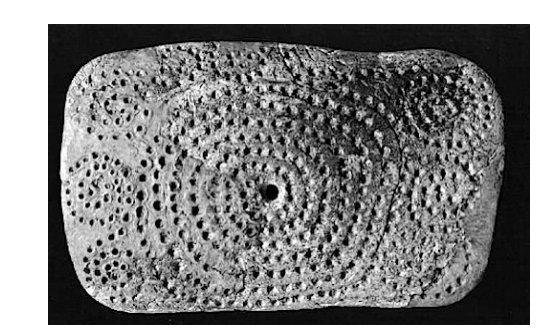
Alexander Marshack (1918-2004), an American independent scholar and Paleolithic archaeologist, was one of the first scientists who stated astronomy played an essential role during the Upper-Paleolithic era.
He studied ancient bone fragments discovered in French caves. He interpreted the various Paleolithic and Mesolithic, mostly portable, objects that bear engraved or painted series of dots or lines as accurate lunar observations.
Juan Antonio Belmonte writes in the book Ancient Astronomy: India, Egypt, China, Maya, Inca, Aztec, Greece, Rome, Genesis, Hebrews, Christians, the Neolithic and Paleolithic that Marshack’s “arguments were based not only on counting the signs but on what he called “microscopic analysis.”
The interpretation of the markings on various artifacts as notational systems rests on the hypothesis of a slow accumulation of these marks, which correlates with lunar or solar motion. Thus he concluded that these artifacts reflect nonarithmetic observational astronomical skills and lore. The most well-known depiction interpreted by him is found on the bone plate about 30 000 years old, from Abri Blanchard (Dordogne, France), which is said to represent the waxing and waning moon positions in serpentine form.”
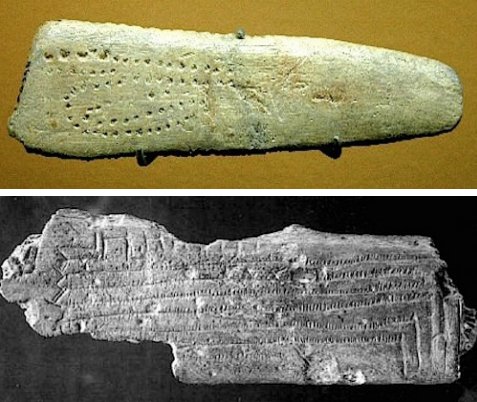
Top: Abri Blanchard, Dordogne, France. Archaeological Museum. Bottom: Cave of Taï, Drôme, France
“Francesco d’Errico and colleagues developed a different type of methodology (d’Errico 1989). Drawing on experimental archaeology, they compiled a database in an attempt to demonstrate whether the notches represent notational systems or not.
After investigating a great number of artifacts they concluded that there were some objects which might have depicted parts of a series of complex codes based on the hierarchical organization of information, and using formally differentiated marks. One of these artifacts might be the find from the cave Taï (Drôme, France) whose age is about 10 000 years.
After studying Eurasian portable art the Russian investigator B.A. Frolov also became convinced that these objects were calendars following the monthly motion of the moon and/or yearly solar path, and claimed they were used by early communities. The most well-known bone plate interpreted as a lunisolar calendar is from Ma’lta (Irkutskaya Oblast, Russia).”
The theory that people created such complex lunar and solar calendars so long ago may sound somewhat far-fetched. Still, there is a lot of evidence that suggests our ancestors were rather familiar with the movements of the Sun, Moon, and even other planets.
Updated on March 22, 2022
Written by Ellen Lloyd – AncientPages.com
Copyright © AncientPages.com All rights reserved. This material may not be published, broadcast, rewritten or redistributed in whole or part without the express written permission of AncientPages.com
More From Ancient Pages
-
 Olive Trees Were First Domesticated 7,000 Years Ago In The Jordan Valley
-
 Will Archaeologists Uncover The Secrets Of A Rare Viking Ship Grave In Norway Before It’s Destroyed?
-
 Mysterious Deserted Medieval Village And Castle Discovered In The Harz Mountains – 2,000 Artifacts Were Found
-
 Abundant Hominin Fossils Dating Back 300,000 Years Excavated In Hualongdong (HLD), East China
-
 Mystery Of The Lydenburg Heads
-
 Vimanas Of The Rama Empire: Flying Machines Dominated Ancient Skies In Distant Past
-
 On This Day In History: The Battle Of Benevento Was Fought – On February 26, 1266
-
 Ancient Books, Scrolls And Manuscripts Burned By Church And Evil Emperors
-
 Puzzling Comb Drawing In Huenul Cave May Be The Oldest Rock Art In South America
-
 Cyclops – First Generation Of Giants Who Were Prisoners Of Tartarus
-
 Ancient Society In The Sahara Desert Rose And Fell With Groundwater – Study
-
 Micro-CT Scans Revealed: It Wasn’t Egyptians’ Falcon-Headed Deity But Malformed Human Baby
-
 47,000 Years Of Aboriginal Heritage Was Destroyed In Mining Blast – Results From Juukan Gorge Show
-
 Extraordinary Ancient Roman Ceremonial Chariot Discovered In Pompeii – It’s Still Almost Intact
-
 Rare Ancient Dacian Stonemason’s Toolkit Discovered In Romanian Forest
-
 Mystery Of The Ancient Sitovo Inscription: Undeciphered Script Or Just A Natural Rock Formation?
-
 How Was The Mysterious Menga Dolmen Built By Neolithic People? New Scientific Theory Presented
-
 Well-Preserved 1,000-Year-Old Ulfberht Sword Found In The Wisla River, Poland
-
 Abric Romaní Cave: New evidence indicates Neanderthals used to heat water some 60,000 years ago
-
 Boxer At Rest – Rare Sculpture And Masterpiece Of Hellenistic Bronze Art

