
Wars Of The Roses: Thirty Two Years Of Struggle To Claim English Throne
A. Sutherland - AncientPages.com - The Wars of the Roses was a civil war in England that lasted from 1455-1487. This thirty-two-year military conflict was fought between the supporters of the House of Lancaster (Lancastrians) and the supporters of the House of York (Yorkists).

Finding Richard's circlet after the battle, Lord Stanley hands it to Henry at the Battle of Bosworth Field, 1485. Engraving, 19th century. Image via Warfare History Network
The name of the wars is related to the roses; a red rose represents the Lancastrians (House of Lancastrians) and the Yorkists by a white rose.
It was a struggle to claim the right to the English throne, and each side sincerely believed they had a rightful claim. The Lancastrians and the Yorkists were two of England's most influential great aristocratic families.
Another important figure in this conflict was an English nobleman, administrator, and military commander, Richard Neville, 16th Earl of Warwick (1428 – 1471). He was wealthy and powerful, with political connections beyond the country's borders.
Neville was initially on the Yorkist side but later switched to the Lancastrian side, and in fact, he was instrumental in the deposition of two kings.
The dispute between the two houses began with the overthrow of King Richard by Henry Bolingbroke, Duke of Lancaster, in 1399. Henry Bolingbroke ( c. April 1367 – 20 March 1413), crowned Henry IV, was King of England from 1399 to 1413, but his rule was widely unpopular. Shortly, a revolt broke out in Wales, Cheshire, and Northumberland, and Henry IV managed to suppress the revolts with difficulty.
He died in 1413, and his successor was Henry V, a popular king and a strong leader who led England against France in the Hundred Years' War (1337 to 1453) and won many battles, giving the Lancastrians enough power to hold on to the throne. When Henry V died in 1422 from dysentery, his son, Henry VI, became his successor as King of England and France, but he had many difficulties in ruling the country. He had a mental illness inherited from his French grandfather, Charles VI.
Henry was an ineffective ruler, surrounded by some unpopular advisors such as Cardinal Beaufort, the Duke of Gloucester, and the Duke of Suffolk When Henry VI's life was about to end, the Yorkists were almost sure their representative would have a right of succession after him.
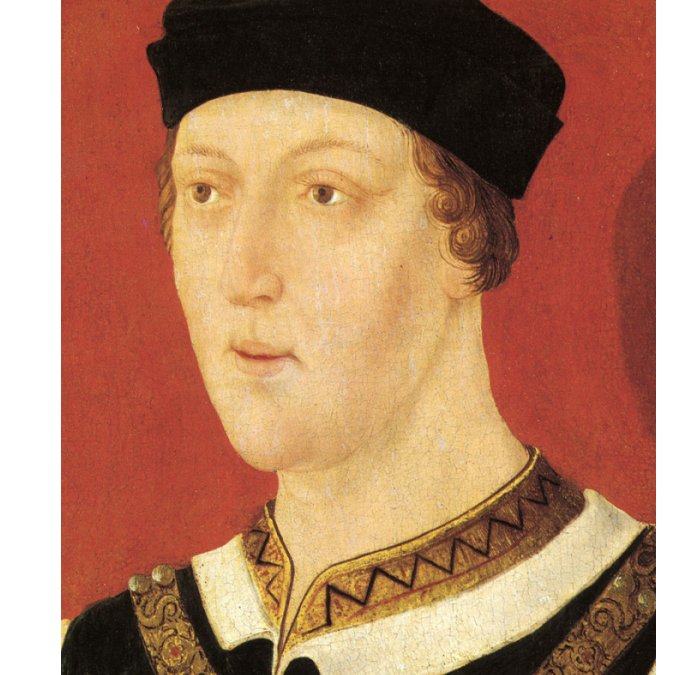
Henrik VI (1421-1471), Image credi: Anonymous - Public Domain
However, it was not that simple. The new King did not inherit the throne; instead, he was elected. Parliament played an essential role in this challenging political process. It had the enormous power to create a king.
"..Haughty, arrogant kings bowed submissively to its will. Henry could not make laws nor impose taxes without first summoning Parliament and obtaining his subjects' consent. But corrupting influences were at work, which was destined to cheat England out of her liberties for many a year." 1
The country's impoverishment to pay for the war and royal extravagances had awakened a troublesome spirit in the House of Commons. Cruelty to heretics also, and oppressive enactments were fought and defeated in this body. The Kikingclergy, and nobles, were drawing closer together and farther away from the people, and were devising ways of stifling their will…" wrote an American author and historian, Mary Platt Parmele, in her "A Short History of England, Ireland, and Scotland."
At the same time, according to the strict rules of hereditary succession, there were two others with claims superior to Henry's. The Duke of Lancaster, Henry's father (John of Gaunt), was only a younger son of Edward III. Richard Duke of York, his cousin, claimed a double descent from Duke Clarence and the Duke of York, both sons of Edward III.
It is also said that another immediate cause of the York revolt related to Queen Margaret Anjou, who unexpectedly revealed her male child. It had raised serious doubts about the origin of the righteous bed and, of course, seriously contributed to the beginning of the Wars of the Roses, a gloomy and very destructive period in the history of England, where most of the fighting took place, which resulted in significant loss of life and property.

"…Murders, executions, treacheries, adorn a network of intrigue and villainy, … was enough to have made the "White" and the "Red Rose" forever hateful to English eyes."
Many more significant battles and minor clashes occurred between the fighting parts; however, the last and decisive battle military encounter is known as the Battle of Bosworth Field (or Battle of Bosworth).
Henry VII (1457 – 1509), an offshoot of the House of Lancaster), raised a Lancastrian army against Richard III, defeated the Yorkists, and killed Richard at the Battle of Bosworth Field in 1485.
After this battle, the throne of England finally fell to the representative of a strong family - Henry Tudor.
Henry VII was crowned King and married Edward IV's daughter, Princess Elizabeth of York - a move to end the very tiring and devastating period in the history of England - Wars of the Roses. He reunited the two royal houses, merging the rival symbols of the red and white roses into the new emblem of the red and white Tudor rose.
The House of Tudor ruled the Kingdom of England until 1603.
Written by – A. Sutherland AncientPages.com Staff Writer
Updated on October 2, 2022
Copyright © AncientPages.com All rights reserved. This material may not be published, broadcast, rewritten or redistributed in whole or part without the express written permission of AncientPages.com
Expand for referencesReferences:
- Mary Parmele, History of England
More From Ancient Pages
-
 LIDAR Data Helped To Discover Unexplored Region Of Maya World In Campeche, Mexico
-
 Enigma Of Étienne Le Ray – Unusual Vagabond Prophet Nicknamed Nostradamus Of Brittany
-
 DNA Reveals Unique Ancestry Of Inhabitants Of The Angolan Namib Desert
-
 The Truth About Ancient Rome’s Vomitorium
-
 U.S. Bible Museum Says Five Dead Sea Scrolls Fragments In Their Collection Are Fake
-
 Subterranean Kingdom Of Shahmaran And The Land Of The Snakes
-
 A 2,000-Year-Old Tomb Of A Roman Physician And His Medical Instruments Found In Hungary
-
 History Of Eyeglasses: One Of The Most Important Inventions Is Lost To History
-
 Climate Change Will Soon Erase Ancient Cave Art Of Sulawesi, Indonesia
-
 Tomb Of Maia, Tutankhamun’s Wet Nurse In Egypt’s Saqqara Opens To Public
-
 Eastern Baltic’s Communities Of First Farmers And Hunter-Gatherers Merged Slowly
-
 Major Underwater Archaeological Find On The Western Coast Of Sicily – Artifacts From The Battle Of The Egadi Islands?
-
 Thousands Of Sacred ‘Images’ With Unknown Signs Hidden In A Monastery Could Be World’s Oldest Alphabet
-
 Calakmul Was Powerful Ancient Maya Seat Of The Snake Kingdom
-
 Stone Age Statues Were Taken To Britain For Restoration In 1990 – Never Returned Home To Jordan
-
 On This Day In History: ‘Lady With The Lamp’ – Florence Nightingale Was Born – On May 12, 1820
-
 Mystery Of The Royal Tombs At Vergina Deepens – Has Alexander The Great’s Sacred Purple Tunic Been Found Inside?
-
 Byzantine Sandals With A Nice Message Found In The Harbor Of Eleutherios (Theodosius) – Now On Display
-
 On This Day In History: Henry IV Is Crowned King Of France – On Feb 27, 1595
-
 Ancient Greeks In Ukraine: 2000-Year-Old Settlement With Previously Unknown Structures – Localized By Polish Archaeologists


