
Triumphal Arch Of Roman Emperor Constantine And His Great Vision
A. Sutherland - AncientPages.com - Roman imperial triumphal arches symbolized the empire's power and greatness of the emperor. The arches were decorated with beautiful historical scenes commemorating the achievements of the Roman leader to his people and the kingdom.

Credit: Adobe Stock - Sergii Figurnyi
Republican tradition meant that the arches were closely associated with an individual's achievements. During the imperial period, emperors used arches to convey information about their military and civil achievements.
The Arch of Constantine, Rome - situated in the vicinity of the Colosseum in Rome - is a monument to the glory of Emperor Constantine the Great. It represented the largest preserved Roman Arch and was exhibited on July 25, 315 AD, in Rome to commemorate the tenth anniversary of Constantine's rule (decennalia) and his great victory at the Battle of Ponte Milvio in 312 AD.
Constantine conquered his great rival for power, Emperor Maxentius, who had co-ruled with him between 306 and 312 AD, before being expelled.
Who Was Constantine The Great?
The emperor Constantine is celebrated as a saint in the Orthodox Church but not in the Western Church.
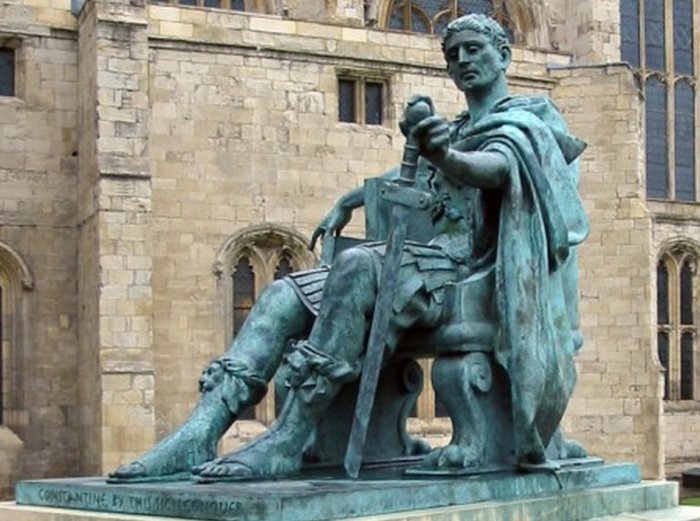
After the battle of Mulvian Bridge on October 27, 312 AD, Flavius Valerius Aurelius Constantinus became the emperor of Rome commonly known as Constantine the Great.
From a Christian perspective, his most outstanding merit was the legalization of Christianity. He also moved the imperial capital to Constantinople.
Ancient chronicles say that Emperor Constantine had a vision that God promised him a victory if his army portrayed the sign of the cross on their shields.
Fourth-century historian and bishop Eusebius of Caesarea wrote in "The Life of the Blessed Emperor Constantine" about Constantine's experience:
 The vision of Emperor Constantine. Credits: P. Rubens
"The emperor said that about the noon hour, when the day was already beginning to wane, he saw with his own eyes in the sky above the sun a cross composed of light, and that there was attached to it an inscription saying, "By this conquer." At the sight, he said, astonishment seized him and all the troops who were accompanying him on the journey and were observers of the miracle.
He said, moreover, that he doubted within himself what the import of this apparition could be, And while he continued to ponder and reason on its meaning, night suddenly came on; then in his sleep, the Christ of God appeared to him with the same sign which he had seen in the heavens and commanded him to make a likeness of that sign which he had seen in the heavens, and to use it as a safeguard in all engagements with his enemies.
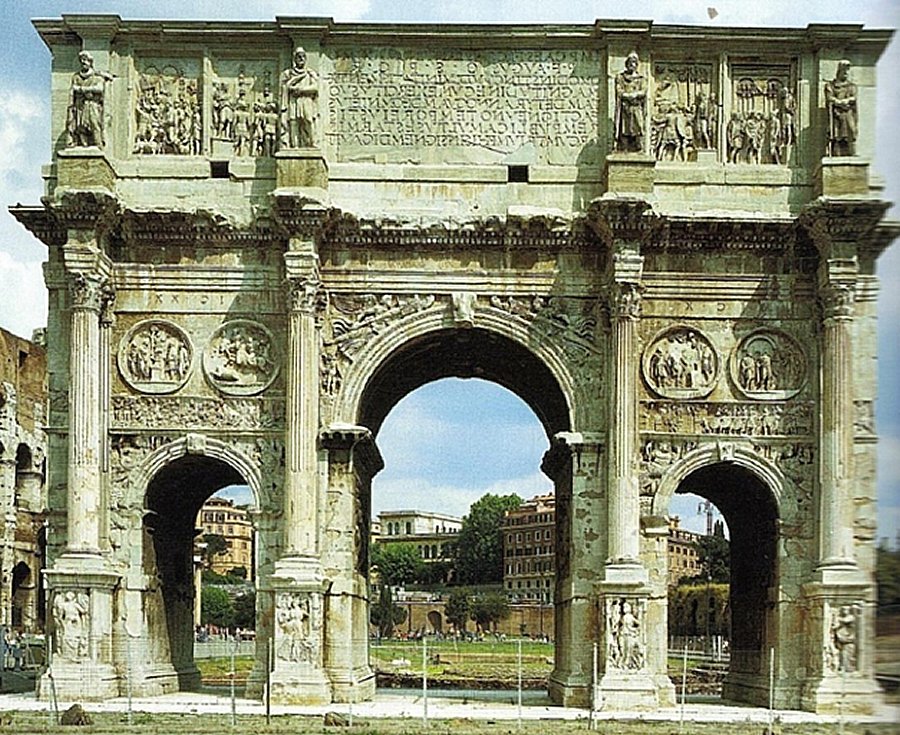
Arch of Constantine, Rome. Image credit: Alexander Z - CC BY-SA 3.0
At dawn of day, he arose and communicated the marvel to his friends; and then, calling together the workers in gold and precious stones, he sat in the midst of them and described to them the figure of the sign he had seen, bidding them represent it in gold and precious stones…"
Constantine did conquer Maxentius, and the battle marked the beginning of Constantine's conversion to Christianity. He also reformed the army, stabilized the economy in the empire, and introduced the solidus. This gold coin continued in the Byzantine Empire and remained used for a thousand years.
Impressive Arch of Constantine In Full Glory But Decorated With Old Reliefs
 Above: Battle of Ponte Milvio in 312 AD: Below: Siege of Verona 312 AD.
The monumental triumphal Arch of Constantine stands 21m high, 25.7m wide, and 7.4m deep. Undoubtedly, the structure is attributed to Constantine's divine inspiration, and this experience could help him win the battle.
However, the Arch does not display visible Christian symbols.
On the contrary, all reliefs that decorate the monument were taken from monuments made for earlier Roman emperors. These reliefs were once dedicated to other great emperors such as Trajan, Hadrian, and Marcus Aurelius, known for their best achievements dating to the 2nd century when the Roman Empire flourished.
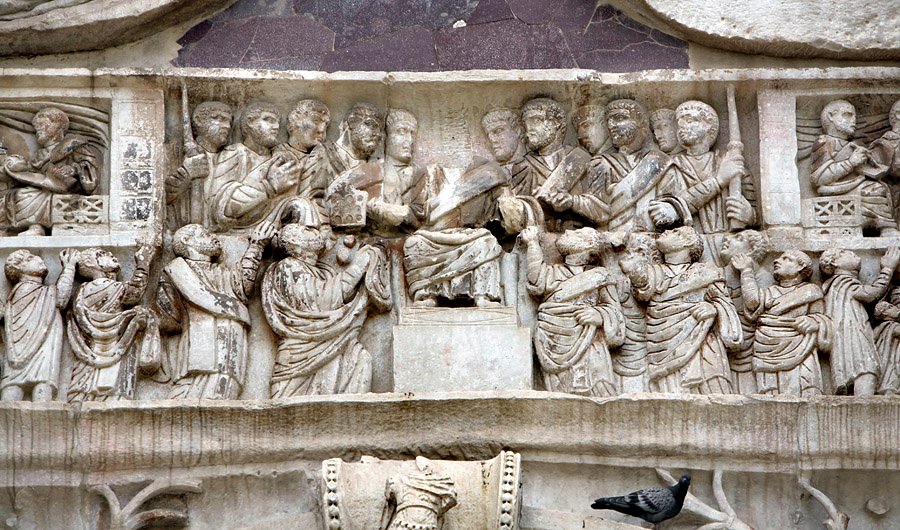
A detail of the northern frieze of the Arch of Constantine. This detail shows Constantine distributing gifts from his throne down to his supporters. Credits: commons.wikimedia.org/
Many historians have long wondered why new decorative elements are missing in the Arch of Constantine.
Was it because artists and builders did not have new fresh ideas to use, or was it better to keep the same older style to show that Constantine's status, legitimacy, and achievements were equal to some other the best Roman emperors?
Written by – A. Sutherland - AncientPages.com Senior Staff Writer
Updated on September 17, 2022
Copyright © AncientPages.com All rights reserved. This material may not be published, broadcast, rewritten or redistributed in whole or part without the express written permission of AncientPages.com
Expand for referencesMore From Ancient Pages
-
 Ancient Irish Games Hurling And Curling Were Forbidden In 1366 By The Englishmen
-
 On This Day In History: Maltese Rebellion Took Place – On Sep 8, 1775
-
 Longest European Burial Mound Pre-Dating The Egyptian Pyramids Discovered In Czechia
-
 Aqrabuamelu – Mysterious Scorpion Men In Babylonian Mythology
-
 Gigantic Unfinished Stone Structures Cut With Amazing Stone-Working Techniques
-
 On This Day In History: John Dee, English Mathematician, Occultist, Astrologer, Astronomer Was Born – On July 13, 1527
-
 Virginia’s Mysterious Vault With Remarkable Secret Ancient Documents Still Raises Many Questions
-
 8,000-Year-Old Petroglyphs Discovered In Oldest Impact Crater In South Africa
-
 Evidence Of Dual Mass Extinctions 260 Million Years Ago – Found
-
 Birka Artifacts Shed Light On Vikings’ Daily Life
-
 Mysterious 3,000-Year-Old Underwater Urartu Castle Discovered
-
 Ancient Monuments The World Is Not Allowed To See – Reason For Denial? – Part 1
-
 Greek Discovery Of Stone Tools In Megalopolis Area Pushes Back Greece’s Archaeological Record Up To 250,000 Years
-
 Spectacular Discovery – Scientists Decipher Previously Invisible Texts In Ancient Manuscripts
-
 Was The Tree Of Knowledge Perhaps The Hall Of Records? – A Mysterious Ancient Library Containing Forbidden Knowledge
-
 15,000-Year-Old Shell Beads Found Kebara Cave Are The Oldest Known Use Of Organic Red Pigments
-
 Medieval Burials Discovered Under London’s Westminster Abbey
-
 On This Day In History: George Plantagenet Privately Executed At The Tower Of London – On Feb 18, 1478
-
 How Did Ancient Civilizations Make Sense Of The Cosmos And What Did They Get Right?
-
 Mystery Of Paracelsus’s Magical Sword Azoth – Rumors Or Truth?

