
Eridu: Pre-Flood City That Belonged To Enki, God Of Creation, Intelligence, Wisdom And Magic
A. Sutherland - AncientPages.com - Modern city Abu Shahrain holds traces of one of the earliest and most sacred cities of the Sumerians – Eridu (E.RI.DU – ‘Home in the Faraway Built’).
According to legend, it was the first city ever established. An ancient Babylonian poem devoted to heroes from the past describes the rise of Eridu as a city:
".... A reed had not come forth,
A tree had not been created,
A house had not been made,
A city had not been made,
All the lands were sea,
Then Eridu was made..."
It was founded by and belonged to Enki, the mysterious god of deep wisdom and magic. Enki was in charge of Earth prior to the arrival of his brother Enlil who is said to have brought civilization to Sumer at this point, or just shortly before.
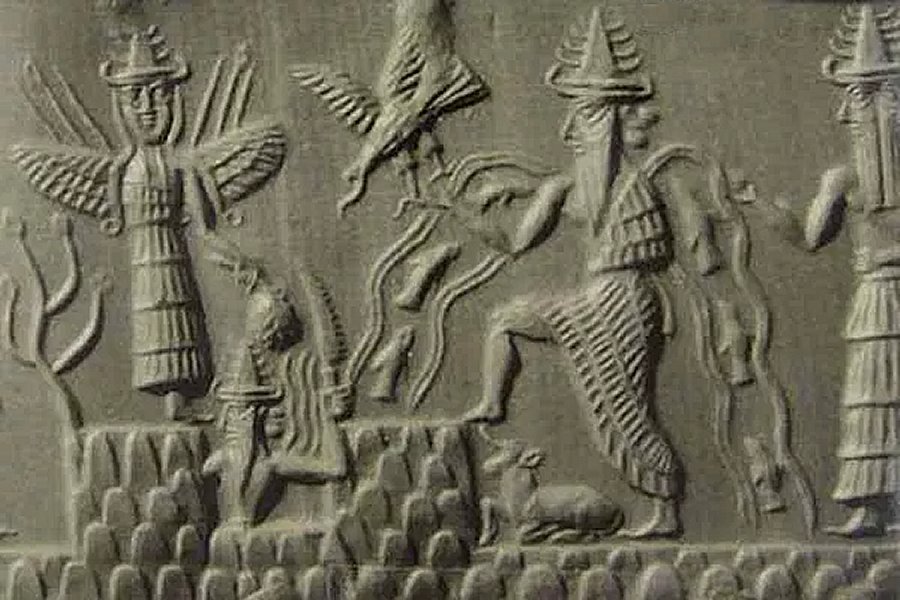
Enki depicted on Adda Seal (c. 2300 BC), Image credit: British Museum
Also known as ‘Eridug’ (‘mighty place’ or ‘guidance place’), Eridu was located in the desert south of the Euphrates, only 12 km southwest from Ur. Today, it is only a group of hills, covered with sand accompanied by a badly preserved ziggurat built by the son of Shulgi, Amar-Sin ('immortal moon-god') also known as Nanna, and the third king of the Ur Third Dynasty.
Any evidence of earlier inhabitation of Eridu cannot be unearthed because it had been swept away by the Flood.
Eridu was one of the five cities built before the Flood and according to the Sumerian king list, it was the first city to hold kingship.
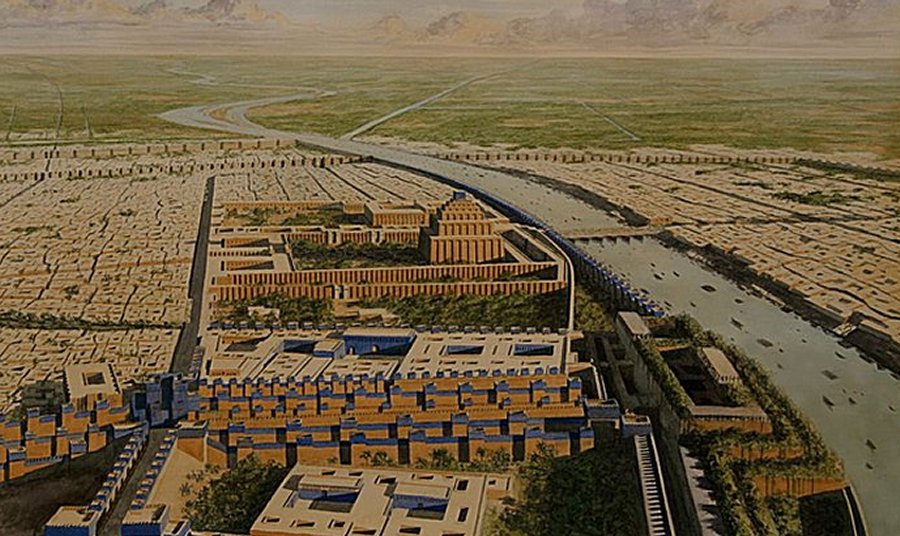
An impression of the Sumerian city of Eridu
Unlike the other cities of Sumer, Eridu was not built on sand and mud but in a valley in close vicinity of the Arabian Desert.
Using stone as a building material, made Eridu distinguished from all the other cities in Sumer. The raised platform, on which the city and its temple stood, was faced with a massive retaining wall of sandstone originating in neighboring quarries.
Undoubtedly, the city was once connected with the Persian Gulf, which is confirmed by cuneiform tablets describing Eridu as standing "on the shore of the sea".
In “The Lost Book of Enki” Zecharia Sitchin mentions Endubsar, master scribe, son of Eridu city, servant of the lord Enki, great god. Endubsar confirms that “in the seventh year after the Great Calamity, in the second month, on the seventeenth day, I was summoned by my master the Lord Enki, great god, the benevolent fashioner of Mankind, omnipotent and merciful.
I was among the remnants of Eridu who had escaped to the arid steppe just as the Evil Wind was nearing the city…”
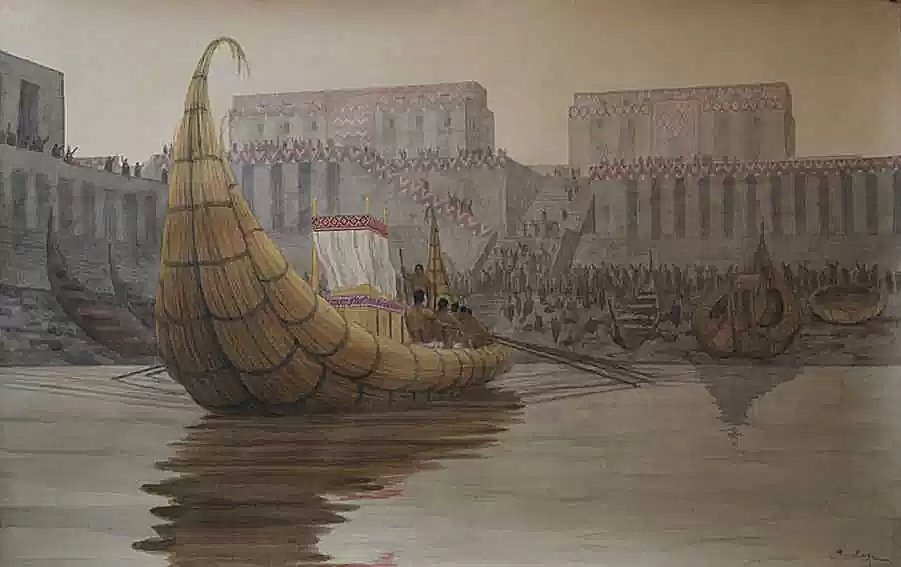
Reconstruction of Eridu
The most important part of the sacred city of Eridu – its urban core - was Enki’s temple ‘House of the Aquifer’ according to cuneiform: E2.ZU.AB; Sumerian: e-abzu. Later, his realm was called ‘House of the Waters’ (cuneiform: E.LAGAB×HAL; Sumerian: e-engur.
The king list says: "When the kingdom came down from heaven, the kingdom was in Eridu." It also says that the first kings of Eridu were indeed long-lived:
The first king of Eridu, and the first king of Sumer, was Alulim, who ruled for 28800 years; Alalngar ruled for 36000 years. 2 kings; they ruled for 64800 years. Then Eridu fell and the kingship was taken to Bad-tibira…”
The kingship continued at Bad-tibira ("Fortress of the Smiths"), identified as modern Tell al-Madineh, located in southern Iraq. It was also one of the pre-Flood cities in the Sumerian King List.
At present, the main ruins remaining from the Third Dynasty of the Ur dynasty occupy an area of about 300 x 400 meters. The oldest settlements date back 5500 years old. Earlier traces of the habitation disappeared in the Flood.
In ancient times, there was a sea line near Eridu and the city was a port situated in the freshwater bay. Currently, the coastline of the Persian Gulf is far more south and Eridu is in the desert.
The modern name of the city is Abu Shahrain.
Written by – A. Sutherland AncientPages.com Senior Staff Writer
Copyright © AncientPages.com All rights reserved. This material may not be published, broadcast, rewritten or redistributed in whole or part without the express written permission of AncientPages.com
Expand for referencesReferences:
Z. Sitchin, The Lost Book of Enki
R. J. Fischer, Historical Genesis: From Adam to Abraham
British Museum
More From Ancient Pages
-
 Remarkable Le Catillon II Hoard – World’s Largest Collection Of Celtic Coins And Jewellery
-
 Egypt’s Dendera Temple: Second Restoration Phase Is Now Completed
-
 Ehecatl: The Snake-Bird Deity And God Of Wind Feared And Respected By The Aztecs
-
 5,000-Year-Old Perga City And Kommagene Civilization: Most Of Treasures Are Still Underground
-
 New Insight Into The Intriguing Megalithic Carnac Stone Alignment
-
 2,000-Year-Old Stringed Instrument Found In Vietnam
-
 Secrets Of The Bible: Codex Zacynthius – Hidden Text In New Testament May Soon Be Uncovered
-
 Huge Ancient Ceramic Workshop With Hundreds Of Stunning Artifacts Solves An Archaeological Mystery In Israel
-
 A Ptolemaic Mummy Reveals Evidence Of Dental Filling Used In Ancient Egypt
-
 Hundreds Of Highly Unusual Burial Gifts Found In Special Viking Chamber Belonging To Woman In Norway
-
 Teeth Pendants And Prominent Status Of Elks In Stone Age – New Study
-
 Izanagi and Izanami And World Creation In Shinto Cosmology
-
 Powerful Thunderbird Sent By The Gods To Protect Humans From Evil In Native American Legends
-
 What Is The Link Between Drought And The ‘Barbarian Conspiracy’ In Roman Britain?
-
 Incredible Technology In Mysterious Huashan Caves, China
-
 Latvia’s Stone Age Cemetery Reveals Stone Goods’ Role In Burial Rituals Of Children, Women, And Men
-
 On This Day In History: American General Benedict Arnold Commits Treason – On Sep 21, 1780
-
 Is A Viking Settlement And Even Older Church Hidden Under St. Clement’s Church In Norway?
-
 Why The Discovery Of Cleopatra’s Tomb Would Rewrite History
-
 New Underwater Discoveries Made Around The Antikythera Shipwreck

