
Menes – Legendary First Monarch Probably Under Different Names Who Unified Egypt
A. Sutherland - AncientPages.com - The earliest rulers of the long-lasting civilization of Egypt were called "The followers of Horus." At the beginning of its long history, Egypt was united when an Upper Egyptian kingdom seized Lower Egypt in the north in the south.
The Upper Egyptian rulers called themselves "followers of Horus," and Horus became the tutelary deity of the unified country and its kings.

Left: Cartouche of Meni (Menes) from the Abydos King List in the temple of Seti I at Abydos. Right: Close-up view of Narmer on the Narmer Palette. Image credit: Wikipedia
According to legend and myth, in approximately 3100 BC, the king who made this unification possible was Menes. He was known by the ancient Egyptians as M'na (in Greek: Mên or Menes). It is assumed that he reigned from 30 to 60 years.
His name is similar to Minos in Greece, Manis in Phrygia, or Menu in India's history. Many modern scholars identified him with the archaic Egyptian kings, Horus Narmer of Naqada III (3200 to 3000 BC) and Horus Aha.
The Horus Name was the oldest part of the royal titular in ancient Egypt. It was a very important and powerful title with great symbolic meaning linking the king's earthly power with the divine power of the mighty celestial god Horus, the falcon.

Many researchers identify Narmer with the First Dynasty pharaoh Menes, who is also sometimes credited with the unification of Egypt, as the first pharaoh. This conclusion is based on the Narmer Palette, in which Narmer is shown as the unifier of Egypt. Image: Egyptian Museum, Cairo via Wikipedia
Priest and historian Manetho, who lived and worked during the Ptolemaic era in the early 3rd century BC, referred to him as 'Menes,' and Herodotus of Halicarnassus (c.480-c.429 BC) mentioned him as 'Min.'
According to tradition - not supported by the archeological record dated to the times of Menes – he was an important monarch always placed at the top of Egypt's dynastic lists, although there were no contemporary monuments or inscriptions referring to him.
Whether he was a legendary or real historical figure has not been determined yet.
Legendary Menes is credited with diverting the course of the Nile in Lower Egypt and founding a brand new administrative city located near the delta and the Nile Valley – 'Inbuhedj' (or 'White Walls').
This city, later known as Mennefer (Memphis), was one of the oldest and most important cities, situated 20 km (12 mi) south of Giza.
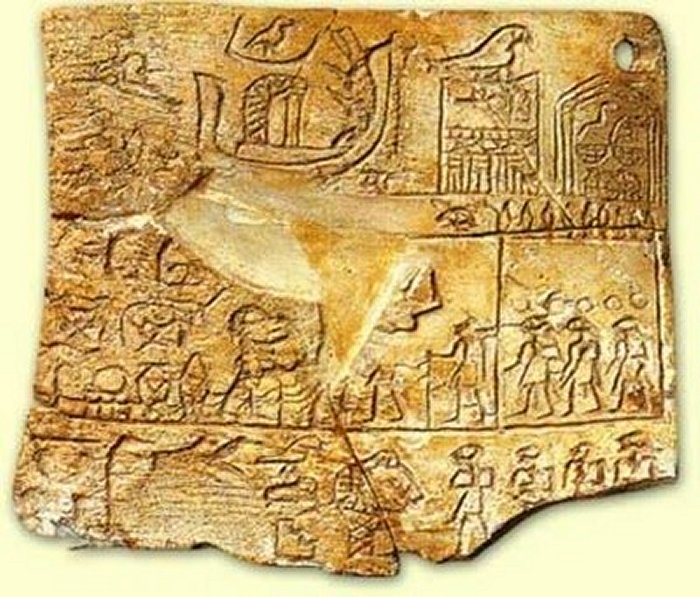
An ivory label found at Naqada shows Narmer's successor, Aha, and could imply that Aha may have been – Menes. Image via touregypt.net
At Memphis, he also founded the temple of Ptah, the divine Craftsman and Potter of the gods, identified by the Greeks as the blacksmith, Hephaestus (Vulcan).
This legendary king Menes who achieved all this, is not attested by archaeology. No object bearing his name or an image was found, but it is known that kings had several names.
Did Menes appear under a different name?
The Narmer palette we mentioned earlier could be proof that Narmer was Menes. The palette shows a King of Egypt wearing two crowns – of both Upper and Lower Egypt. The palette commemorates the victory, a significant historical event of the unification of the two lands in one. Also, an ivory label found at Naqada shows Narmer's successor, Aha, and could imply that Aha may have been – Menes.
Menes is, in fact, a mystery because he could also be Horus Aha or Narmer, as many researchers have suggested. Perhaps the figure of king Menes was based on the legendary victories of several kings, but what's most important is the first dynasty of Egyptian kings had begun.
Updated on June2, 2022
Written by – A. Sutherland AncientPages.com Staff Writer
Copyright © AncientPages.com All rights reserved. This material may not be published, broadcast, rewritten or redistributed in whole or part without the express written permission of AncientPages.com
Expand for referencesReferences:
W. M. Flinders Petrie, The Royal Tombs of the Earliest Dynasties
E. J. Sweeney, The Genesis of Israel and Egypt
More From Ancient Pages
-
 Huge Untouched Vassal King Tomb From The Ming Dynasty Discovered In Xinfu District, China
-
 Ancient Viking Age Music Recreated – This Is What It Sounds Like
-
 Are The Baffling La Marche Cave Paintings Authentic Or Cunning Forgeries?
-
 Dingoes Given ‘Almost-Human’ Status In Pre-Colonial Australia – Archaeological Study Finds
-
 Dozens Of Ancient Villages Discovered In British Columbia – The Pit Houses ‘Older Than The Pyramids’!
-
 Ancient Fossil Found In Sahara Suggests Loch Ness Monster Could Be Real
-
 First-Ever Discovery Of Roman Road Network Spanning The South West UK Made By LIDAR
-
 Human Activities In The Year 1300 Impacted Earth’s Atmosphere More Than Previously Known
-
 Genetic Links Between Traits Are Often Overstated – UCLA Study
-
 Polycarp Of Smyrna: Burned At The Stake And Pierced With A Dagger
-
 Three Ancient Tombs Of High-Ranking Officials Discovered In Luxor, Egypt
-
 Artifacts From King Henry VIII’s Warship The Mary Rose – Analyzed
-
 Sarcophagus Of Pharaoh Ramesses II Found In Abydos, Egypt
-
 Lhasa’s Potala Palace: Greatest Building In Tibet With History Of 1300 Years
-
 Was The Mysterious Powerful Viking Warrior Buried In A Ship In Scottish Highlands A Woman?
-
 1,800-Year-Old Entrance To Turkey’s Zerzevan Castle Found Among The Ruins
-
 On This Day In History: Gerardus Mercator Famous Mapmaker Of All Time Died – On Dec 2, 1594
-
 How King Arthur Became One Of The Most Pervasive Legends Of All Time
-
 Excavations Begin In Ancient City Of Antiocheia Ad Cragnum, Turkey
-
 Island Archaeology Could Be A Model For Space Exploration

