
Gnomon: Ancient Time Measuring Instrument Used By Babylonians, Egyptians And Chinese
A. Sutherland - AncientPages.com - A gnomon ("one that knows or examines") is the part of a sundial that casts a shadow.
The term has been used for many different purposes in mathematics, astronomy, and other fields. In the distant past, this vertical stick was called 'shadow stick,' but today, it is known as 'gnomon.'

A simple astronomic instrument, the 'gnomon' used to calculate the time, season, and so on) is composed of a vertical gnomon and a horizontal ruler. Image: Cultural China
It was probably the first device for indicating the time of day, dating from about 3500 BC. The length of the shadow this simple instrument cast gave an indication of the time of day.
Gnomon was known in Inca's Peru, megalithic Europe. In ancient China, the gnomon was a valuable instrument for astronomical observations throughout the centuries of Chinese civilization.
The instrument is mentioned in the 2nd-century' Nine Chapters on the Mathematical Art' as being used much earlier by the Duke of Zhou (11th century BC).
Pre-Socratic Greek philosopher Anaximander (610-546 BC) introduced the instrument to the Greeks. Greek mathematician (geometer) and astronomer, Oenopides (lived ca 450 BC) used the phrase drawn gnomon-wise to describe a line drawn vertically to another.
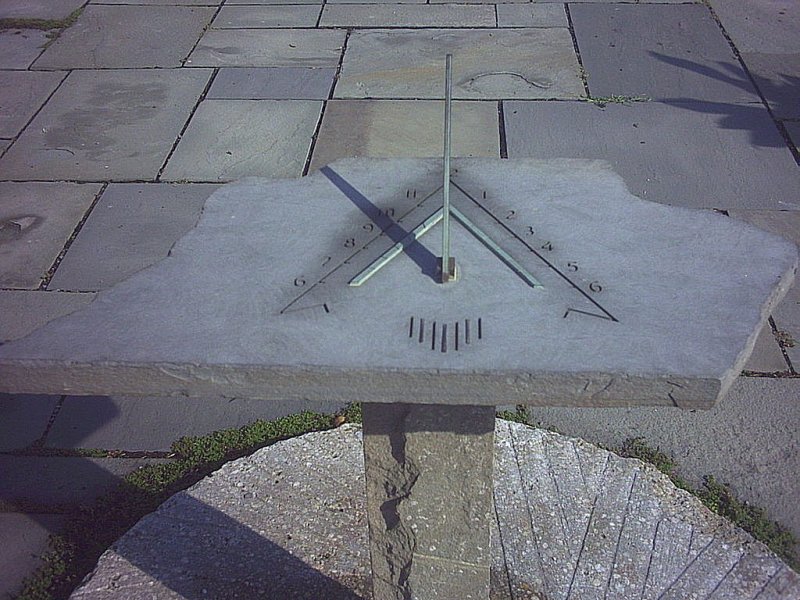
Garden sundial at 9:30am in the Robison Herb Garden, part of the F. R. Newman Arboretum at the Cornell University Plantations. Image credit: Gesslein - Public Domain
Hero of Alexandria defined the gnomon as a figure, when added to another figure, formed a similar figure to the original.
By the 8th century BC, more precise devices were in use.
At midday, the shadow of a stick is the shortest. This alignment was used by the civilizations of Mesopotamia, Egypt, and China as the North-South direction.
According to Egypt's hieroglyphic texts, an instrument was an L-shaped object with a short vertical arm and a long graduated horizontal arm, called 'setchat or merkhet' (device of knowledge.
Today, a three-dimensional gnomon is commonly used in CAD and computer graphics to aid in positioning objects in the virtual world.
Written by – A. Sutherland - AncientPages.com Senior Staff Writer
Updated on January 9, 2023
Copyright © AncientPages.com All rights reserved. This material may not be published, broadcast, rewritten or redistributed in whole or part without the express written permission of AncientPages.com
Expand for referencesMore From Ancient Pages
-
 Why Is A Biscuit Named After Giuseppe Garibaldi – Italy’s Military Leader And Hero?
-
 Beautiful Mosaic Dated To Graeco-Roman Times Discovered In Alexandria, Egypt
-
 Who Said ‘Eureka’ First And Why?
-
 Choctaw Indians’ Legend Of Nanih Waiya Cave Mound – Mysterious Underground Realm Of Their Ancestors And Their Battle With Giants
-
 On This Day In History: Favorite Ship Of King Henry VIII ‘Mary Rose’ Sank – On July 19, 1545
-
 Hyksos: Foreign Rulers Of Avaris Who Founded The Fifteenth Dynasty Of Egypt
-
 Magnificent Burial Chamber Of Idy, Ancient Egyptian Priestess Of Goddess Hathor Discovered In Asyut
-
 Secrets Of The Freemasons – Masonic Symbols Reveal Worship Of Ancient Mother Goddesses
-
 Stunning Colorful Ancient Roman Mosaic With Found Under Aldi Supermarket Site In UK
-
 Exceptionally Rare Medieval Loop For Hanging Keys Found Near Kamień Pomorski, Poland
-
 Red-Headed Alevi In Kurdistan Could Be Guardians Of Watchers’ Secret Knowledge And Shed Light On The Excalibur Legend
-
 Longstanding Cultural Continuity At Oldest Occupied Site In West Africa – New Study
-
 Why Was The Dmanisis Gora Fortress Community So Resilient In The Transition From The Bronze To Iron Age
-
 Ancient Stone Ram Figurine – Symbol Of Abundance And Great Courage – Unearthed In Old Cemetery
-
 Illinois’s Mazon Creek: Recreating 300-Million Year-Old Ecosystem – Fossil Preservation And Diversity Of Life
-
 Possible Viking Boat Burials Discovered On The Isle Of Mull
-
 3.2 Million-Year-Old ‘Lucy’ Could Walk On Two Legs – First Hominin Muscle Reconstruction
-
 10 Remarkable Jain Temples – Marvelous Ancient Architecture And Stone Carvings
-
 A Presently Submerged Land Bridge Could Help Early Human Move From Turkiye To Europe
-
 On This Day In History: HMS Challenger Begins Scientific Exploration Of Oceans – On Dec 21, 1872

