
Glory And Fall Of Babylon Dedicated To The Cult Of Marduk
A. Sutherland - AncientPages.com - More than a thousand years, Babylon (in Akkadian "Babilim" means "Gate of God") was the symbol of power, greatness, and destruction.
For over one thousand years, Babylon was also the center of worship of the god Marduk.
The ruins of the city (the canal system, gardens, walls, and the remains of some temples) are located approximately 80 kilometers south of Baghdad on the east bank of the Euphrates River.
 A mural near the reconstructed Ishtar Gate shows the palace quarter during the early 600s BC. The ice gate is visible in the upper left corner of the image. Image credit: photo CM, Iraq - CC BY-SA 3.0
One of the most prominent buildings of Babylon was the ziggurat Etemenanki, which means "temple of the foundation of heaven and earth").
The structure - initially Etemenanki was 91 high - was dedicated to Marduk in the city of Babylon of the 6th century BC Neo-Babylonian dynasty. Etemenanki may have been an inspiration for the biblical story of the Tower of Babel.
In ancient times, Babylon was considered almost the “center of the world”. Even, Alexander the Great was charmed by its beauty and power. One day, Babylon became the capital of his gigantic empire and became a place where he died.
In 331 BC, Alexander the Great captured Babylon and ordered repairs to the Etemenanki but he noticed no progress in repairs when he returned to Babylon in 323 BC. On Alexander’s orders, his army destroyed the entire Etemenanki to prepare a final rebuilding.
It never happened, Alexander the Great died in Babylon.
For the ancient people, Babylon was the "sacred city" dedicated to the cult of Marduk, who had there his temple and a golden statue, which unfortunately was looted several times by attacking Hittites, Elamites, Assyrians.
The first historical records that mention Babylon date back to c. 23rd century BC and the reign of Sargon of Akkad and c. 1900 BC, Babylon was occupied by Amorites.
However, the most famous ruler of Babylon was Hammurabi, the sixth king of the First Babylonian Dynasty, reigning from 1792 BC to 1750 BC and famous for his code, known as the Code of Hammurabi.
Hammurabi made Babylon the center of his kingdom, as the capital with flourishing trade and economy, and the power center of worship.
Babylon lost its independence many times and was destroyed by its conquerors. Somehow, the city could still recover and be stronger and stronger, with the help of Nebuchadnezzar II, a Chaldean king of the Neo-Babylonian Empire, who reigned c. 605 BC – c. 562 BC and constructed the Hanging Gardens of Babylon but unfortunately, also destroyed the temple of Jerusalem.
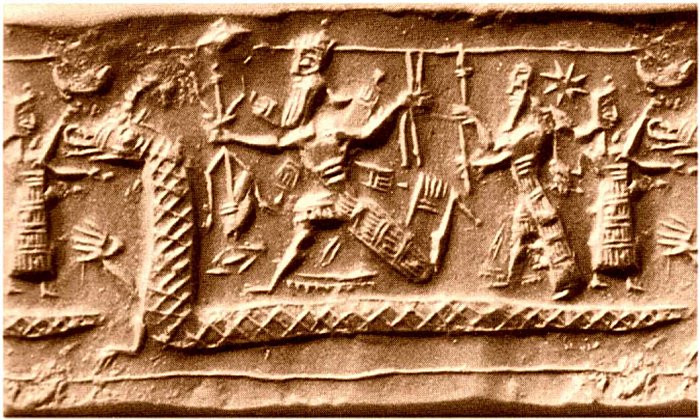
Cylinder closure that possibly depicts Marduk's battle with Tiamat. image credit: Ben Pirard - CC BY-SA 3.0
One day Babylon’s glorious times had to end.
In 539 BC, the Neo-Babylonian Empire fell to Cyrus the Great, king of Persia but under Persian rule, the town still flourished; it became a center of learning and science. In Achaemenid Persia, the ancient Babylonian arts of astronomy and mathematics were revitalized, and Babylonian scholars completed maps of constellations.
The city became the administrative capital of the Persian Empire and remained very important for more than two centuries.
"... the new monarchs of the realm chose not to locate their capital in Babylon but were content to rule from their original homeland, which meant from Pasagard, from Ecbatana (modern Hamadan), from Persepolis (modern Takht-e-Jamshid), and from Susa (modern Shush), former chief city of Mesopotamia’s ancient enemy Elam. Somehow Babylon had lost its overwhelmingly glamorous allure.
"Can we say then that it is here that we have reached the end of Mesopotamian civilization? Not really. A tradition more than 2,000 years old does not vanish overnight, in a year, in a decade, or even in a single century. For a long time yet, among the many peoples of what had been the Neo-Babylonian Empire, business would continue to prosper, the gods would continue to be served and lauded, the heavens continue to be observed, the omens to be read, the ancient texts to be studied, and the cities to be thronged by multinational, multilingual, multicultural crowds of Anatolians, Egyptians, Greeks, Judaeans, Persians, and Syrians. Though Mesopotamia was reduced to the status of a mere province – albeit retaining the still prestigious name Assyria – in an empire that now extended over four million square miles, the Persians never made any attempt to substitute their own traditions for those of their provincial subjects." 1
The Persian kings made several attempts to protect religious ceremonies in the city of Babylon but, the Babylonian people protested against the Persian dominance. The walls of Babylon and the ziggurat Etemenanki were destroyed and the golden statue of Marduk – disappeared. Then, Alexander the Great became the ruler of Babylon, who as we mentioned earlier, tried to restore the city’s glory. He never did it because he died in Babylon.
According to a tablet dated 275 BC, the inhabitants of Babylon were deported to Seleucia, and thus, Babylon became insignificant as a city.
Written by A. Sutherland AncientPages.com Staff Writer
Copyright © AncientPages.com All rights reserved. This material may not be published, broadcast, rewritten or redistributed in whole or part without the express written permission of AncientPages.com
Expand for referencesReferences:
- P.Krivaczek, Babylon, Mesopotamia and the Birth of Civilization (pp. 276-277).
G.S. Goodspeed, History of Babylonians and Assyrians
More From Ancient Pages
-
 Vikings: Facts And History About The Tough Norse Seafaring People
-
 Rare Ancient Boomerang Collection Sheds New Light On Australia’s Past
-
 Traces Of An Unknown Ancient Race Of Winged Beings And Other Mysterious Creatures Discovered In Japan
-
 Humans In Africa Fled To The Mountains During The Last Ice Age
-
 8,000-Year-Old Petroglyphs Discovered In Oldest Impact Crater In South Africa
-
 On This Day In History: Battle Of Marathon Was Fought – On Sep 12, 490 BC
-
 Mysterious 2,800-Year-Old Channel Installation Discovered In The City Of David, Jerusalem
-
 Egyptian ‘Golden Boy’ Mummy Was Protected By 49 Precious Amulets On His Journey To The Afterlife – CT Scans Reveal
-
 Pazyryk Carpet: Extraordinary Craftsmanship Of Siberian Iron Age Textile Dyers
-
 Aboriginals Inhabited South Australia 29,000 Years Ago – New Study
-
 Tomb of Patriarchs In Hebron Was Used And Visited By Pilgrims 2,700 Years Ago – New Study
-
 Trentren And Caicai: The Battling Serpents Of Chilote Mythology
-
 Coca-Cola Was Invented As A Cure For Headache And Hangover In The 1880s
-
 On This Day In History: Battle Of Svolder One Of Greatest Battles of Viking Scandinavia Was Fought – On Sep 9, 1000
-
 Gold Spiral In Early Bronze Age Grave – Unearthed
-
 Two Inca Measurement Systems Calculated By Polish Architect
-
 Mystery Of The Real Sword: How Did A Meter Long Sword End Up In Solid Rock?
-
 Mystery Of Egyptian Tomb 10A And The Mummy’s Head – A 4,000-Year-Old Crime
-
 Incredibly Rare Iron Age Wooden Objects Discovered In 2,000-Year-Old Waterlogged Site In The UK
-
 Ife Head: Significance Of The Head ‘Ori’ In Yoruba Ancient And Present Beliefs

