
Colossi Of Memnon: Gigantic Stone Statues Guarding The Temple Of Pharaoh Amenhotep III
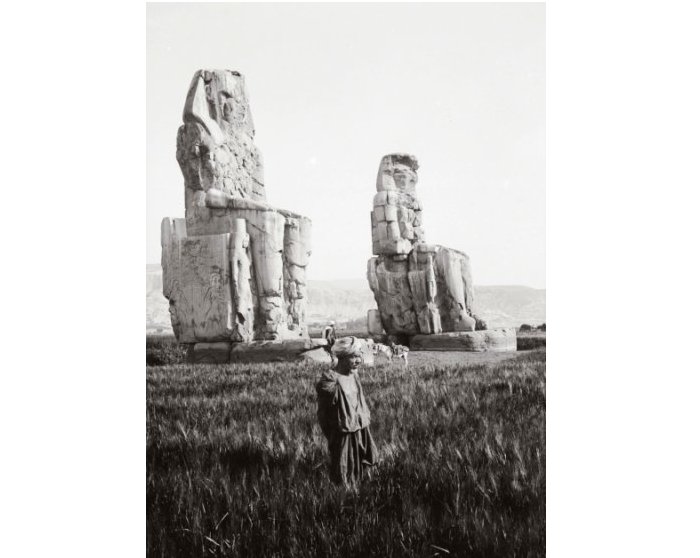
AncientPages.com - For the last 3,400 years, since 1350 B.C. two gigantic stone statues known as the Colossi of Memnon have been guarding the temple of Pharaoh Amenhotep III, who was worshiped as a god-on-earth both before and after his departure from this world.
The massive statues, each about 20 meters high resemble Amenhotep III himself. They got their name after one of the statues, the right one to the north was damaged in an earthquake.

However, these are not the only massive statues of Pharaoh Amenhotep! In 2014, archaeologists unearthed two more statues of the pharaoh. The new statues of the pharaoh join a pair of already famous giants at the temple known as the Colossi of Memnon - two 16-meter-high images of King Amenhotep III seated on his throne, also made of quartzite.
Strabo, a Greek historian and geographer of the 1st century recorded an earthquake in 27 BC that shattered the northern colossus, causing the upper section to fall away. For some reason, after it was damaged, the statue would emit strange sounds in the morning, possibly related to the heat of the Sun.
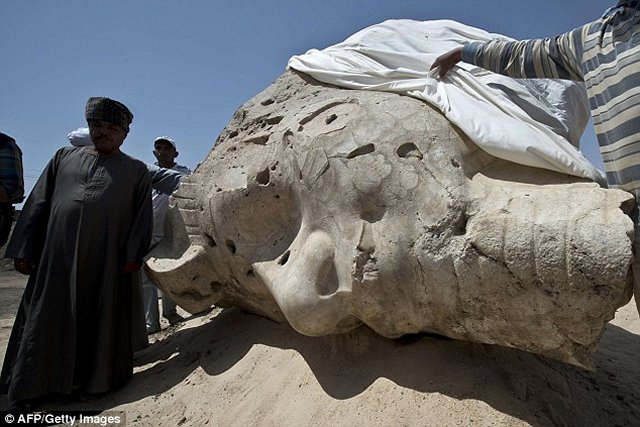
Archaeologists also discovered the alabaster head from another Amenhotep III statue.
Ancient Greeks tried to find an explanation for the sound and looked to the story of Memnon by Homer.
Memnon was a hero of the Trojan War, a King of Ethiopia who led his armies from Africa into Asia Minor to help defend the beleaguered city but was ultimately slain by Achilles.
However, the damage to the statue created a fissure in the rock which made it "sing" or "whistle" every morning at dawn. It is thought that this was caused by the evaporation of dew inside the porous rock, but the sounds led to the birth of the legend of the "Vocal Memnon.
According to the legend, hearing the sound brought good luck and it was believed that the statue was an oracle. When this became known, known outside of Egypt, and a constant stream of visitors, including several Roman Emperors, came to marvel at the statues.
The last recorded reliable mention of the sound dates from 196. Later in the Roman era, the upper tiers of sandstone were added and the sound vanished.
See also:
Mysterious Enormous Underground Labyrinth Of Egypt Holds Secrets Kept From The Outside World
Palermo Stone: Oldest History Book Of Ancient Egypt
Not only are the statues very high, they are also very heavy. Each of the statues weighs around 700 tons. They are made from blocks of quartzite sandstone which were quarried at el-Gabal el-Ahmar (near modern-day Cairo) and transported 675 km (420 mi) overland to Thebes (Luxor).
The temple of Pharaoh Amenhotep III is today completely destroyed. It was first ruined by floodwaters and later cannibalized for its stone. Both statues are damaged as well, lacking their faces and tall royal crowns. Yet, these ancient statues are still very impressive and their presence attests to the greatness of our ancestors. Ancient Egypt simply refuses to be forgotten.
Copyright © AncientPages.com All rights reserved. This material may not be published, broadcast, rewritten or redistributed in whole or part without the express written permission of AncientPages.com
More From Ancient Pages
-
 Invisible Ink On Antique Nile Papyrus From The Island Of Elephantine – Revealed
-
 Ancient Petroglyphs In Toro Muerto Are Not What We Thought – Archaeologists Say
-
 Hundreds Of Undiscovered Roman Forts Revealed By Spy Satellites
-
 Lifestyle And Face Of 7th-Century Anglo-Saxon Teen – Reconstructed
-
 Archaeological Finds Shed New Light On The Paleo Diet Habits Of Ancient Hunter-Gatherers
-
 Aboriginal Creation Story Of Marala Was True – World’s Largest Dinosaur Footprints Confirm Ancient Creation Myth
-
 Ancient Secrets Of Mistletoe – Sacred Celtic Plant With Magical Powers
-
 Ancient Roman Coffin Found In Leeds Revealed To The Public For The First Time
-
 Oldest Human Genome From The Iberian Peninsula Helps Reconstructing Human History
-
 Ancient Oral History Of Lake Babine First Nation Confirmed By Archaeologists
-
 Researchers Use 21st Century Methods To Record 2,000 Years Of Ancient Graffiti In Egypt
-
 Sculpture Of Lord Vishnu Dated To The Early 9th Century Found In Kashmir
-
 5,000-Year-Old Arminghall Henge In Norwich Reveals Some Of Its Secrets
-
 What Can Grinding Stones Reveal About Europe’s Earliest Neolithic Communities?
-
 Unraveling The Secret History Of King Arthur And Robin Hood
-
 Fragarach: Supernatural Sword That Controlled Winds, Cut Through Wood, Metal And Bricks In Irish Myths And Legends
-
 7 Magnificent Thracian Gold Bracelets Found In Romanian Forest By Amateur Archaeologist
-
 On This Day In History: Vädersol Painting Depicting ‘Sun Dog’ Phenomenon Observed Over Stockholm – On Apr 20, 1535
-
 Discovery Of Second Viking Site Point Rosee In North America Could Re-Write Ancient History
-
 Nazi Photo Album Made Of Human Skin Found At Polish Antiques Market

