
Mystery Of The Brave Viking Chief Buried On The Gokstad Ship
A. Sutherland - AncientPages.com - In 1880, archaeologists discovered a Viking grave in Norway. Scientists examined the burial site, but fear of moisture led to the decision that the grave should be closed.
Everyone agreed that the corpse of a brave Viking warrior who met a brutal death should be left in peace, at least for now.
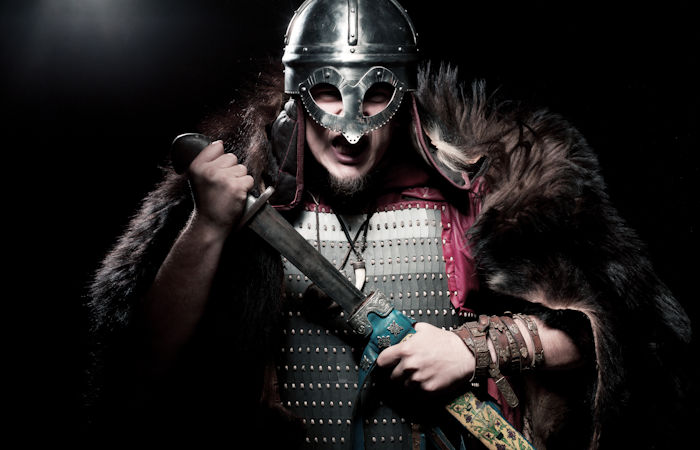
The identity of the Gokstad Viking Chief remains a mystery. Credit: Adobe Stock - Studio Kwadrat
In 2007, scientists re-opened the grave and examined the body. Now, we can finally learn more about the man who became known as one of the most famous Vikings in Norway – the Gokstad Viking Chief and his remarkable ship.
The Discovery Of The Gokstad Viking Ship And The Viking Chief
There was a large burial mound on the Gokstad farm in Sandefjord, Norway.
The Gokstad ship was accidentally discovered by two curious young boys who began to dig into the mound to see if they could find anything interesting. What they found caused a sensation in Norway. Onboard the ship was a dead man. He was fully dressed and surrounded by several ancient artifacts, such as a bronze kettle, runic inscriptions, a gameboard, and a sleigh.
It soon became apparent that, about 900 A.D., a rich and powerful man died, and the Gokstad ship was used for his burial.
A burial chamber was built at the stern of the ship. It was covered with several layers of birch bark. Stuck between the roof joists, archaeologists found scraps of silk interwoven with gold thread. These are probably the remains of costly woven hangings that decorated the walls on the inside. In the burial chamber stood a raised bed on which the corpse was laid.
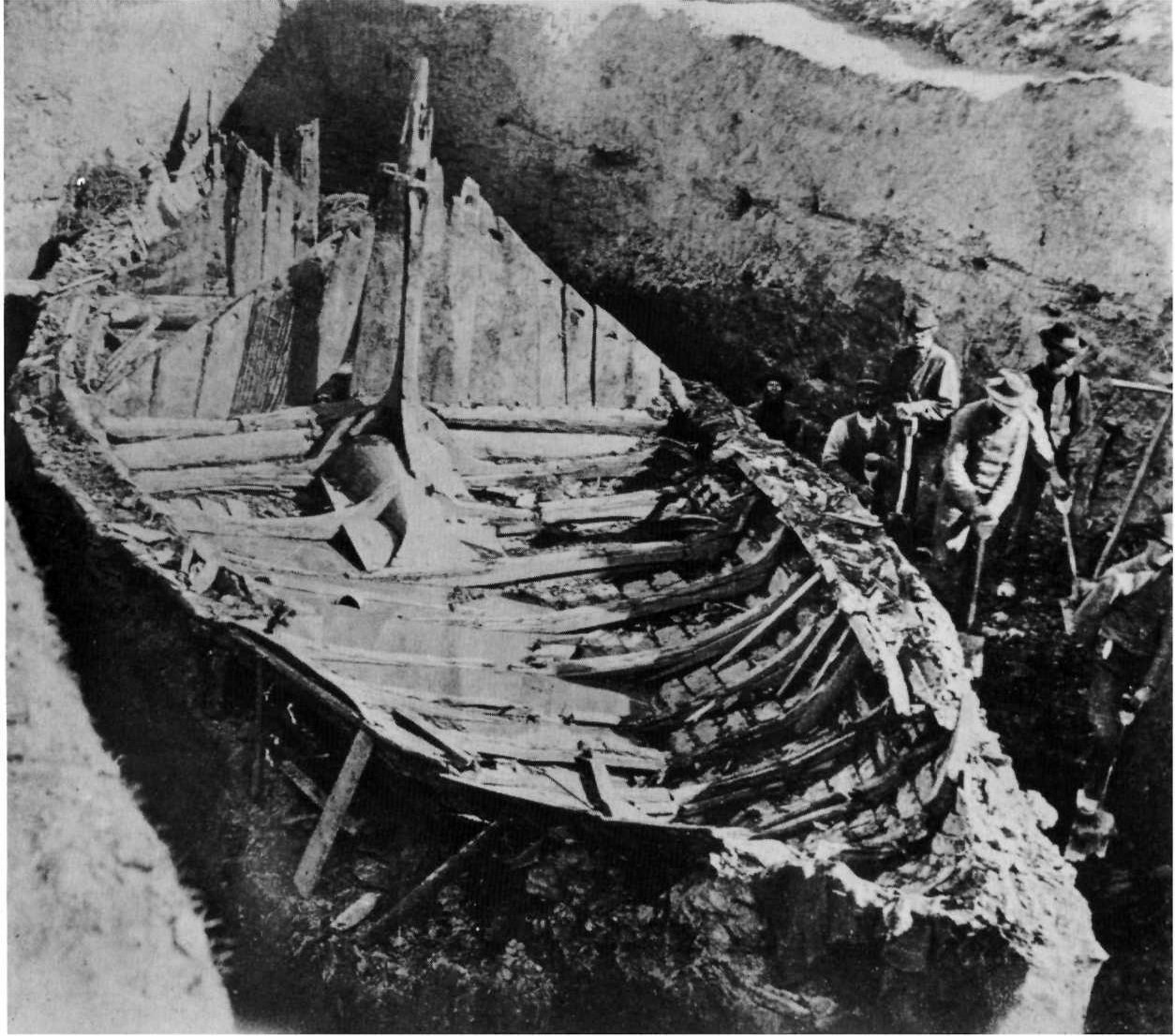
The Gokstad Viking ship in 1880 when it was discovered. Credit: Public Domain
Archaeologists examined the site and concluded that the ship had been built with turf and sod. The Gokstad ship was built in about 850, at the height of the Viking period. In those days, there was a need for vessels that could serve many purposes. The Gokstad ship could have been used for voyages of exploration, trade, and Viking raids. It could be both sailed and rowed. There are 16 oar holes on each side of the ship. With rowers, steersman, and lookout, that would have meant a crew of 34.
The Gokstad ship was about five meters high and had a diameter of almost 45 meters. The mound was most likely even more extensive in Viking times. The boat itself was buried in the clay below ground level, and its discovery was, without a doubt, one of the most significant archaeological discoveries in the history of Norway. Never before had an impressive, almost intact Viking ship of this kind been unearthed elsewhere in the country. After proper excavation, the ship was restored. Everything was taken apart, steamed, and bent back into its original shape. Some of the original timber was in too poor a condition to be exposed to this treatment.
These parts were replaced with new wood, and today the Gokstad Viking ship can be admired at the Viking Ship Museum in Oslo, Norway, where it stands next to another impressive Viking ship known as the Oseberg ship. The Oseberg ship was discovered in 1904, along with two female skeletons.
Problems With The Remains Of The Viking
For some time, scientists were uncertain how to proceed with the remains of the deceased Viking aboard the Gokstad ship. Many researchers wanted to examine the body and learn as much as possible. However, some researchers believed the bones should be respected and re-buried.
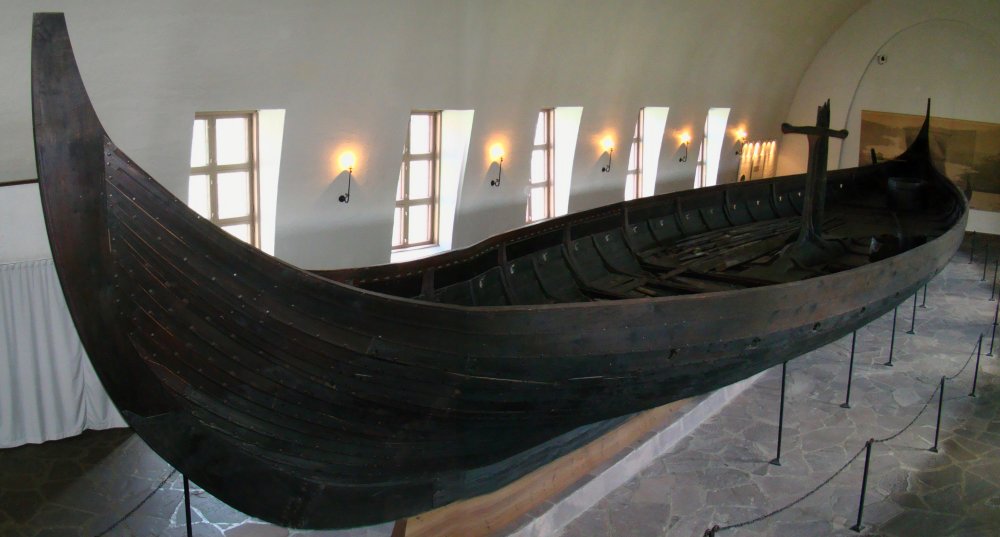
The Gokstad Viking ship is currently at the Viking Ship Museum in Oslo. Credit: Bjørn Christian Tørrissen - CC BY 3.0
The result was a compromise. Researchers collected as much material as possible, and the Viking was re-buried.
The Viking Chief Met A Brutal Death
In 2007, scientists re-opened the grave and examined the body. Analysis of the corpse revealed the skeleton belonged to a man in his 40s. He was a muscular and large man between 181 and 183 cm tall. A cut to the right shinbone shows that he would not have been able to stand upright, but a knife wound to the inside of the right thigh indicates the probable cause of death. Signs of cutting blows to both legs mean that he died in battle. Striking at the legs was a common fighting technique in Viking times and the middle ages.
The dead man must have been shrouded in a sewn-up costume when he was buried.
Further analysis showed that at least three weapons were used to kill the Viking chief. It indicates that he encountered several men in battle before he died. He met a gruesome and brutal death. But why he had been killed remained a mystery.'
Was The Gokstad Viking Chief A Warrior Of Harald Fairhair – The First King Of Norway?
Who was the Gokstad Viking chief? His burial revealed that he must have been a man of great importance. Still, his identity remained a mystery.
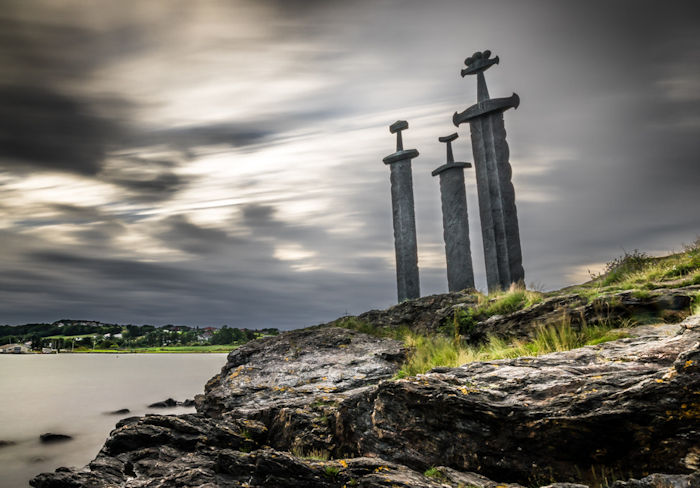
Sverd in Fjell monument was created to commemorate the Battle of Hafrsfjord in 872. Credit: Giuseppe Milo - CC BY 3.0
We know that around 900 A.D. when the unidentified Viking Chief died, King Harald Fairhair (Norwegian: Harald Hårfagre) struggled to unify Norway. This unification was by no means a simple process. Vikings in the southwest of Norway made resistance and received support from their relatives in Scotland. Allying with King Athelstan (r. 924-39) of England, Harald Fairhair organized several invasions on Scotland. It was not until the Battle of Hafrsfjord in 872 that King Harald Fairhair finally crushed the opposition from Norway's southwestern portion. Winning the Battle of Hafrsfjord resulted in King Harald I of Norway's declaration to become the sole ruler of Norway.
Somehow, the mysterious Gokstad Viking chief must have been involved in all these events. Why was he killed? Another option is that the opposition to King Harald Fairhair killed him. It is also possible that unknown men, like thieves, murdered him.
We may never know the true story of the Gokstad Viking chief, but even without a proper name and identity, he has become one of the most famous Norwegian Vikings.
Written by – A. Sutherland - AncientPages.com Senior Staff Writer
Updated on November 29, 2022
Copyright © AncientPages.com All rights reserved. This material may not be published, broadcast, rewritten or redistributed in whole or part without the express written permission of AncientPages.com
Expand for referencesReferences:
N. Nicolaysen: Viking Ship Discovered at Gokstad in Norway, Gregg Publishing 1972
More From Ancient Pages
-
 Tooth Analysis Sheds Light On South Australia’s Early Colonial History
-
 Prehistoric Evidence Of Sophisticated Prosthetics In Ancient Egypt – Artificial Toes Helped Egyptians Walk
-
 First Peoples’ Early Migration To Australia – Influenced By Evolving Landscapes
-
 On This Day In History: Aztec Calendar Stone Rediscovered – On Dec 17, 1790
-
 Clovis Culture: Will Ancient Tools Solve Mystery Of North America’s Earliest Inhabitants?
-
 Oldest Aqueduct Dated To 3rd Century BC Discovered In Rome
-
 Humans Used Shells As Body Ornaments 30,000 Years Ago – Discovery In Malaga’s Cueva de Ardales Reveals
-
 Remains Of 1,600-Year-Old Roman City Of Neapolis Devastated By A Tsunami Discovered
-
 Ancient Treasure Hidden In Perplexing Secret Underground Labyrinth In France – Discovery And Forbidden Excavations – Part 2
-
 Mysterious And Frightening Sculptor’s Cave Of The Picts Reconstructed In 3D Model
-
 Monte d’Accoddi – Mesopotamian Ziggurat In Europe Built By King Of Uruk?
-
 On This Day In History: A Solar Eclipse Occurs, As Predicted By Thales Of Miletus – On May 28, 585 BC
-
 Stunning Ancient Roman Artifacts And Three Shipwrecks Discovered Underwater Off The Coast Off Alexandria, Egypt
-
 Was Mysterious 2,000-Year-Old Miniature Clay Token Used By Pilgrims Arriving To The Temple In Jerusalem?
-
 More Than 10,000 Pre-Columbian Earthworks Remain Hidden Throughout Amazonian Forests
-
 Millennia Old Ceremonial Stone Belt And Maya Pok-A-Tok Ball Game
-
 3D Scans Used To Study Mysterious Roman Burial Practice
-
 Atlatl Weapon Use By Prehistoric Females Equalized The Division Of Labor While Hunting – Study Shows
-
 Aqrabuamelu – Mysterious Scorpion Men In Babylonian Mythology
-
 Caligula: The Sole Roman Emperor Associated With The Plant Hellebore And The Ancient Greek Town Of Antikyra

