
Strange History Of Safety Coffins: From Ancient To Modern Times
A. Sutherland - AncientPages.com - The fear of being buried alive has been a constant companion of humankind for as long as anyone can remember. As bizarre as it might sound, certain variations of safety coffins designed during the 18th and 19th centuries are still in practice today.
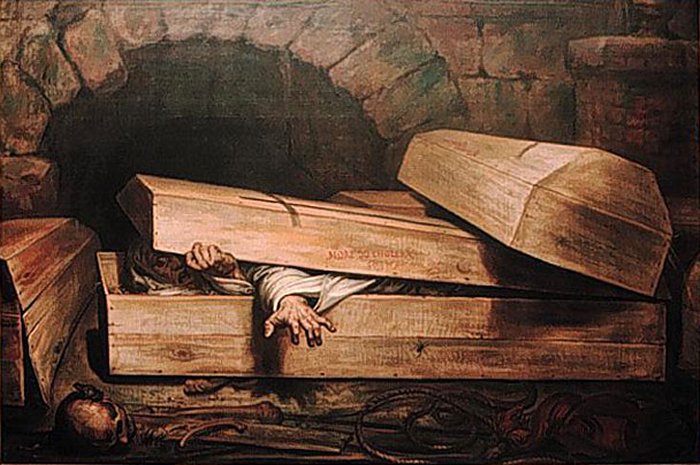
The recovery of supposedly dead victims of cholera, as depicted in The Premature Burial by Antoine Wiertz, fuelled the demand for safety coffins. Image credit: - source - Public Domain
Taphophobia is the medical term for fear of being buried alive due to being incorrectly pronounced dead.
Taphophobia can be justified due to the number of cases of people being buried alive by accident. In 1905, the English reformer William Tebb collected accounts of premature burial. He found 219 cases of near-live burial, 149 actual live burials, 10 cases of live dissection, and 2 cases of awakening while embalmed. Of course, Edgar Allan Poe's novel The Premature Burial, published in 1844, resulted in even greater fear, mainly since the book contained accounts of supposedly genuine cases of premature burial.
Therefore, it's not a surprise people feared coffins and graves.
During the 18th and 19th centuries, many safety coffins were patented. Many sarcophagi were fitted with a mechanism to allow the occupant to signal that they had been buried alive.
The first recorded safety coffin was constructed on the orders of Duke Ferdinand of Brunswick before he died in 1792. The Duke demanded to have a window installed to allow light in and an air tube to supply fresh air, and instead of having the lid nailed down, he had a lock fitted. In a unique pocket of his shroud, he had two keys, one for the coffin lid and a second for the tomb door.
The trouble with many designed safety coffins was that they included ladders, escape hatches, and even feeding tubes, but their creators forgot to implement a method for providing air.
In 1798, P.G. Pessler, a German priest, suggested that all coffins must have a tube inserted from which a cord would run to the church bells. If an individual had been buried alive, he could draw attention to himself by ringing the bells.
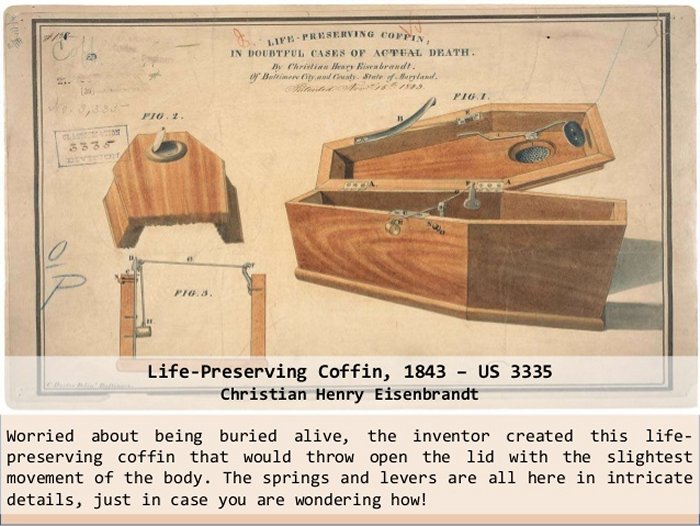
Pessler's colleague, Pastor Beck, suggested that coffins should have a small trumpet-like tube attached. Each day, the local priest could check the state of putrefaction of the corpse by sniffing the odors emanating from the box. If no smell was detected or the priest heard cries for help, the coffin could be dug up and the occupant rescued.
In 1822, Dr. Adolf Gutsmuth wanted to demonstrate his ingenious safety coffins. He was buried alive, stayed underground for several hours, and even ate a meal delivered to him through the coffin's feeding tube.
Improvement of safety coffins and their mechanism continued. In 1829, Dr. Johann Gottfried Taberger designed a system using a bell that would alert the cemetery night watchman.
In 1900, Walter McKnight of Buffalo, NY, patented an all-electric device for "indicating the awakening of persons buried alive." In addition to the usual air pipe to the surface, a giant electromagnet (solenoid) pulled up a cap on the air pipe when the movement of the corpse's hands closed a switch. An electric bell was mounted outside the enclosure.
A telegraphic grave signal device was patented in 1901 by Monroe Griffith of Sioux Falls, IA. In addition to the wiring of hands and feet to signal awakening and movement of the corpse switches under the corpse would close if grave robbers lifted the body. Rather than a buzzer above the grave, the wires lead to a central office such as "the home of the cemetery sexton or police station."
In 1908, George Willems of Roanoke, IL, patented a grave attachment that consisted of a pipe at the foot of the coffin leading to the surface, with an adjustable mirror at each end and a remote-controlled flashlight. The idea was to observe the corpse for several days after burial.
1913 brought a more sophisticated device for detecting a corpse "in hospitals, morgues, crematories, at bathing beaches and on ocean-going steamers." Peter Backus, of Delphos, OH, was the inventor. The elaborate apparatus consisted of a motor-driven vacuum pump, electric heaters, a telephone monitor, and a unique stretcher in a sealed casket. Presumably, a professional operated this apparatus and performed tests for residual life in the corpse.
As late as 1983, Fernand Gauchard of France patented a coffin life detector. The device used electrical relays and included a vacuum pump but still relied on the old standby of detecting body movement to trigger the alarm.
In 1995, a modern safety coffin was patented by Fabrizio Caselli. His design included an emergency alarm, an intercom system, a torch (flashlight), a breathing apparatus, a heart monitor, and a stimulator.
It is believed that the phrases "saved by the bell," "dead ringer," and "graveyard shift" come from the use of safety coffins in the Victorian era.
The fear of being buried alive is still with us today. However, it is interesting to note that no documented cases of anybody being saved by a safety coffin.
Written by - A. Sutherland - AncientPages.com Senior Staff Writer
Updated on October 29, 2023
Copyright © AncientPages.com All rights reserved. This material may not be published, broadcast, rewritten or redistributed in whole or part without the express written permission of AncientPages.com
Expand for referencesMore From Ancient Pages
-
 Seppuku: Ancient Suicide Ritual That Guaranteed Honorable Death Instead For Life In Shame
-
 Incredible 5,000-Year-Old Temple Complex In Orkney Could Re-Write History Of Scotland
-
 Ming-Era Two Shipwrecks With 100,000 Ancient Relics Examined By Scientists
-
 ‘Stone Club Head Of Mesilim’ Probably The Most Powerful Sumerian Ruler At That Time
-
 Unlocking The Secrets Of The Ancient Coastal Maya
-
 Statuettes Of Gods And Goddesses Unearthed At Ancient Site Of Kültepe
-
 Fragment Of A Fine Marble Statuette Of Heracles Found In Jezreel Valley, Israel
-
 Race To Save Magnificent Underwater Stone Age Paintings Hidden In The Cosquer Cave
-
 Rare Stone Showing Ancient Rome’s City Limits – Accidentally Found
-
 What Ancient Civilization Discovered Metallurgy?
-
 Headless remains related to Huns or Sarmatians puzzle archaeologists in Kazakhstan
-
 What Caused The Year Without A Summer In 1816?
-
 Roman-Byzantine Grave Unearthed In Turkey
-
 Stunning Ancient Roman Artifacts And Three Shipwrecks Discovered Underwater Off The Coast Off Alexandria, Egypt
-
 King Mithradates VI Of Pontus Used Poison To Avoid Death By Poison
-
 Brihadeshwara Temple – Outstanding Example Of Chola Architecture In Tamil Nadu, India
-
 Humanity’s Earliest Recorded Kiss Occurred In Mesopotamia 4,500 Years Ago – New Study
-
 First Insight Into 3,500-Year-Old Cuisine Of The Enigmatic Nok Culture
-
 Cyrus The Great: Founder Of Achaemenid Empire Who Conquered Medians, Lydians And Babylonians
-
 On This Day In History: Du Fu – ‘The Sage of Poetry’ Was Born – On Feb 12, 712

