
Evidence Of Early Metalworking In Arctic Canada – European Technologies Involved
AncientPages.com - A new evidence related to an early (pre-Columbian) European presence in Arctic Canada has been examined in a study conducted by Dr. Patricia Sutherland, an honorary research fellow at the University of Aberdeen.
Dr Sutherland has spent 15 years recovering other specimens in Arctic Canada that resemble those used by Europeans of the Viking and Medieval periods.

The Inuit and earlier peoples of Arctic Canada cold-hammered meteoric iron and native copper in order to make tools, but neither they nor other indigenous peoples of northern North America practized high - temperature metalworking.
Dr Sutherland's team studied artifacts from archaeological sites that had been assumed to relate to pre-Inuit indigenous occupations of the region in the centuries around A.D. 1000 have recently been recognized as having been manufactured using European technologies.
The Viking-age Norse established settlements on the southwestern coast of Greenland about A.D. 1000, and these continued to be occupied until the early 15th century.
Although less than 400 km separated the Norse Greenlandic colonies from the coasts of Arctic Canada, and explorations to the west of Greenland are described in Icelandic sagas, surprisingly little is known of ventures to North America.
The Inuit and earlier peoples of Arctic Canada cold-hammered meteoric iron and native copper in order to make tools, but neither they nor other indigenous peoples of northern North America practized high - temperature metalworking.
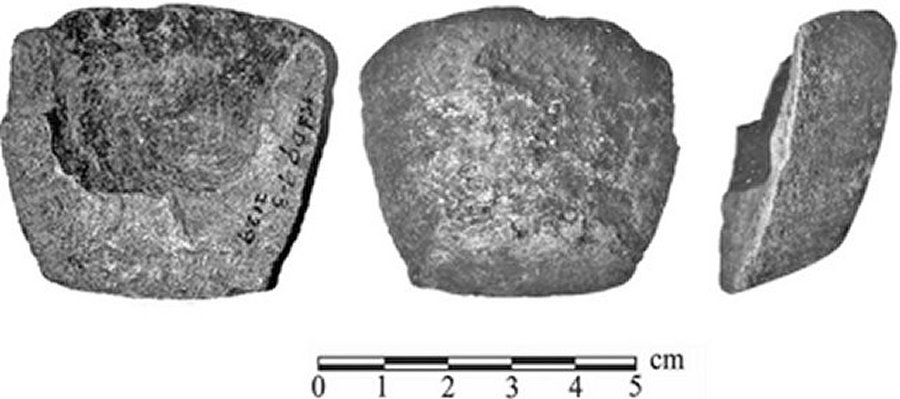
Three views of the broken crucible. Credit: Patricia Sutherland/University of Aberdeen
The results of the recent research show the earliest evidence of high-temperature non-ferrous metalworking in North America to the north of what is now Mexico.
An object that was found by archaeologists a half-century ago has now been recognized as further evidence of a Viking or Mediaeval Norse presence in Arctic Canada during the centuries around 1000 A.D.
The artifact was originally excavated during the 1960s and identified as the fragment of a small soapstone pot made by the local indigenous people, the Palaeo-Eskimo who occupied the area in the centuries around 1000 A.D.
Now researchers have employed scanning electron microscopy to determine if metal traces were present in a small stone container (about 48 mm tall) from an archaeological site on southern Baffin Island.
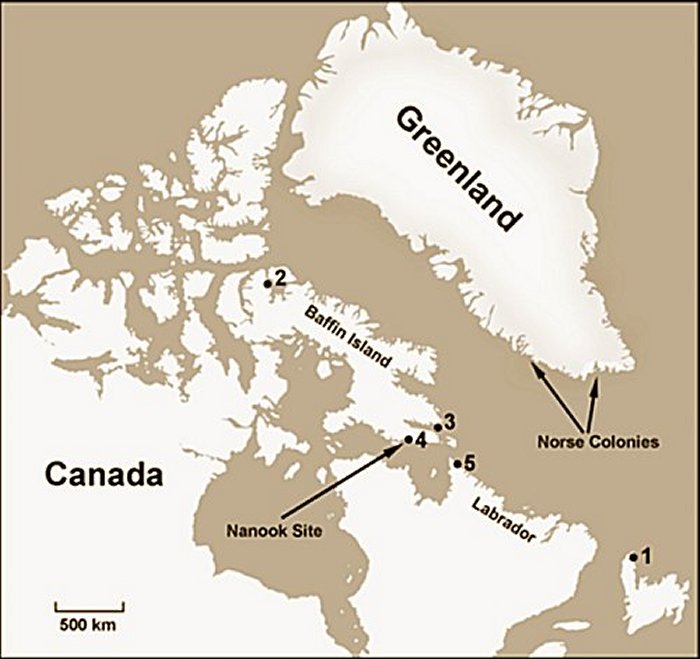
The Vikings and their mediaeval Norse descendants established colonies in southwestern Greenland about 1000 AD, and occupied the region for over 400 years. After more than a decade of research on material from the Eastern Arctic, the evidence indicates a significant early European presence in Arctic Canada.
They found that the interior of the vessel contained fragments of bronze, an alloy of copper and tin, as well as small spherules of glass which are formed when rock is heated to high temperatures.
The object is a crucible for melting bronze, likely in order to cast it into small tools or ornaments. The crucible appears to have been broken while in use, suggesting that it was likely used at the locality where it was found.
Among the Palaeo-Eskimo artifacts Sutherland has identified a wide range of specimens - like lengths of yarn spun from the fur of local animals, whetstones bearing metal traces from tools that had been sharpened, and tally sticks of the type used for recording transactions.
Interestingly, these artifacts resemble those used by Europeans of the Viking and Mediaeval periods.
The Vikings and their mediaeval Norse descendants established colonies in southwestern Greenland about 1000 AD, and occupied the region for over 400 years. After more than a decade of research on material from the Eastern Arctic, the evidence indicates a significant early European presence in Arctic Canada.
The Norse would likely have travelled to the area in order to obtain furs and walrus ivory, either by hunting or by trading with the indigenous people.
AncientPages.com
More From Ancient Pages
-
 Ancient DNA Reveals Unknown Genetic Exchanges Between North And South America
-
 Ten Inscriptions Related To Sargon Unearthed At Ancient Assyrian Site In Iraq’s Kurdistan Region
-
 Mystery Of The Royal Tombs At Vergina Deepens – Has Alexander The Great’s Sacred Purple Tunic Been Found Inside?
-
 Mystery Of A 5,000-Year-Old Mass Grave In Poland Reveals A Family Tragedy
-
 Birka: Major Trading Center During The Viking Age And The First Christian Gathering In Sweden
-
 Rare Discovery Of 8,500-Year-Old Human Teeth Used As Jewelry
-
 Rare Gladiator Tombs Found In Ancient City Of Anavarza In Southern Turkey
-
 How Did Indus Civilization Manage To Resist Climate Change?
-
 Extraordinary Discovery: Clay Vessel With Sour Soup For The Gods Found In Medieval Hut
-
 Satellite Images Of 66 New Roman Army Sites Show More Clues About One Of The Empire’s Most Infamous Conflicts
-
 2,000-Year-Old Aramaic Inscription Unearthed Near Jerusalem
-
 One Of A Kind 2,500-Year-Old Ritual Wash Basin Painted With Mythological Figures Discovered In The Ancient City Of Klazomenai
-
 Isle Of May Was A Pictish Healing Center – Monks Used Herbs To Treat Sick And Dying People
-
 Evidence People Lived In Australian Desert 50,000 Years Earlier Than Previously Thought
-
 Wooden Pre-Columbian Human-Like Statues Discovered At Chan Chan Complex In Peru
-
 Evidence The Khufu Channel Aided The Construction Of The Giza Pyramids Found – Scientists Say
-
 Denisovan Family Tree: New Branches Revealed In Ancient DNA
-
 Anqa: “Forgotten Twin” Of Dura-Europos Where Time Stood Still
-
 How Did Hunter-Gatherers Spread Knowledge Of Pottery Vast Distances Over A Short Period Of Time?
-
 How Did These Beautiful Venetian Glass Beads Reach North America Long Before Columbus?

