
Mystery Of Panxian Cave: How Could Gigantic Animals Reach A Mountain Cave Located Over 1600m Above Sea Level?
A. Sutherland - AncientPages.com - Did early Homo sapiens exist in China at the same time when Homo erectus (the "Peking Man") occupied the Zhoukoudian site located near Beijing?
The Panxian Dadong is a Paleolithic karst cavern located in a small valley 1630 m above sea level on the western Guizhou Plateau, Southern China.
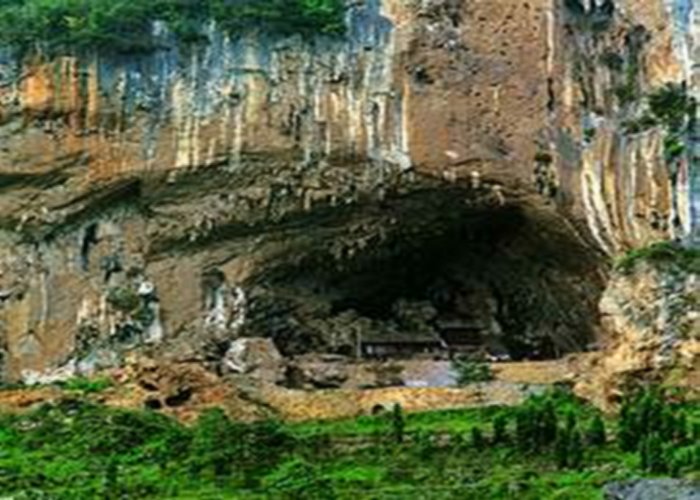
Humans were present at Panxian Dadong Cave about 300,000 years ago and so were also gigantic animals. But scientists are baffled over how these animals could reach a mountain cave located over 1600m above sea level!
In Panxian cave lived one of Asia's earliest human populations. Large deposits up to 19 meters deep contribute with satisfactory evidence of that.
Prehistoric deposits analyzed in the Panxian Dadong Cave indicate that such animals as elephant-like Stegodons and lumbering Rhinoceros lived there.
There has been found a large number of remains which belong to these large animals. The Panxian Dadong, (the name "Dadong" means "grand"), revealed a complete deposit of the Middle Pleistocene period. Diggings uncovered over 40 species of mammals, stone artifacts, human teeth, and animal teeth. Over 30 percent of the large animal remains constitute teeth and approximately 2 percent of remains are related to their skulls.
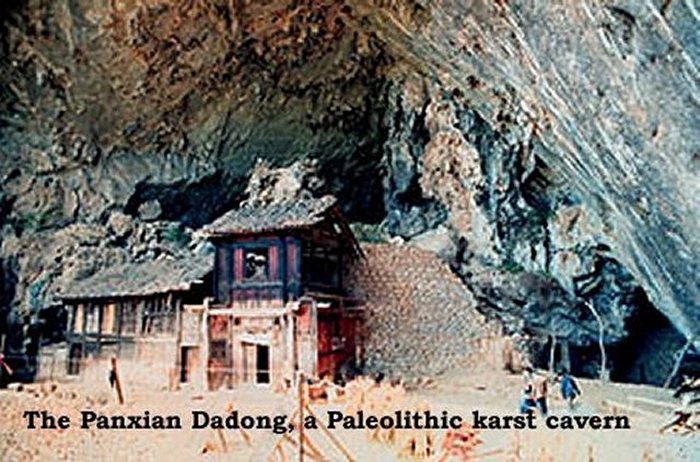
Mostly all those teeth come from very large animals like buffalos, Rhinoceros, and Stegodons.
The cave is the central cavern of three stacked caves extending into a hillside. The central cave, 220 meters deep, covers 8000 square meters.
Test excavations showed that humans used the cave over a long period of time. The uranium-lead dating technique gave indications that the deposits are at least 300,000 years old, and they may go back as far as 700,000 years ago.
The Panxian Dadong Cave system, where digging unearthed a fossilized human tooth, may hold some important answers in this matter.
Some years ago, an expedition to Guangxi province (neighboring province to that of Guizhou), in Southeast Asia established that Gigantopithecus blackii, a large ape, 10 feet tall (3 meters) and weighing about 1,200 pounds (544 kg), lived at the same time as early humans for over a million years.

It was the largest primate that ever lived. Gigantopithecus blackii died out 100,000 years ago during the Pleistocene period. Considering the time range from 1,000,000 to 100,000 years, it would mean that Gigantopithecus blackii coexisted with Homo erectus in this region of Asia. It is believed that the gigantic primate also roamed certain areas of Thailand.
Archaeological material found in Guangxi caves in the form of fossils of humans and Gigantopithecus blackii supports the theory.
The Panxian Dadong is only one of many caves of China and Tibet. Thousands of others, very old and with a great variety of shapes hosted rather prehistoric people than animals.
Both China and Tibet have numerous secret caves. Many of them, created by people rather than natural processes, have symbolic and sacred meaning.
Written by – A. Sutherland AncientPages.com Staff Writer
Copyright © AncientPages.com All rights reserved. This material may not be published, broadcast, rewritten or redistributed in whole or part without the express written permission of AncientPages.com
More From Ancient Pages
-
 1,750-Year-Old Fresco Travertines Buried Underground – Recovered In Ancient Laodicea
-
 Coronavirus: Advice From The Middle Ages For How To Cope With Self-Isolation
-
 Four Roman-Era Brooches And A Ring Found In The Borki Forest, Poland
-
 Mikoshi-Nyudo: Evil, Bald-Headed And Long-Necked Yokai Goblin In Japanese Folklore
-
 Oldest-Known Grinding Tool Used 350,000 Years Ago Was Found In Tabun Cave, Israel
-
 Ancient Egyptians Invented Toothpaste
-
 Secrets Of An Unusual And Mysterious Medieval Danish Axe Revealed By Scientist
-
 Mysterious Medes: Was It An Ancient City Of Ecbatana?
-
 Ancient Mosaics Dated To The First Century Discovered In Southern Turkey
-
 Early Christian Necropolis Unearthed In Sant’Appianu Cathedral In Sagone, Corsica
-
 Societies In Iberian Peninsula Deployed “Escape Economics” 4,000-Year-Old
-
 Untold Story Of The Glencoe Massacre In 1692 Revealed By Archaeologists In Scotland
-
 King Geirrod Betrayed His Brother Agnar And Sent Him To Die But Justice Finally Prevailed
-
 Crop Circles: Are They Cosmic Messages That We Cannot Decipher?
-
 407-Million-Year-Old Plant Fossil Challenges Long-Held Theory On Fibonacci Spirals Found In Nature
-
 Magnificent Decorated Tomb Of Scribe Unearthed At Abusir Sheds New Light On Ancient Egyptian History
-
 Rare Preserved Written Account Of North America’s Ancient Lost Civilization Of Tall Beings From An Unknown Land
-
 Mysterious Rongorongo Script Remains Undeciphered – Does It Contain A Prophetic Warning?
-
 Unsolved Ancient Mystery Of Hand Of Prêles – Unique Discovery Of Ancient Bronze Hand Puzzles Scientists
-
 3,000-Year-Old Geoglyphs May Depict The Heavens

