
Mysterious Mohenjo Daro Was Home To An Unknown Advanced Civilization Far Ahead Of Its Time
A. Sutherland - AncientPages.com - Thousands of years ago, the mysterious city of Mohenjo Daro was home to an unknown, advanced and prosperous civilization that used technology and constructed buildings that were unique to the ancient world.
Artifacts, relics and ruins reveal startling evidence that the inhabitants of Mohenjo Daro possessed inventions that were far ahead of their time.

How and from whom did these remarkable people acquire knowledge of such sophisticated technology?
Why did this enigmatic civilization vanish? The history of the ancient world is full of secrets.
Can some of the interesting archaeological discoveries cast more light on what really happened to one of the world's oldest and advanced civilizations?
The ruined great city of Mohenjo-Daro ("Mound of the Dead") was once a major urban center of the Harappa Culture or Indus Civilization, a highly developed civilisation that flourished on the banks of the rivers Indus and Saraswati, around 3000 BC. (in Pakistan now)
Excavations in 1920-22 at Harappa -Mohenjodaro (which lie in what is now Pakistan) confirmed the existence of an unknown civilization in the Indus Valley, the home of one of the oldest highly advanced civilizations of the world.
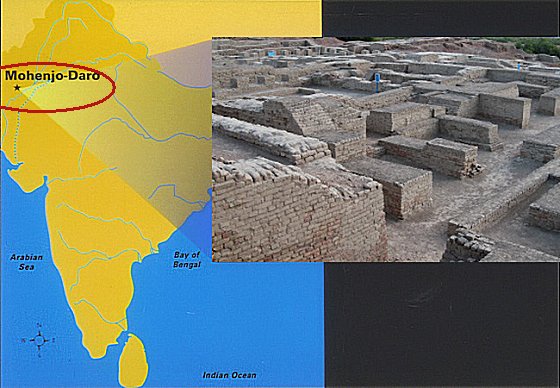
The sophistication of the infrastructure relating to the water supply and effluent disposal systems of the mysterious city was unique!
Why was Mohenjo-Daro abandoned?
The Indus Civilization collapsed around 2000 BC Mohenjo-Daro - discovered in 1922 - was a center of trade and manufacture built on two gigantic artificial mounds; a higher mound the so-called citadel or acropolis overlooked the lower mound considered as residential with hundreds of dwelling houses, larger buildings and a regular system of streets.
Mohenjo-Daro's infrastructute displaced very advanced techniques focused on water supply and effluent disposal systems, extremely important for public health.
This prehistoric society valued good roads, clean fresh water and a system of law.

Probably the most impressive building was a bath-house having absolutely no equal in cities until the Roman period. It was covered with a pool measuring 40 feet by 23 feet, with a steam-bath and a hot-air heating system.
When the city flourished, fresh water was supplied by a network of over 700 unique wells for drinking water, constructed in form of cylindrical shafts several meters deep.
Mohenjo-Daro's citizens used them long before Egypt and Mesopotamia, where water was still fetched from rivers to be stored in cisterns.
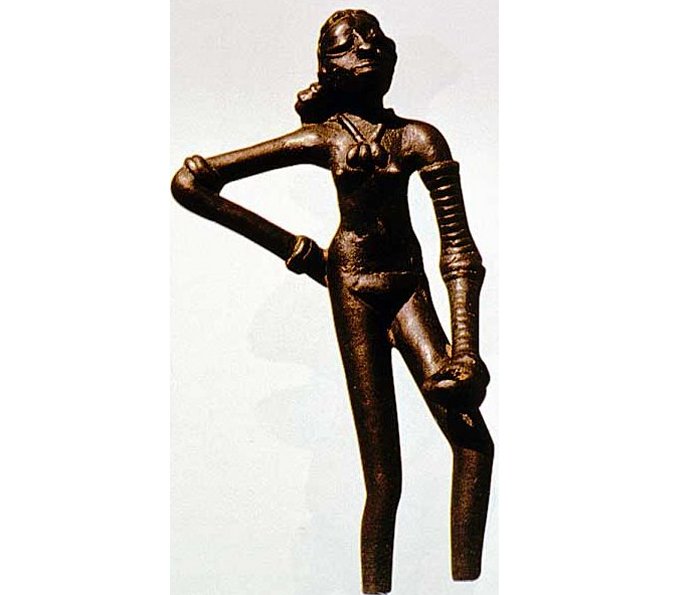
The Dancing Girl, the iconic bronze figurine of Mohenjodaro. (Benoy K. Behl/Collection: National Museum, New Delhi)
The city's engineers and masons also built bathrooms in every home while polishing the tiles of its grand ritual bath to a highly burnished waterproof glaze.
Unique water supply from wells was integrated with a drainage system. Waste water along with sewage from houses was channeled into a complex system of drains running along and below the streets.
The drains had removable covers to give access for cleaning. Cesspools and soakaway pots were commonly used and each bedroom had running water and a bathroom and lavatory.
The municipal sewerage was so efficient that according to British engineers, they could do no better at the present day.

Some interesting terracotta female figurines of the so-called "mother goddess" have been discovered at Mohenjo-Daro.

One of these figurines, dated to approximately 3000 BC, depicts a woman wearing extremely short mini skirt, a necklace and belt and only her face is rather strange and very unusual.
Was she looking like this, when this clay figurine was formed? Was it her real appearance?

If this was the case, one can say that the civilization of Mohenjo Daro had a lot in common with our modern society.
Among more than 40,000 artifacts unearthed in Mohenjo-Daro, there are hand-carved chess pieces, perfectly clay toy animals, and clay urns, platters, and ovens that highlight a culinary culture and stone weights and measures.
When the 5,000-year-old ruins of the city were first unearthed, it was one of the greatest archaeological discoveries. Today Mohenjo-Daro's situation is not is in danger to be completely destroyed and forgotten.
According to archaeologists, Mohenjo-Daro will most probably disappear within 20 years without an urgent rescue plan. If this happens, an important and valuable piece of our history will be lost.
Written by – A. Sutherland AncientPages.com Staff Writer
Copyright © AncientPages.com All rights reserved. This material may not be published, broadcast, rewritten or redistributed in whole or part without the express written permission of AncientPages.com
More From Ancient Pages
-
 The Untold Story Of The Inca – Fire In The Sky – Part 1
-
 Puzzling McClelland Sherd – Undeciphered Inscription Could Be Early Bronze Age Writing
-
 Ancient Celtic Necropolis With Magnificent Swords And Artifacts But No Human Remains Discovered
-
 Large Earthwork At Wichita Site In Kansas – Is It Long-Lost Native American City Of Etzanoa?
-
 Young Boy Discovers Rare Ancient Roman Treasure In Sussex, UK
-
 Arrowhead Made Of Meteoritic Iron From The Late Bronze Age Settlement Of Mörigen, Switzerland – Examined
-
 On This Day In History: Island Of St. Helena – Last Residence Of Napoleon Discovered – On May 21, 1502
-
 Intriguing Petroglyphs Reveal Traces Of A Lost Ancient Civilization In India
-
 Ancient History Of The Christmas Tree And Its Pagan Roots – How The ‘Forbidden’ Tree Survived Against All Odds
-
 Legendary Viking Sunstones Did Exist: Viking Sagas Were More Truthful Than We Realized
-
 Islands Of The Tropical Pacific Ocean Were Settled Much Earlier Than Previously Thought – New Theory
-
 Discovery Of Queen Nefertiti’s Mummy Will Be Announced Next Month – Zahi Hawass Says
-
 Skulls and inscriptions on three rings found by archaeologists in Wales
-
 Underwater Archaeologists Retrieve Over 100 Magnificent Glass Objects at Chengene Skele Bay, Bulgaria
-
 Controversial 3D Reconstruction Of 10,000-Year-Old Apiuna Man Reveals First Americans Came From Africa
-
 Giant Blocks For Sphinx-Shaped King Amenhotep III Colossi Uncovered In Luxor, Egypt
-
 Huldra: Seductive Female Creature Living In Forest Or Mountains In Norse Beliefs
-
 Kizilkoyun Necropolis: Excavations Of 2,000-Year-Old Rock Tombs Will Solve Mysterious Past Of Göbeklitepe
-
 On This Day In History: National Foundation Day Celebrated In Japan – On Feb 11, 660 AD
-
 5 Surprising Things DNA Has Revealed About Our Ancestors

