
John Hawkwood ‘John Sharp’: Feared, English Mercenary And His White Company In 14th Century Italy
A. Sutherland - AncientPages.com - John Hawkwood was widely known in Europe eight hundred years ago. He was an English military in the Hundred Years' War (1337 to 1453) and a mercenary operating in Italy, where he was known as Giovanni Acuto.
Hawkwood was born about 1320 in Sible Hedingham in Essex, England. His father was a leather tanner and landowner.
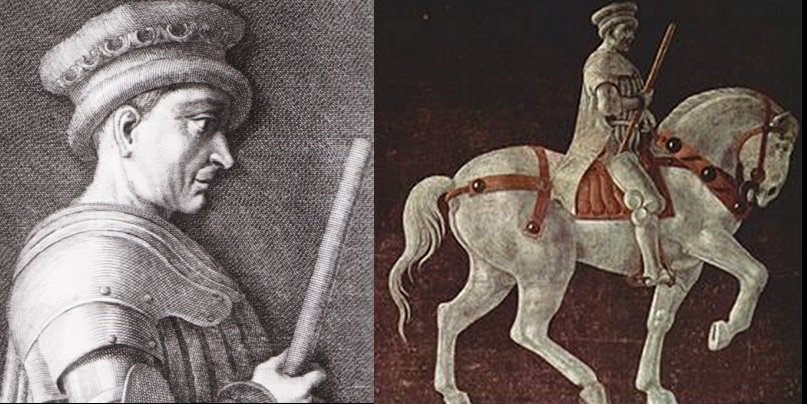
Left: Engraving representing John Hawkwood. Public Domain; Right: Funerary Monument to Sir John Hawkwood by Paolo Uccello (1436). Public Domain
The family was not wealthy, and when his father died, John inherited only a sack of wheat and 20 pounds. Such a legacy was not enough to make a career, so he searched for new opportunities to improve his life.
John Hawkwood – Knight And Leader Of The White Company
At that time, Edward III (1312–1377) was King of England, celebrated for his military successes and restoring royal authority after the devastating reign of his father, Edward II.
Edward III regularly needed new soldiers in the Hundred Years' War with France; John Hawkwood took this opportunity and found work as an archer in Edward's troops. He soon showed his skill on the battlefield.
After the Battle of Poitiers (1356), Hawkwood joined the White Company, an ill-famed group of mercenaries. With them, he entered Italy in 1361; only three years later, he became the company's commander. He was knighted, but it was never precisely specified when and by whom (though the Black Prince and the English King were suggested)
He Was A Leading Figure In Italian Warfare
Hawkwood was one of the leading figures in Italian warfare for the next thirty years. As the leader of the White Company, he specialized in archery and sneaky attacks.
After arriving in Italy, he fought for several factions, such as the Pope, Milan, and Florence. He served as a mercenary and was first the Pope and then various lords.
In his book 'Mercenaries and their Masters,' Michael Mallett writes that Hawkwood was "a tough, professional soldier who seemed to care less about money and more about military reputation than most of the other contemporary leaders. Much of his success is attributed to the advantages that his troops enjoyed. Still, there can be no doubt that he established unprecedented unity and loyalty in his company. He also acquired a reputation for fidelity and honesty, which was to some extent a reflection on the behavior of his rivals because Hawkwood was no paragon of virtue."
In Italy, his group was constantly moving. The Pope had been annoyed with the people of Milan because the city's prince had his mighty army, and in his opinion, he could practically do what he wanted. He was wrong.
These were times when different Italian cities remained in conflict. For example, Pisa rented John and his men to fight against Milan. Hawkwood's troops trounced him and his city. In the coming years, many of the members of the White Company died in all those more or less significant military encounters.
However, with time, John had established an excellent reputation as a commander and a formidable soldier. Many people were privileged to fight at his side. He paid them well and had no problems replacing those he lost in battles.
Hawkwood was a well-paid mercenary; he had money and knew how to make more money. For example, the city of Florence paid him 130,000 florins because it wanted to be in peace, and soon others did the same, and this clever mercenary became a rich man.
John Hawkwood's Career And 1377 Cesena Massacre
Hawkwood was responsible for the 1377 Cesena Massacre, where troops innocently killed 6,000 people under his command.
"…at Cesena in 1377, the papal mercenaries carried out massacres of the civilian populations which were to be permanent stains on the records of Italian warfare…. Cardinal Robert of Geneva, who at Cesena demanded the blood of the entire population in revenge for the murder of some of his mercenaries."
"Hawkwood is said to have obeyed Cardinal Robert's instructions with the greatest reluctance and saved some women in Cesena.
By this time, he had already been in Italy for fifteen years. He had developed a sympathy for the country and its inhabitants that the Breton mercenaries could scarcely be expected to share. However, in Cesena, more than 5,000 of the population were slaughtered, and the moats were filled with the bodies of those who tried to escape from the city..."
Hawkwood devoted himself to various diplomatic missions for the English King for the rest of his long life. He ended his career in Florence. He had always expected to return to England before he died, and he was just about to sell his possessions in Italy, but it never happened. He died in 1394 in Florence.
Updated on January 18, 2024
Written by – A. Sutherland - AncientPages.com Senior Staff Writer
Copyright © AncientPages.com All rights reserved. This material may not be published, broadcast, rewritten or redistributed in whole or part without the express written permission of AncientPages.com
Expand for referencesReferences:
Caferro W. John Hawkwood: An English Mercenary in Fourteenth-Century
Caferro W. Mercenary Companies and the Decline of Siena
More From Ancient Pages
-
 Evidence Of A Hybrid Population Of Neanderthals And Modern Humans Discovered At La Cotte De St Brelade
-
 Mysterious Advanced Underground Civilization And A Secret Society – Astonishing Discovery And Connection – Part 1
-
 Mysterious Ancient Andean Waskiri Structure Built For Unknown Purpose Investigated By Scientists
-
 Oral Stories Of Australia’s First Nations Might Be 10,000 Years Old – Evidence Found
-
 Who Made The Intriguing Wawa Runestone Found In Ontario, Canada?
-
 Meskhenet: Egyptian Goddess Of Household And Childbirth Who Governed Over Fate And Destiny
-
 Prehistoric Bone Tool ‘Factory’ Shows Human Ancestors Had Advanced Reasoning Skills One Million Years Earlier Than Believed
-
 142,000-Year-Old Shell Beads Found In A Cave Are The Oldest Known Evidence Of Human Communication
-
 Amazing Ancient Underwater Treasures And Temples Discovered At Thonis-Heracleion
-
 Invention Of Ancient Military Technologies Throughout World History Investigated
-
 Story Of David And Goliath Linked To Horvat Qeiyafa In The Valley Of Elah, Israel
-
 Four Roman-Era Brooches And A Ring Found In The Borki Forest, Poland
-
 Chinese Writing System – Increasingly Complex Over The Course Of Its 3000-Year History
-
 Engraved Trees Are Living Records Capturing The Rich History And Traditions Of The Sámi People
-
 An Ancient Woman’s DNA From A 20,000-Year-Old Pendant – Recovered By Researchers
-
 New York Was Once Called New Amsterdam – History Behind The Change Of Name
-
 The Parthenon Marbles Evoke Particularly Fierce Repatriation Debates – An Archaeologist Explains Why
-
 Amazing Prehistoric Forest Submerged Under Water Thousands Of Years Ago Re-Emerges On Welsh Beach
-
 2,250-Year-Old Iron Age Settlement Discovered Near Upton-Upon-Severn
-
 Millennia Old Extremely Complex Object Of Unknown Origin

