
King Offa Of Mercia And The Murder Of King Ethelbert – Revenge Or Jealousy?
David Tee - AncientPages.com - It all began in Anglo-Saxon England. A couple of generations before England's unification, the country was divided into several minor or smaller kingdoms, and each had its own king. One of the main kingdoms at that time was Mercia.
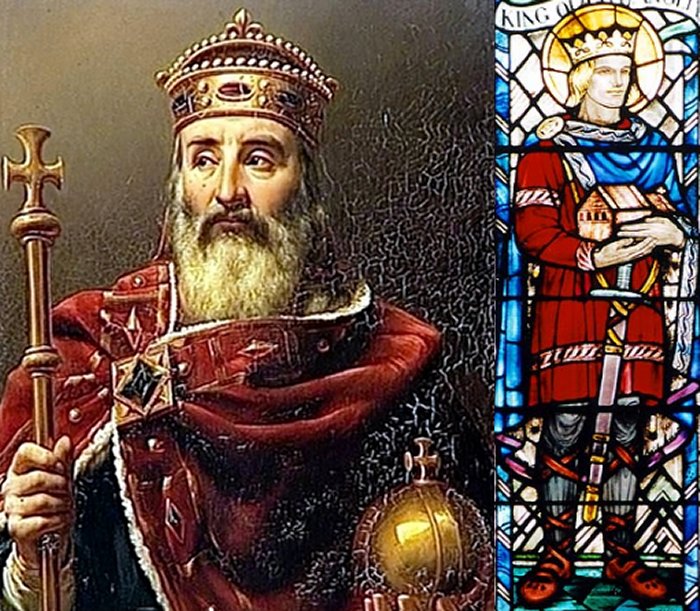
Left: King Offa. Credit: madeupinbritain - Right: A stained glass of St. Ethelbert the Martyr of East Anglia. Credit: OrthoChristian.com
This little kingdom had existed for at least 150 years before Offa came to the throne in 757, approx. Sources for the early history of England are sparse, and the Anglo-Saxon Chronicle is the main one.
Yet, it does not hold much information about Offa's reign or life. All it seems to mention is his death and how long he reigned. Mercia was the most prominent kingdom then, and for 80 years, it had only two kings, Ethelbert and Offa, both reigning for approx. 40 years each.
King Offa Consolidated His Power
Offa came to the throne through a civil war that started with the murder of his predecessor Ethelbert. Offa set out to consolidate and expand his power and territory upon reaching the throne.
His targets, of course, began with the smaller and weaker kings surrounding Mercia. He defeated the kingdom of Kent, the kingdom of Wessex, and the men of South Wales. But Offa was unsatisfied with those new pieces of territory and continued to battle rival kings for their land and wealth. Another king to fall was the king of East Angles.
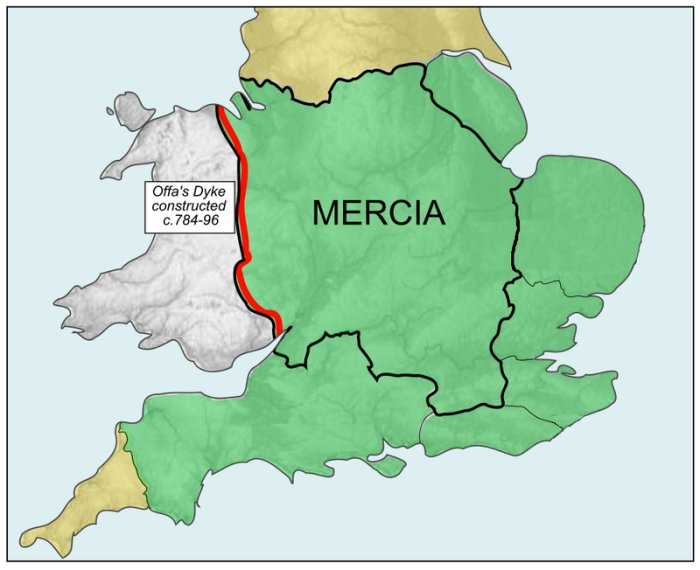
Location of Mercia. Credit: Public Domain, CC BY-SA 3.0
It is said that the objective of Offa was to conquer all of England and make it one nation. He was not able to accomplish that goal as he died too soon. It wasn't until roughly 100 years later that a relative united the nation.
To govern his land, Offa did create a law code. Unfortunately, his law code has been lost to time and history. But it is well-known that Alfred used the same principle to guide his law creation when he ruled Wessex.
Laws were insufficient to stop the Welsh from invading and poaching his land. Offa soon got tired of the thievery, the plundering, and the invading by these troublesome people who were hard to conquer.
In his great wisdom, Offa decided to build what he was known best for. He created the great divide. A dyke was constructed that stretched between the Dee River and Severn River, roughly 80 to 115 miles. Parts of it are still seen today.
According to history, there are two reasons why the dyke was built. First, it stopped people, especially the Welsh, from invading the Mercia territory. It also provided a military advantage for the defenders.
Second, the construction of the dyke was to claim that Mercia was a European power to be reckoned with. Status seemed to be one of the goals Offa strived for as he claimed that he was the King of England or the King of the English.
Was It King Offa's Revenge On Ethelbert?
Many people have thought that Offa's murder of the King of Anglia was an act of revenge. But the historical records do not support that conclusion. Offa had the habit of marrying a daughter to a rival king to make an alliance and keep his border safe from future conflict.

Ethelred, King Offa and Alfrida. Credit: HUK
Charlemagne, the King of the Franks, agreed to allow one of Offa's sons to marry one of his daughters.
The kings of Northumbria and Wessex were recipients of such deal-making. They seemed to have no trouble with their new father-in-law throughout their lives.
This move provides evidence that Offa was being taken seriously by the other powerful kings of Europe. The theory goes that it was not Offa who had it in for his future son-in-law. But it was Ethelbert who was not so fortunate.
History seems to agree that Offa's wife, Queen Cynethryth, became very jealous of her daughter's happiness. This jealousy led her to convince her husband to kill Ethelbert before the wedding.
It took some time to travel from Anglia to Mercia. At one stop, Ethelbert had a dream that something was going to happen at his wedding. No one knows why he did not stop and return to his own land. He may have been too much in love with Alfrida, Offa's daughter.
When Ethelbert arrived at Offa's castle, he was immediately bound and beheaded. From what can be discerned from the surviving historical documents, Ethelbert had done nothing for Offa to deserve this treatment.
The strange twist to the story was that in 795, Offa probably made Ethelbert a patron saint of Hereford Cathedral; we cannot be sure. But Offa erected a shrine in the memory of Ethelbert that year. Some call it hypocrisy, but that may not be the case. It could be that Offa came to his senses and regretted his hasty actions.
Kingdom Of Mercia After King Offa
In 825 AD, Mercia went to war again with West Saxon. It seems that the kingdom could not survive the death of this ambitious king. His son was not as strong in spirit or body, and he died roughly four months after his father.
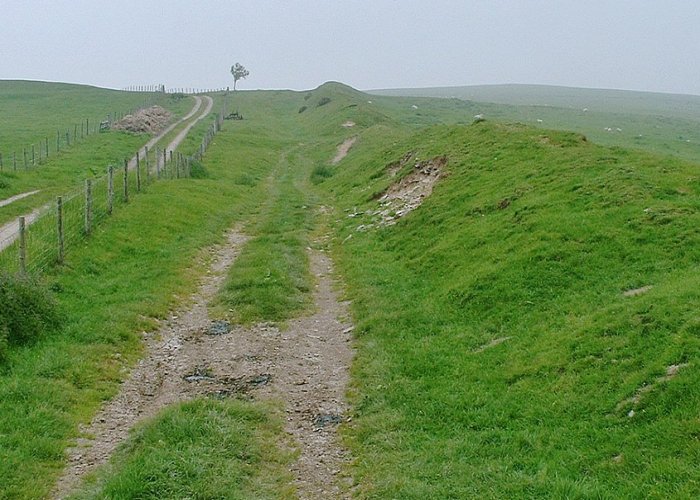
A fragment of Offa's Wall -Image credit: aloys5268 - CC BY-SA 3.0
Without their strong and influential leader, the arm of Mercia was defeated. The kingdom went into decline and did not rise again. The kingdom's fall opened up a power vacuum, one which was filled later by the King of Wessex.
Except for that one son-in-law incident, history seems to remember Offa well. His ambition to be England's ruler did not deter him from making the right alliances and constructing a law code.
It also did not harm his relationship with the church. It is said that Offa was very generous to the church. He also tried to create a new archbishopric with a promise of a yearly payment to the Pope.
This founding never took place and was abandoned eight years after Offa's death.
Written by – David Tee AncientPages.com Staff Writer
Updated on November 15, 2022
Copyright © AncientPages.com All rights reserved. This material may not be published, broadcast, rewritten or redistributed in whole or part without the express written permission of AncientPages.com
Expand for referencesMore From Ancient Pages
-
 Mysterious Grave Of King Valdemar IV Atterdag – Will The 600-Year-Old Historical Puzzle Ever Be Solved?
-
 Holmgang – Dangerous Viking Duel Settled Disputes
-
 Mesopotamian People Liked To Drink Beer Using Variety Of Drinking Vessels
-
 Remarkable South-Pointing Chariot – Ancient Cybernetic Machine Invented 1,700 Years Ago Is An Engineering Masterpiece
-
 Obeah: Who Were The Feared Shadow Killers Of Jamaica?
-
 Ancient Doll And Mythical Animal – 4,500-Year-Old Toys Discovered In Siberia
-
 Humans Spread The Black Death – Not Rats – Scientists Say
-
 Underwater Nabataean Temple With Marble Altars Discovered In Pozzuoli
-
 Unique Glass Bead From The Time Of Jesus Discovered In Fire Pit In Sweden
-
 St. Simeon’s Monastery And History Of Its Founder Shed Light On Christian Past In Anatolia
-
 1.5-Million-Year-Old Footprints Of Two Different Species Of Human Ancestors Found At The Same Spot
-
 Puzzling Ancient Artifacts Found In Secret Cave In The Four Corners States
-
 Huangluo: Long-Hair Village Where Women Don’t Cut Their Hair – A 2,000-Year-Old Tradition Of The Yao People
-
 Fascinating 3,000-Year-Old Artifacts Found At Herne Bay, Kent, UK
-
 Unusual And Well-Preserved Skeleton Discovered In Ancient Pompeii Sheds New Light On The Cultural Life Of The City
-
 Was King William II Murdered In The New Forest?
-
 Takshashila: Renowned Learning Center That Attracted Buddhist Masters, Disciples And Students Of The World
-
 Humans Survived A Covid-19-Like Pandemic 25,000 Years Ago
-
 Scientists Reconstruct The Climate Of The Ancient World Using Small Wooden Artifacts And Mummies
-
 Circe: Powerful Divine Sorceress Who Mastered Healing, Miracles And Transforming People Into Animals In Greek Mythology

