
Draugr – Vikings Feared This Ugly Living Dead With Prophetic Visions
Ellen Lloyd - AncientPages.com - In Norse mythology, there are many references to a creature known as Draugr, often described as a fearsome, ugly living dead who would rise from the grave and make life miserable for people.
Archaeological evidence shows Vikings feared the draugr so much that they took the necessary precautions to prevent the draugr from returning to the world of the living.
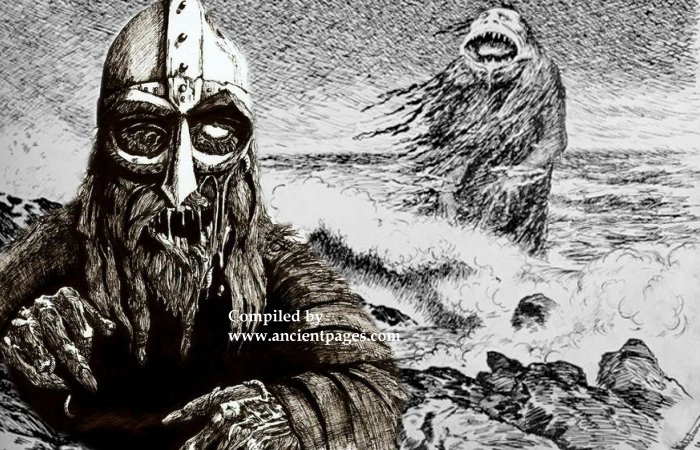
The draugr was by no means a stupid creature. The creature knew the secrets of the past and future. There were many reasons why Norse people feared the arrival of this horrible being.
What Was A Draugr?
The origin of the word 'Draugr' is not entirely clear. Some scholars think it comes from the same root as dream or Traum in modern German, but others trace it to the Indo-European' dhreugh' (harm, deceive). It's also possible there is a strong connection between the Old Norse' draugr' and the Old English 'draco.' We can identify the draugr as a human ghost we find in Norse people's beliefs.
In the Norse Sagas, the draugr (plural, draugar) is mentioned several times, and descriptions of this fearsome creature vary. Also, we shouldn't forget that there are different types of them. The Draugar lived in graves and guarded treasures buried with them.
These beings could rise from the grave and increase their size at will. The size attributed to this being was a way of expressing the vast strength of the creature. The draugr was not an ignorant creature. It could exhibit supernatural powers and possessed knowledge of the past and future. In Norse society, a female shaman known as Völva was attributed with the ability to foretell future events. However, in Norse sagas, stories describe how some draugar mastered prophetic visions.
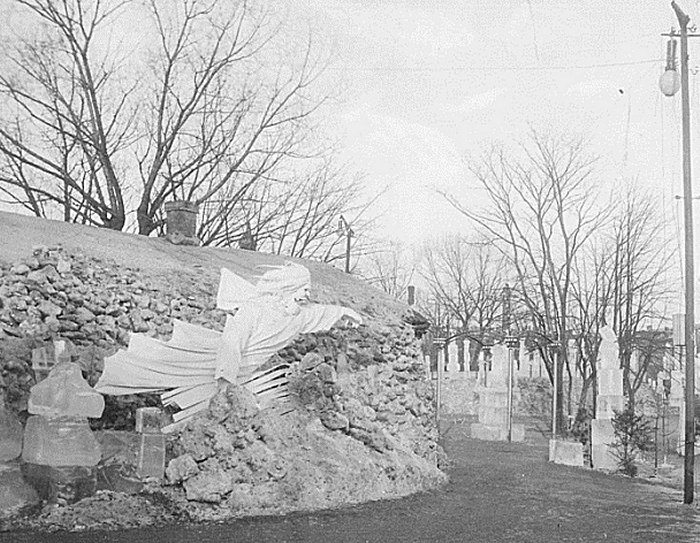
An ice sculpture representing a draugr. Image credit: -Oslo Museum: image no. OB.F18000 (Byhistorisk samling), via oslobilder.no. - Public Domain
People feared the draugr because it displayed abnormal behavior, violent tendencies, and a hostile attitude toward humans. To the Norse people, a draugr was like a piece of wood.
In the sagas, there is not a single description of a bleeding draugr. One could find out whether a person had turned into it or was still human by checking if blood came from a wound.
This hideous being had lost human appearance and the capability to behave like humans and lacked social abilities. Yet, it could move, talk, and even recite poems. Some draugar were also associated with the gift of speech and prophetic visions. Sometimes, they could come in large groups to attack a settlement, but not everyone was interested in terrorizing humans. Many of these creatures enjoyed staying in their burial mound.
Who Could Become A Draugr?
Like many other ancient civilizations, the Vikings did not consider death to be the end of a person's existence. The concept of an afterlife played a significant role in Norse society. Sometimes, the afterlife seemed more real than the people living in it.
Norse scholars have identified two different sets of beliefs related to the fate of the dead. Some believed that life continued in Valhalla, the halls of the gods; others thought there was a continuation of life within the grave-mound. These two Norse afterlife beliefs are archaeologically supported.
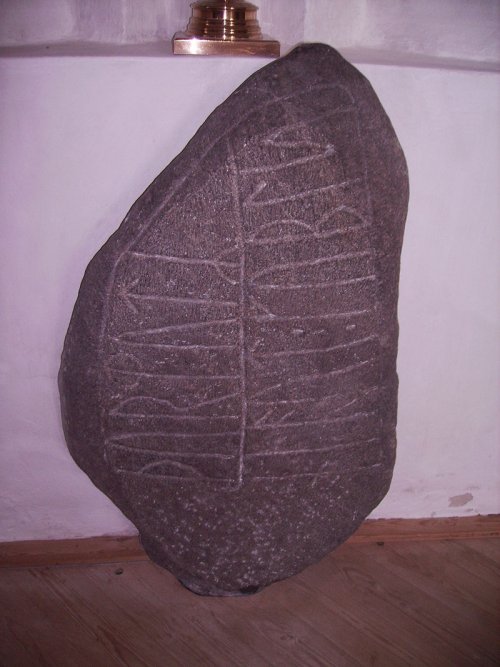
The Nørre Nærå Runestone is interpreted as having a "grave binding inscription" used to keep the deceased in its grave. Credit: Søren Møller
A Viking warrior's ultimate dream was to enter Valhalla, God Odin's gigantic and majestic chamber of the fallen heroes – warriors and mighty chiefs – who died in heroic deaths in battle. But not everyone could enter Valhalla.
The person was not dead when a deceased body was placed in a grave. The 'dead' body was believed to become animated with strange life and power and could turn into a draugr. Anyone who had been buried could do it, too.
Archaeological Evidence Reveals Vikings Feared The Draugr
Archaeologists have discovered runestones that mention the Draugr. There is an inscription on the Karlevi Runestone on top of a burial mound: "Danger! Ghosts!"
The belief in the existence of draugr is ancient. Dated to the late 10th century, the Karlevi Runestone is the oldest runestone on the island of Öland, Sweden. Archaeologists discovered that the dead person's weapons had been made impossible to use in some Viking graves.
We have previously discussed complex ancient Viking funeral traditions and rituals.
By burning a body, one could be sure the deceased did not turn into a draugr.
Many relics in ancient tombs reveal that the type of burial a Viking received depended on his importance in society. When a Viking died, he could either be buried or burned. Powerful Viking chiefs who received ship burial could never come back as a draugr, and they were on their way to Valhalla, but Vikings buried in mounds risked turning into this horrible and feared creature.
Updated on February 16, 2024
Written by - Ellen Lloyd – AncientPages.com
Copyright © AncientPages.com All rights reserved. This material may not be published, broadcast, rewritten or redistributed in whole or part without the express written permission of AncientPages.com
More From Ancient Pages
-
 Controversial Prehistoric Structures That Resisted Water And Extreme Weather Conditions
-
 Why Was Pharaoh Hatshepsut’s Reign Virtually Erased From History?
-
 Huge Unknown Ancient Lost World Discovered Inside Giant Sinkhole In China
-
 Stonehenge Served As An Ancient Solar Calendar And We Know How It Worked – Scientists Say
-
 Ancient Egypt: The Eldest Sons Traditionally Held Significant Power And Authority – New Study
-
 Ancient Greek Seven-Room Building And Treasures Found Underwater Off The Coast Of Salamis
-
 Ruins Of Biblical City Of Corinth Discovered Underwater – Giant Monuments and Remains Of Lighthouse Still Well-Preserved
-
 Controversial 3D Reconstruction Of 10,000-Year-Old Apiuna Man Reveals First Americans Came From Africa
-
 Ancient DNA Extracted From A 2,900-Year-Old Clay Brick – Unique Time Capsule Of Plant Life
-
 Roman Naval Base of Haltern in Germany Was Rebuilt Four Times 2,000 Years Ago
-
 On This Day In History: ‘Earl of Northumberland’ Thomas Percy Executed Because He Was Catholic – On August 22, 1572
-
 On This Day In History: Mathematician And Astronomer Simon Marius Independently Rediscovered Andromeda Galaxy – On Dec 15, 1612
-
 Did Neanderthals And Modern Humans Meet In The Czech Republic 50,000 Years Ago?
-
 Ancient City Machu Picchu Was Originally Called Huayna Picchu By The Incas – Study Of The Name Reveals
-
 Mystery Of The 80 Million-Year-Old Sharks’ Teeth In The City Of David
-
 Living Descendant Of Legendary Native American Leader Sitting Bull Confirmed Using DNA From Hair
-
 Batavia Shipwreck Reveals Secrets Of 17th-Century Dutch Seafaring Domination
-
 Extraordinary Discovery Of ‘Time Capsule’ Belonging To Jules Verne – It May Contain Unpublished Works
-
 On This Day In History: Magna Carta Sealed By King John Of England – On June 15, 1215
-
 Italy’s Stunning Secret Temples Of Damanhur – City Of Light

