
Nazar Amulet – Blue Color Wards Off The Evil Eye According To Ancient Belief
Ellen Lloyd - AncientPages.com - Millions of modern people believe in the power of the Evil Eye, just like our ancestors did in ancient times. This belief has nothing to do with that people are afraid of eye contact, but rather of harmful power that comes from emotions such as envy or greed.
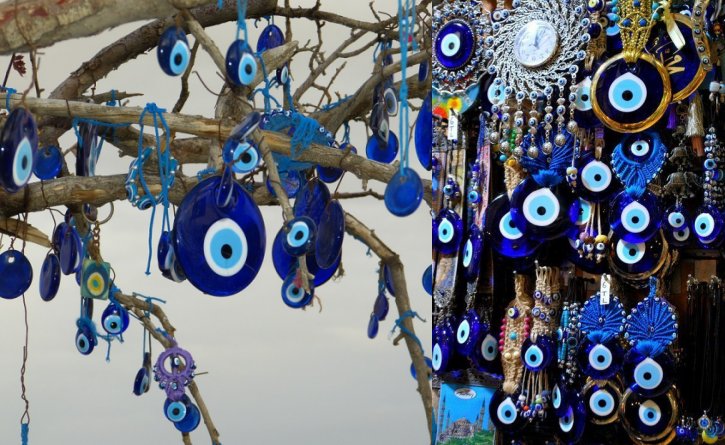
Nazar amulets can be bought in many places today.
All across the world it’s possible to stumble upon ancient symbols that are thought to protect against the curse of the Evil Eye. Some of these symbols are very old, but their meaning and purpose have never been erased from history. In ancient times it was believed that blue color was strong protection against the Evil Eye, a magical power that is at least 5,000 years old.
3,000-Year-Old Sumerian Clay Tablet - Oldest Reference To The Evil Eye
As previous discussed on Ancient Pages, the curse of the Evil Eye is an ancient, superstitious and almost universal belief that certain people possess the supernatural power to cause disaster, illness, calamity and even death.
They have an ability to do it with a gaze or stare that gives an unpleasant emotion. The evil eye is widely feared in many parts of the world.
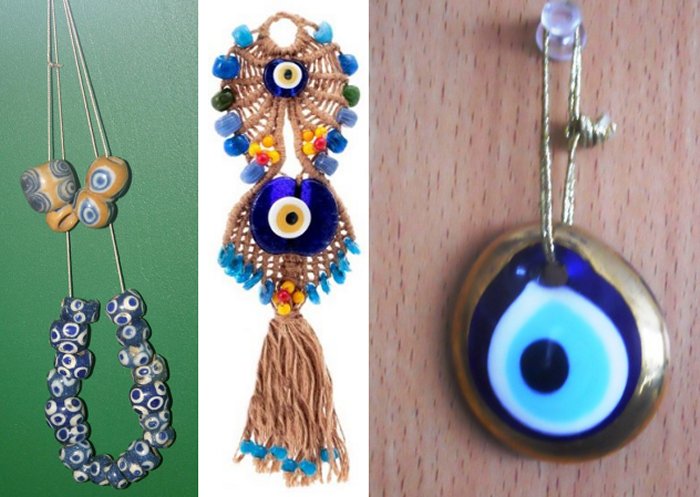
Nazar symbol. Credit: Public Domain
In modern English we have an expression such as “if looks could kill” and we may joke about it, but ancient people took this notion very seriously. The history of the Evil Eye history stretches back to ancient Mesopotamia, Greece, and Rome through to the Bible, Medieval Europe, and the modern day. One of the oldest reference to the Evil Eye comes from Mesopotamia. About 3,000 years ago, Sumerians wrote on a cuneiform tablet that there are water cures against the Evil Eye. The ancient text reads:” The eye ad-gir, the eye a man has…. The eye afflicting man with evil, the ad-gir. Unto heaven is approached and the storms sent to rain.” The next part of the text involves a Sumerian cure. “Seven vases of meal-water behind grinding stones. With oil mix. Upon (his) face apply.”
Hamsa Symbol Protects From Harm Caused By The Evil Eye
To gain a more permanent protection from the Evil Eye, ancient civilizations started using various protection amulets.
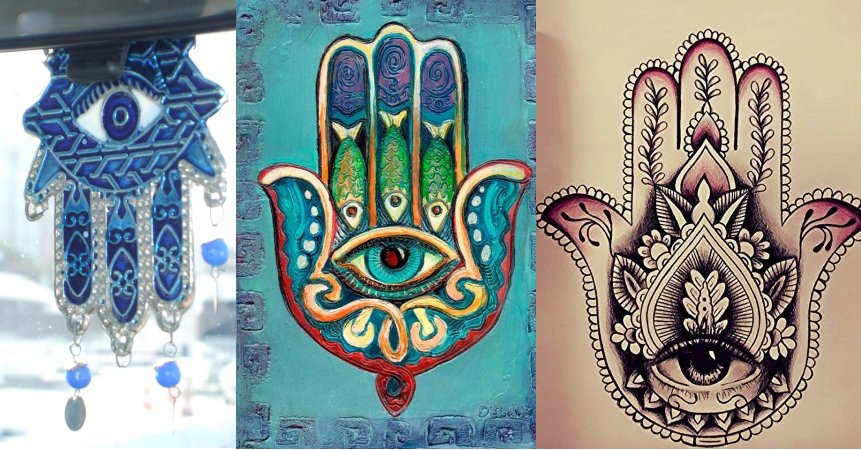
Ancient Symbol Hamsa - Read more
One of the most famous symbols protecting against the Evil Eye is called Hamsa. As described on Ancient Pages in a previous article, Hamsa is a universal symbol and we encounter it in many faiths. It is especially popular among Jews and Muslims. The Hamsa is variously known as the Hand of Fatima (Mohammed’s daughter) and the Hand of Merriam (Moses’ sister) suggest, which is why the amulet carries significance to both Jews and Muslims. It is also sometimes referred to as the Hand of Mary representing Mary, mother of Jesus.
Nazar Amulets And Why Blue Color Ward Off The Evil Eye
Many people who fear the Evil Eye buy protection amulets that can be found in many corners of the world. Nazar amulets are especially popular in Turkey, but they can be found in other countries as well.
In Macedonia, Albania, Bosnia and Herzegovina, Bulgaria, Greece, Cyprus, Syria, Lebanon, Israel, Egypt, Armenia, Iran, India, Afghanistan, Pakistan, Iraq and Azerbaijan, Nazar is often hung in homes, offices, cars, children's clothing, or incorporated in jewelry and ornaments. The belief in the curse of the Evil Eye is very much alive.

The belief in the evil eye goes back thousands of years. Read more
The word Nazar derives from Arabic, meaning literally sight or seeing (hence Nazarite, the knowing ones, or Gnostics).
See also:
Eye Of Providence – Powerful, Secret Symbol With Deep Meaning
Vegvisir – Very Old And Sacred Norse Symbol Of Protection And Guidance
12 Ancient Egyptian Symbols Explained
Ancient Symbol Fleur-de-lis: It’s Meaning And History Explained
Nazar is an eye-shaped amulet. A typical Nazar is made of handmade glass featuring concentric circles or teardrop shapes in dark blue, white, light blue and black, occasionally with a yellow/gold edge. Glass beads were produced and widely used in Mesopotamia, Egypt, Carthage, Phoenicia, Persia and the Roman Empire.
The color blue in the Nazar amulet is of particular importance. History reveals many ancient cultures considered blue color to be of divine origin. Ancient Egyptians saw the deep blue color of water as life and blue sky was divine.
Sumerians made many statues of beings who had very big and blue eyes. Like many other ancient civilizations, the Sumerians considered blue eyes to be a sign of gods.
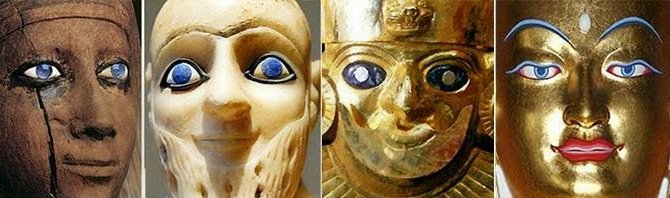
Many ancient civilizations depicted beings with blue eyes. Read more
Also, blue eyes were an unusual color in western Asia. Blue eyes were perceived as having powerful magic, powerful enough even for deflecting the Evil Eye.
Today, some people buy Nazar amulets because of their intriguing appearance and it’s true they are nice to look at, but we should not forget the history behinds this powerful symbol that is at least 5,000 year-old.
Written by Ellen Lloyd – AncientPages.com
Copyright © AncientPages.com & Ellen Lloyd All rights reserved. This material may not be published, broadcast, rewritten or redistributed in whole or part without the express written permission of AncientPages.com and Ellen Lloyd
About the author:
Ellen Lloyd – is the owner of AncientPages.com and an author who has spent decades researching ancient mysteries, myths, legends and sacred texts, but she is also very interested in astronomy, astrobiology and science in general
More From Ancient Pages
-
 Powerful Thunderbird Sent By The Gods To Protect Humans From Evil In Native American Legends
-
 Zagros Mountains: Home To Tribes, Kingdoms And Empires For Thousands Of Years
-
 Mysterious Shasu – Bandit Canaanites Or Israelites?
-
 Ancient DNA Illuminates Unknown ‘Ghost’ Populations In Sub-Saharan Africa
-
 Discovery Of Half-Million-Year-Old Wooden Structure Shows We’re Wrong To Underestimate Our Ancient Relatives
-
 Ancient Wooden Slips Inform About China’s First Emperor’s Search For Mysterious Elixir Of Immortality
-
 Prehistoric Brits Used Rare Rock Crystals To Mark Burial Sites – New Study
-
 Viking Burial Rituals: High Ancient Funeral Pyre Reflected High Social Status
-
 Teotihuacán: Enigmatic Birthplace Of The Gods And Its Obscure History
-
 On This Day In History: Roman Emperor Trajan Was Born In Spain – On Sep 18, 53 AD
-
 Unexpected Danger Lurks Beneath Ancient Maya Cities – Mercury Pollution Discovered
-
 Ancient Greek Inscription Could Reveal Biblical Saint Peter’s Birthplace – Archaeologists Say
-
 Ancient African Empires’ Impact On Migration Revealed By Genetics
-
 Mysterious Circular Neolithic Structure Used For Unknown Purpose Found In Marliens, France
-
 Mystery Of Merit Ptah And The Unknown Identity Of Peseshet Who History Forgot
-
 On This Day In History: The King James Bible Is Published For The First Time In London – On May 2, 1611
-
 Longstanding Cultural Continuity At Oldest Occupied Site In West Africa – New Study
-
 Earliest Evidence Of Rice Harvesting Provided By China’s Ancient Stone Tools
-
 On This Day In History: 4000 Defenders Of Pilėnai Commit Mass Suicide When Attacked By Teutonic Knights – On Feb 25, 1336
-
 Intriguing Ptolemaic And Roman Treasures Unearthed In Al Bahnasa, Egypt

