
Holmgang – Dangerous Viking Duel Settled Disputes
Ellen Lloyd - AncientPages.com - Like in any other ancient society, Norse people had to follow laws and rules, but there were often disputes, and sometimes people decided it was better to solve a matter through a challenge.

Egill Skallagrímsson engaging in Holmgang with Berg-Önundr, a painting by Johannes Flintoe. Credit: Public domain
It was done by a Holmgang, a duel that had to occur within three to seven days after the challenge was announced. Not showing up for the challenge was not a good idea.
If the person challenged did not show up for the Holmgang, then his opponent was considered the winner of the dispute by default. Not turning for a Holmgang caused shame to the entire clan. A person who decided not to participate in a Holmgang was deemed niðingr.
In modern days we would say a coward, but looking through the eyes of the Norse people, it was one of the worst things you could be called. It was a social stigma implying the loss of honor and the status of a villain. The result was that he could be sentenced to an outlaw.
 A Holmgang often resulted in death or severe injuries. Credit: Adobe Stock - alex_marina
One of the most famous Viking outlaws was Erik the Red, a very controversial Viking. He was very violent, and his temper was beyond his control. It resulted in him being exiled from his country on two occasions!
As the Norse Sagas reveal, honor was significant in Norse society. A Holmgang could be called for in matters involving recognition, retribution, debt, legal disagreement, or intention to help a wife or relative or avenge a friend.
As previously discussed in Ancient Pages, Viking law and order was based on the Thing System. The ancient Viking society had a sophisticated government and law system, but talks and negotiations could not settle certain disputes. Some people demanded payment in blood. For example, in the case of a murder, relatives were expected to require a Holmgang. It often happened that a murder had been sentenced to death or banished from the country for some time, but relatives had the legal right to ask for a Holmgang. Anyone, regardless of social status, could be challenged in a Holmgang.
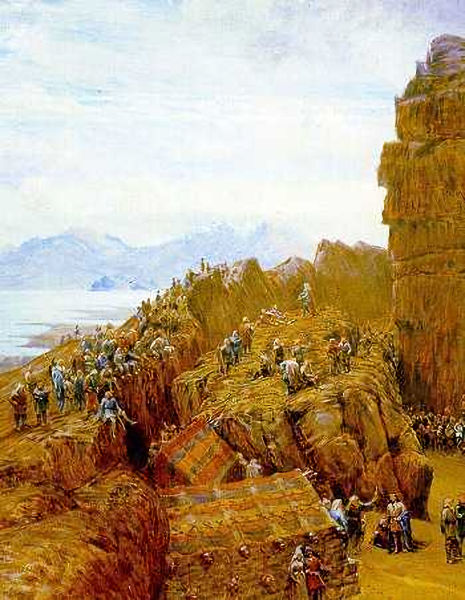
The Thing system was considered better than having disputes settled by duel or family feuds. In Viking society, all free men and women had the right to conduct revenge killings. Read more
Illustration - The Icelandic Althing in session, as imagined in the 1890s by British artist W. G. Collingwood. Credit: Public Domain
Holmgang can be translated as "to go to (or walk on) a small island." It is because the duel' took place upon a small piece of hiding or cloak placed on the ground. During the fight, the participants had to stay within the marked boundaries. The exact rules varied from place to place and changed over time, but before each challenge, the duelists agreed to the rules they used.
The oldest Holmgangs resulted in death battles or incapacitation of one combatant. Killing an opponent did not constitute murder and therefore did not lead to outlawry, and weregild ( a fine to the victim's family) was not required to be paid by the victor.
In 1006, Iceland declared Holmgangs were no longer allowed, and Norway outlawed the dangerous duel in 1014.
Updated on February 23, 2023
Written by - Ellen Lloyd – AncientPages.com
Copyright © AncientPages.com All rights reserved. This material may not be published, broadcast, rewritten or redistributed in whole or part without the express written permission of AncientPages.com
Expand for referencesMore From Ancient Pages
-
 On This Day In History: Terrible Day In Moscow Engulfed By Fire – On June 21, 1547
-
 Carian Princess’ Tomb, Golden Artifacts – Now On Display In Renovated Hall Of Bodrum Castle
-
 Mystery Of Europe’s Bog Body Phenomenon Solved By Scientists
-
 At Least 20 Ancient Colored Wooden Coffins Discovered In Asasif Necropolis, Luxor
-
 Secrets Of Nanomaterial From The Middle Ages Examined By Scientists
-
 Mysterious Ancient Ruins Of Fortress Discovered In Scottish Highlands
-
 Being Anglo-Saxon Was A Matter Of Language And Culture, Not Genetics
-
 Ancient Egyptian Women Had Equal Rights As Men – Egyptian Cosmology And Goddess Maat Reveal Why
-
 Enigmatic 2,000 -Years-Old Carved Stone Owl Pipes – An Ancient Unsolved Secret Of Illinois
-
 Number ‘Seven’: Mystical Number Of The Universe And One Of The Most Sacred Numbers
-
 Dwarf Alvis (‘All-Wise’) Who Was Tricked By God Thor And Turned Into Stone
-
 Colonnaded Hall Decorated With Captivating Frescoes Unearthed At Pompeii
-
 On This Day In History: Henry VIII Ascended The Throne Of England – On Apr 22, 1509
-
 Huge 7,000-Year-Old Man-Made Structures Used For Religious Rituals Spotted In Poland
-
 Two-Million-Year-Old DNA Opens A ‘Game-Changing’ New Chapter In The History Of Evolution
-
 Burnt Mound Complex Dated To Bronze Age – Uncovered At Suffolk Site
-
 Carthage: Prosperous Phoenician Colony That Became Dominant Power In The Western Mediterranean
-
 Ancient Roman Wine Was Spicy And Smelled Like Toast – Dolia Vessels Reveal
-
 Statuettes Of Gods And Goddesses Unearthed At Ancient Site Of Kültepe
-
 Legend Of Evil Spearfinger And The Cherokee Who Were Guided By Celestial Beings

