
5 Different Types Of Priests In Ancient Rome – Their Role And Responsibility Explained
Ellen Lloyd - AncientPages.com - In ancient Rome, religion formed an integral and vital part of everyday life. People were convinced that gods were in control of everything that happened to an individual and the nation as a whole.
With religion pervading every aspect of daily life in ancient Rome, there was a need for those who were in charge of gods’ prophecies, declaration of religious festivals, organizations of rituals and ceremonies, and everything else that was of religious importance.
In ancient Rome, there were different types of priests who were assigned various tasks vital for the nation’s religious life.
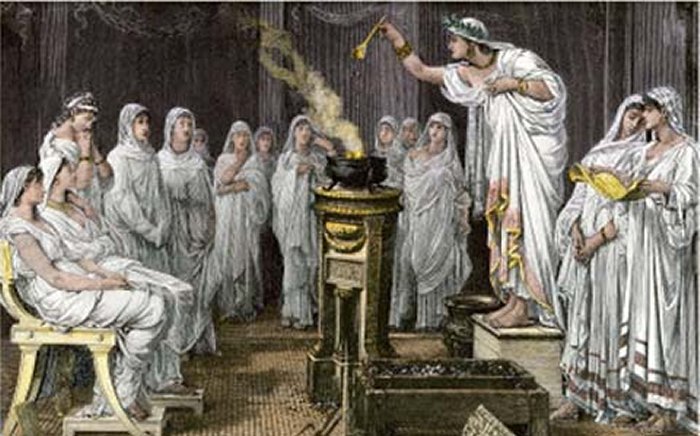
Religion was very important in ancient Rome.
Rex Sacorum – Priest Who Was Originally King Of The Sacred Things
The Rex Sacrorum (“king of the sacred things”) was chosen for life by the Pontifex Maximus from a list of patricians (a group of ruling class families in ancient Rome) submitted by the Collegium Pontificum. To become Rex Sacorum it was necessary to be born from parents married through the ritual of confarreation (a traditional patrician form of marriage), which was also the form of marriage he himself had to enter.
Rex Sacorum was a priest whose original purpose was to replace the religious role previously held by the kings of Rome.
During the Roman Republic, the responsibilities of Rex Sacorum changed and so did his power.
To limit the power of Rex Sacorum, he was no longer allowed to hold public office and he was barred from sitting in the senate. Instead, his responsibilities included the declaration of the many religious festivals on the calendar.
Quindecimviri – Priests Who Guarded The Sibylline Books

The Sibylline Books were sacred.
The Quindecemviri priests were charged with the important task of guarding the Sibylline Books that contained prophecies concerning the fate of the Roman Empire. These sacred scrolls were consulted and interpreted at the request of the Senate whenever there was a need to make an important decision. The Quindecimviri were also responsible for amalgamating any gods of foreign origin adopted by Rome.
Pontiffs - Highest-Ranking Priests Of The State Religion

College of Pontiffs
Overseen by the Pontifex Maximus, a position that in time became that of Pope, this group carried out the public ritual and ceremony involved on daily basis. Pontiffs were the general overseers of public rites. The most illustrious of the four main colleges of priests, they also appointed members to the other priesthoods.
Augurs – Priests Who Interpreted The Will Of The Gods
Augurs were priests who were responsible for divination through interpreting the flight paths of birds. They watched if birds were flying in groups or alone, what noises they made as they flew, the direction of flight, and what kind of birds they were. Based on these studies, they interpreted the will of the gods.
Augurs, who were very important priests were also charged with declaring whether the outcome of action would be positive or doomed to failure in all aspects of life, from battle to trade to religion.
Flamines – Priests Who Served One God

Flamines, distinguished by their pointed headdress, as part of a procession on the Augustan Altar of Peace.
Flamen was a priest who was devoted to the service of one particular god or goddess. Flamines were responsible for taking care of the temple of the god they represented. The most important of the flamines were those of
Jupiter (flamen dialis), Mars, (flamen martialis) and Quirinus (flamen quirinalis). Believed by some to be the oldest of the Roman priests, the flamines tended to hold their post for life.
Written by - Ellen Lloyd – AncientPages.com
Copyright © AncientPages.com All rights reserved. This material may not be published, broadcast, rewritten or redistributed in whole or part without the express written permission of AncientPages.com
Expand for referencesJonathan M. Hall - Artifact and Artifice: Classical Archaeology and the Ancient Historian
More From Ancient Pages
-
 Cursed Biblical City Bethsaida May Have Been Found – But Scientists Argue About The Discovery
-
 Mystery Of The Knights Templar – Secret Mission And Loss Of A Great Treasure – Part 2
-
 Evidence Of Neolithic Bird Hunting In Upper Mesopotamia
-
 Advanced Ancient Irrigation Network Discovered In Mesopotamia
-
 Stonehenge May Have Aligned With The Moon As Well As The Sun
-
 Reconstructed Roman Gateway Tells The Story Of Britain’s Invasion
-
 Were Owl-Shaped Plaques Children’s Toys In Copper Age?
-
 Piece Of Puzzling Roman Artifact Discovered In Belgium
-
 Ancient ‘Rising Sun’ Coins Provide Evidence Of Historical Connections, Trade Networks And Cultural Exchanges From Bangladesh To Vietnam
-
 Early Humans Used Fire To Make Stone Tool – New Study
-
 Tullus Hostilius: Warrior King Of Rome, Who Succeeded Numa Pompilius And Feared Prophecies
-
 Man Following Sinister Green Light Discovers Mysterious Ancient Artifacts And Strange Mummies In Secret Cave
-
 Shining Ones And Magic In Ireland – Secret Wisdom Of The Gods
-
 Ruins Of Xunantunich – Mayan City That Once Flourished
-
 What Is The History Of Pancakes?
-
 Unique Viking Age Silver Treasure Found On Farm Near Stockholm In Sweden
-
 How Was The 3,600-Year-Old Nebra Sky Disc Made? New Clues
-
 Strange Mummies Of Venzone: Ancient Bodies That Never Decompose Remain An Unsolved Mystery
-
 Pyramid Texts Of Ancient Egypt That Charted Journey Of Pharaohs Into Afterlife
-
 Cooking Gear Found In Graves Of Viking Men And Women

