
Head Of The Great Sphinx Was Changed – It’s The Gateway To A Secret Underground City– Historians Suggest
Ellen Lloyd - AncientPages.com - How much do we really know about the Great Sphinx of Giza in Egypt? Why and when was the enigmatic Great Sphinx built? What is hidden beneath the Great Sphinx? Was the head of the Sphinx changed?
There are many questions and theories, but few reliable answers and solid evidence. However, this should not stop us from speculations and hopefully, investigations that could bring some successful results bring us closer to answers.
According to two historians, the Great Sphinx of Giza could be the entrance to a secret underground city built by a lost civilization. It’s a though-provoking theory that cannot be easily dismissed.

Ancient writers such as Herodotus, Strabo, Diodorus, and Pliny suggested there is a giant, lost labyrinth in Egypt. As we mentioned here on Ancient Pages, the mysterious enormous underground labyrinth of Egypt holds secrets kept from the outside world.
The lost labyrinth, full of hieroglyphs sculpted for eternity in its endless stone walls is believed to contain all knowledge of ancient Egypt. It could be one of the most important discoveries in human history, but its location is unknown.
A Great Sphinx Cover-Up?
Now, two historians, Gerry Cannon and Malcolm Hutton who previously suggested that the Great Sphinx of Giza once had a twin, have put forward a new controversial theory.
They believe there is a hidden underground city beneath the Sphinx. In their forthcoming book, The Giza Plateau Secrets and a Second Sphinx Revealed, Cannon and Hutton state that beneath the Sphinx there is a huge labyrinth full of ancient tunnels leading to an underground metropolis.
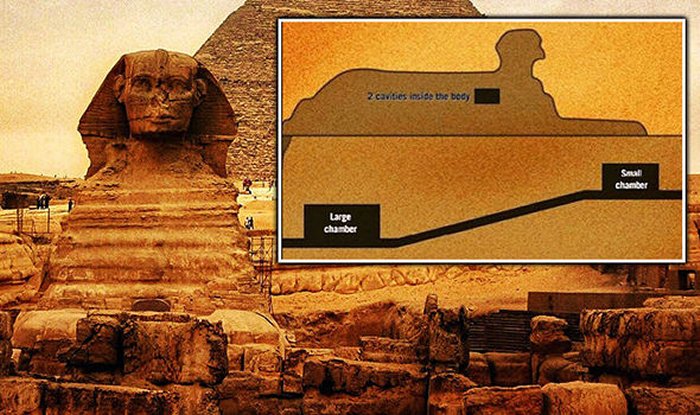
Historians think there is a huge underground city beneath the Sphinx. Credit: Garry Cannon
According to historians, the reason the public knows nothing about this secret ancient subterranean world is that Egyptian authorities are covering up the truth.
A hole on the top of the head of the Sphinx could be an entrance to this lost city, along with other openings on the structure.
Investigating this claim is easier said than done because Egyptian authorities do not allow proper examination of the Great Sphinx.
“There are things under there, tunnels. Lots of people have written about it but they try to cover it all up. Nobody knows what’s under there, no one has been able to investigate.
They’re frightened that if they find stuff under there, it’s going to blow all their books and all their history out of the window.
They started to investigate it but then they stopped. So, they must have known there’s stuff there but they’re worried.
Once it’s proven that all their history is wrong, all their books they’ve written will be thrown out. If they’ve found stuff, they daren’t show it.
There are entrances, there are photographs that show it. There’s this hole in the top of the Sphinx, on its head. Why should it be there? It goes down about 8-10 feet and then it goes off into passages.
They’ve never taken cameras down there - or they have and they don’t want to show it,” historian Cannon said in an interview with the Express UK.
Was The Head Of The Sphinx Changed?
Cannon and Hutton think the head of the Great Sphinx was changed since it was first built. They point out that while the body of the Sphinx is made out of limestone the head is carved from a manmade substance.
“It is obvious from the totally different construction material and color of the Sphinx head, which we believe is not rock, but some type of manmade substance compared to its limestone and eroded body.

The Sphinx in Egypt showing the entrance through the head. Credit: Garry Cannon
The head and face of the Sphinx must have been changed from its original shape long after the monument was first carved. There is hardly any damage and no erosion on its head compared to its body.” Cannon explained.
The Egyptian authorities deny having knowledge of such discoveries. According to Egyptian authorities, it’s impossible to investigate these claims because the chambers are either blocked up or full of water.
Zahi Hawass, former minister of state for antiquities affairs has stated several times before there is nothing under the Sphinx.
According to Hawass, “the Sphinx has traditionally been dated to the reign of Khafre, the builder of the second pyramid on the Giza plateau. This dating is based on its location near the pyramid complex of Khafre and the similarity of its temple, the so-called Sphinx's temple, to the lower or Valley temple of Khafre. Indeed, new evidence confirms that the Sphinx and its temple were not included in the original master plan developed by Khufu, but were integrated into the plan as a new architectural component by his successor, Khafre, probably for cultic reasons.”
Alternative historians are of a different opinion. They suggest the Great Sphinx of Giza is much older and the reason for its construction is unknown.
Written by - Ellen Lloyd – AncientPages.com
Copyright © AncientPages.com All rights reserved. This material may not be published, broadcast, rewritten or redistributed in whole or part without the express written permission of AncientPages.com
Expand for referencesMore From Ancient Pages
-
 Parthian Jar Burial Dated To 247 BC – 224 CE Unearthed In Iran’s Kurdistan Province
-
 3,000-Year-Old Shoe Found On A Beach In Kent, UK
-
 Paleolithic Stone Tools Reveal Where The First Americans Migrated From
-
 Thousands Of Ancient Tools From A South African Cave Reveal Prehistoric Human Connections
-
 Vercingetorix: Greatest Of All Gallic Leaders And Hero Of The French People
-
 Search For Noah’s Ark Continues – The ‘Inside Mount Ararat’ Research Project
-
 Mystery Of The Demon Wall In Sauherad Church Finally Solved
-
 Comet Strike 13,000 Years Ago May Have Changed Human Civilization
-
 Strange History Of Stele Of Ankh-ef-en-Khonsu – ‘Stele Of Revealing’ Gave Birth To Thelema, A New Religion
-
 Rare Discovery Of Ancient Artifact Depicting Norse God Loki In Denmark Remains A Mystery
-
 New Insights Into The Dawn Of The Indo-European Languages
-
 Impressive 2,700-Year-Old Farmhouse And 1,500-Year-Old Monastery Uncovered In Rosh Ha-‘Ayin
-
 The Caesar Cipher: Ancient And Simple Yet Effective Cipher Used By Julius Caesar
-
 Curious Giant Shaped Rock In China – An Ancient Man-Made Construction Or Natural Formation?
-
 Skeleton Of Irish Giant Charles Byrne Will Not Be Displayed In The Hunterian Museum In London
-
 Mictlan – Underworld Realm Of The Dead In Ancient Aztec Beliefs
-
 Rock-Hewn Burial Shafts And 38 Symbolic Pots Discovered In Abusir Necropolis, Egypt
-
 3,000-Year-Old Female Statue Unearthed In Turkey
-
 Peculiar Neolithic Anomaly Investigated In Scotland
-
 Takshashila: Renowned Learning Center That Attracted Buddhist Masters, Disciples And Students Of The World

