
Did Crassus, Ancient Rome’s Wealthiest Man Really Die From Drinking Molten Gold?
Ellen Lloyd - AncientPages.com - Marcus Licinius Crassus (c. 115 B.C. —53 BC.) was a Roman general and politician. Today, he is remembered as the wealthiest man in ancient Rome, suppressing the slave revolt led by Spartacus and forming the so-called First Triumvirate with Julius Caesar and Pompey to challenge the Senate's power effectively.
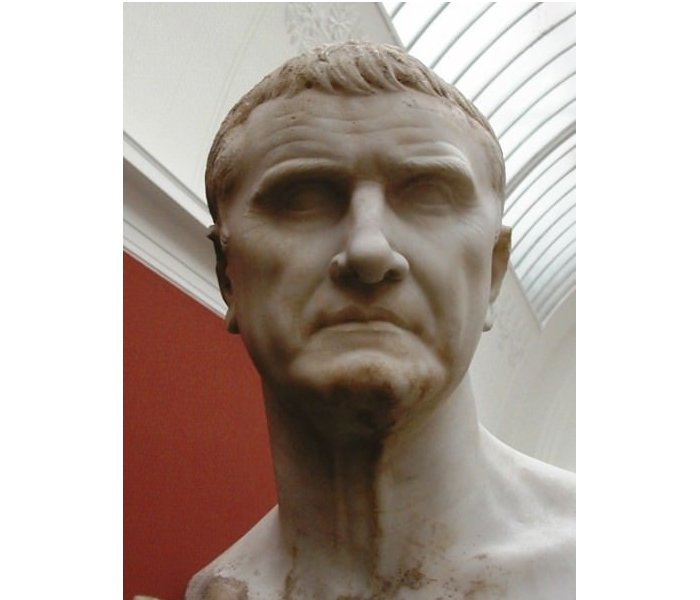
A bust of Roman statesman and general Marcus Licinius Crassus (c. 115-53 BCE). Glyptothek, Copenhagen. Image credit: Diagram Lajard - Public Domain
When Crassus died, a Civil War broke out between Caesar and Pompey. According to some historical sources, Crassus died from drinking molten gold, but is this really true?
Crassus was born a wealthy man but lost his entire inheritance during the Marian-Cinnan proscriptions. He was forced to flee to Hispania (the Roman name for the Iberian Peninsula).
Crassus got his revenge while commanding the left wing of Lucius Cornelius Sulla's army, making a fortune from proscriptions himself.
Soon Crassus became a wealthy man. He earned his fortune from prescriptions, slave trafficking, judicious purchases of land and houses, and purchases of burning property.

Ancient Roman army and their general. Credit: Adobe Stock - vukkostic
Prescriptions were only part of his overall wealth. It is said that after receiving word of houses being on fire, Crassus would arrive with an army of 500 "firefighters" and attempt to offer a modest sum for the property. Crassus would let the property burn to the ground if the offer was refused.
Crassus became a politician and used his wealth to gain support from senators. However, wealth was not enough to give Crassus the power he wanted. Crassus needed a military victory to consolidate his grip on power and make a name for himself in military matters. Crassus used Syria as the launchpad for a military campaign against the Parthian Empire, Rome's long-time Eastern enemy.
The Parthian people had established an empire that lasted almost 500 years, from the mid-3rd century BC until 224 CE. Crassus' military campaign was a disastrous failure, resulting in his defeat and death at the Battle of Carrhae.
It remains unknown whether Crassus died fighting or committed suicide to prevent being captured.
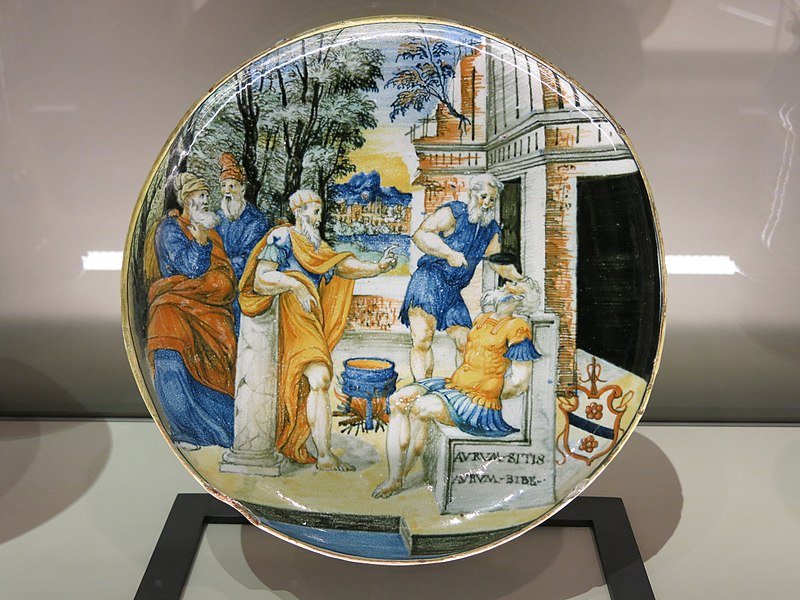
Historian Cassius Dio wrote that the enemy “poured molten gold into his mouth. The torture of Crassus. Faience. Circa 1530-1540 - Louvre Museum. Credit: Tangopaso - Public Domain
Crassus was well-known for being greedy. Plutarch said that "before he (Crassus) went upon his Parthian expedition, he found his possessions to amount to seven thousand one hundred talents; most of which, if we may scandal him with a truth, he got by fire and rapine, making his advantages of the public calamities." He died in pursuit of wealth from Asia."
The rumor about "dying from drinking molten gold" can be traced to historian Cassius Dio who wrote that having discovered his body, the enemy "poured molten gold into his mouth in mockery for he had set great store by money."
Where and how exactly Dio obtained this information is unknown, but it helped Roman prejudices about Parthian brutality.
Written by - Ellen Lloyd – AncientPages.com
Updated on February 11, 2023
Copyright © AncientPages.com All rights reserved. This material may not be published, broadcast, rewritten or redistributed in whole or part without the express written permission of AncientPages.com
Expand for referencesMore From Ancient Pages
-
 Native Americans’ Visions Of Distant Explorers May Unravel Some Ancient Mysteries Of North America – The Arrival – Part 1
-
 Who Made The Mysterious Ancient Cave Paintings And Inscriptions In Oklahoma 2,500 Years Ago?
-
 Apkallu – Seven Antediluvian Sages Created By God Enki – Were They The Watchers?
-
 Humans Carry DNA From An Ancient, Unidentified Ancestor – Scientists Say
-
 A Rare 1,500 Year Old Mosaic That Depicts Ancient Streets And Buildings in Egypt – Discovered
-
 Ancient Mystery Of Acra Citadel – Solved
-
 ‘Graffiti’ Found On The Walls Of Dayu Cave, China
-
 Bacteria Found In 4,000-Year-Old Human Molars Found In Cave – Responsible For Tooth Decay And Gum Disease – New Study
-
 Ancient DNA Unveils How Slavs Transformed Europe
-
 Ancient Mystery Of The Before – Time People – Traces Of An Unknown Lost Race – Part 1
-
 Ancient DNA Reveals Mongolia’s First Nomadic Empire Was Multiethnic
-
 Unsolved Old Cherokee Mystery In The Great Smoky Mountains
-
 Rare Iron Age Cauldrons And Their Almost Exact Replica Reveals Its Secrets
-
 Beautiful Mosaics Reveal Ancient Secrets Of Unknown Roman City Ucetia In France
-
 Mystery Of How Ancient Maya Accurately Predicted Solar Eclipses Solved
-
 2,000-Year-Old Instruments Used By Roman Surgeons Revealed By Archaeological Scanners
-
 How Did Sea Level Rise Impact Human Groups During Mesolithic And Neolithic Periods?
-
 John Dee’s Magical Mirror Used To Contact Spirits Can Be Traced To The Aztecs
-
 Mythical Place Where Gorgon Medusa Dwelled And Was Killed May Have Been Found By Archaeologists
-
 Mystery Of Zendan-e Eskandar – Alexander The Great’s Prison

