
Scipio Africanus – Rome’s Greatest General Who Defeated Unbeatable Hannibal
Angela Sutherland - AncientPages.com - Scipio Africanus, Publius Cornelius – (237-183 BC) was a Roman general and the greatest of the famous Roman family of the Scipios, aristocrats, and militaries that commanded armies.
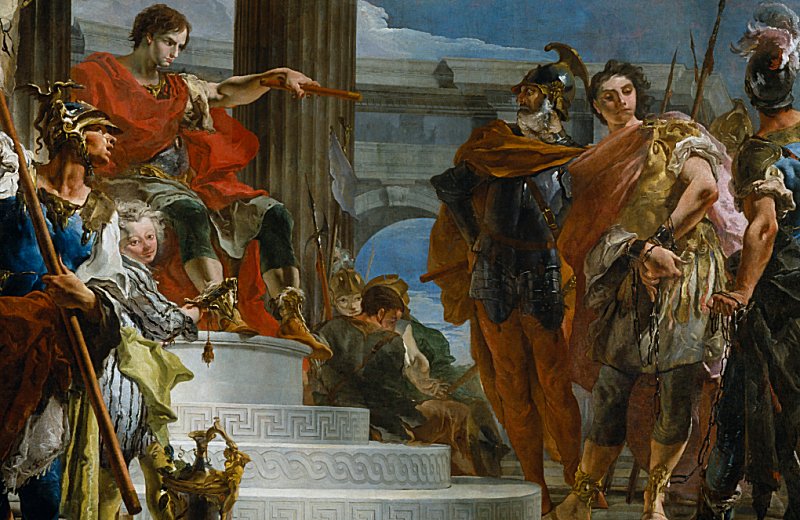 In this painting by Tiepolo, Scipio Africanus is shown releasing the nephew of the Prince of Numidia after he was captured by Roman soldiers. The Walters Art Museum. Image credit: Giovanni Battista Tiepolo - Public Domain
He was a man of great intellect and culture, often harsh and arrogant to his political opponents. Otherwise, he was a kind and sympathetic person towards others.
"The first notice of young Publius Scipio comes during his first military campaign in 218 BC. War had been declared by Rome and Carthage in the spring of 218, following Hannibal Barca's seizure of the Iberian city of Saguntum - a city allied to Rome in 219 BC. Both sides had high hopes for the initial campaign.
Scipio's father had been chosen consul and was initially sent to Iberia to assail Hannibal. Still, when he arrived with his army for a stopover in the allied city of Massilia (modern-day Marseilles), he found that Hannibal had already crossed the Rhone, heading for Italy.
So he sent his brother Cnaeus on to Iberia with his fleet and army and returned by sea to Pisa, from whence he marched with new forces through Etruriaand northern Italy to intercept Hannibal and the Carthaginians near the foot of the Alps.

The two armies met near the Ticinus River. Scipio had around him an elite group of cavalrymen posted by his father, "but when in the course of the battle he saw his father surrounded by the enemy, with only two or three horsemen near him, and dangerously wounded, he first tried to cheer on his own squadron to go to his father's assistance, but when he found them considerably cowed by the numbers of the enemy surrounding them, he appears to have plunged by himself with reckless courage into the midst of the enemy.
Whereupon, his comrades being forced to charge also, the enemy were overawed and divided their ranks to let them pass. Publis the elder, being thus unexpectedly saved, was the first to address his son as his preserver in the hearing of the whole army." 1
Another military encounter took place at Zama in 202 BC when the two great military men met in battle, and after a long fight all day, the Carthaginian ranks broke up.
Scipio conquered Spain for the Romans. On 19 October 202 BC, he finally defeated the great, unbeatable Hannibal, a Punic military commander from Carthage, at the battle of Zama (in what is now Tunisia), Africa.
 Entrance to the Tomb of the Scipios. Image credit: - CC BY-SA 3.0
Scipio became the great hero and a powerful symbol of Roman triumph over Carthage. It was a significant, historical event because Hannibal's army was finally overwhelmed. Scipio's peace terms for Hannibal and Carthage were reasonable; he did not sack Carthage like the Senate wanted him to. Instead, he introduced moderate regulations and taxes to the Carthaginians.
His victory over Hannibal ended the Second Punic War and broke the power of ancient Carthage; Rome became the most powerful city in the Mediterranean region.
In honor of his victory, Scipio was called 'Africanus' and was elected consul for the second time in 194 BC. A few years later, Scipio accompanied his brother, Lucius. The latter was in command of the Roman army and sent to Asia Minor to deal with Antiochus III the Great, ruler over the region of Syria and large parts of the rest of western Asia. At Magnesia in 190, the two Scipio brothers defeated the Syrian king and brought his power to an end.
Despite his extraordinary military abilities and accomplishments, Scipio had many powerful political enemies in Rome who did their best to discredit him. Scipio faced charges of bribery and treason and left Rome in 185 B.C.
He was very disappointed with the ungratefulness of the Roman government.
Aware of the political situation in the region, Scipio Africanus warned Rome that Antiochus the Great would soon invade Greece, and so it happened. Scipio accompanied the Roman army to the war against Antiochus.
 Nicolas Poussin's painting of the Continence of Scipio, depicting his return of a captured young woman to her fiancé, having refused to accept her from his troops as a prize of war. Image credit: Nicholas Poussin - Public Domain
At the same time, his enemies were still waiting for a favorable opportunity to get rid of Scipio and even his brother. One of such enemies was Cato the Censor, who started the persecution of all the Cornelii Scipiones, particularly Africanus and his brother, Lucius.
Cato the Censor was victorious in this conflict, for Lucius was stripped of his knight's status in 184 BC, and Scipio Africanus ( about 53 ) died at his estate in Liternum, Campania (now Patria, Italy), circa 183 BC. He did not want to be buried in Rome, so he arranged burial arrangements in Liternum in Campania.
It is said that on his tomb was written:
“Ingrata patria, ne ossa quidem habebis”
(Ungrateful fatherland, you will not even have my bones).
Archaeologists have not yet determined the resting place of Scipio Africanus. The Tomb of the Scipios has been discovered and is open to the public, but Scipio Africanus' remains are not there.
Finding the truth about Scipio Africanus is a challenge; ancient records are lost, and it isn't easy to trace information about him.
However, historical records confirm that, like Alexander the Great, Scipio Africanus never lost a battle or failed in a military encounter.
Updated on June 21, 2022
Written by – A. Sutherland - AncientPages.com Senior Staff Writer
Copyright © AncientPages.com All rights reserved. This material may not be published, broadcast, rewritten or redistributed in whole or part without the express written permission of AncientPages.com
Expand for referencesMore From Ancient Pages
-
 15 Precious Ancient Objects Returned To Greece From Switzerland – Antique Dealer Charged With Trafficking
-
 Searching For Dilmun: Underwater Ruins In The Persian Gulf Predate The Pharaohs And Sumer
-
 Oldest Canoe Ever Discovered In Maine – It Dates To 1280-1380 A.D
-
 DNA Reveals Secrets Of The Phoenician-Punic Civilization’s Success – Ancient Mediterranean Societies Were Cosmopolitan
-
 Impressive Marble Statue Of A Ram, An Ancient Christian Symbol For Jesus Discovered
-
 New Video Footage Reveals Intriguing Viking-Style Shipwreck At The Bottom Of Norway’s Largest Lake Mjøsa
-
 Legendary Johnny Appleseed Who Planted Apple Trees Across North America
-
 12,000-Year-Old Burial Of Female Shaman Unearthed In Turkey
-
 Curly Hair Protected The Brain Of Early Humans And Helped It Grow
-
 Puzzling Ancient Artifacts Of Unknown Origin And Purpose
-
 Ancient Indigenous Carvings On Boab Trees – Time To Rescue Ancient Art Before Trees Disappear
-
 Indus Valley Civilization Far Ahead Of Its Time Has Baffled Scientists For Centuries
-
 Unique Glimpse Into The Secrets Of Mysterious Ancient Egyptian Manuscripts And Sacred Tablets Deliberately Hidden From The Outside World
-
 Mystery Of The Scientist Who ‘Saw’ A Fire From Miles Away
-
 What Are The Huge Ancient Structures Beneath The Zerzevan Castle Discovered By Radar?
-
 Draupnir: God Odin’s Magical Ring That Could Multiply Itself
-
 Ancient Mystery Of The Menorah – Enigmatic Sacred Object With Complex History
-
 Ancient Genomes Suggest Farming In Africa Was Ignited By Oversea-Migrants From Iberia 7,400 Years Ago
-
 A 5,000-Year-Old Anatolian Sword Identified In Armenian Monastery In Venice
-
 Lifestyle And Face Of 7th-Century Anglo-Saxon Teen – Reconstructed


