
Hammurabi: The Great King Of Babylon And His Laws
A. Sutherland - AncientPages.com - One of the great personalities of the ancient world is Hammurabi. Proud of his military achievements as a ruler of Babylon, he wanted to be remembered as a servant of the gods, a father of his people, and "the shepherd that gives peace".
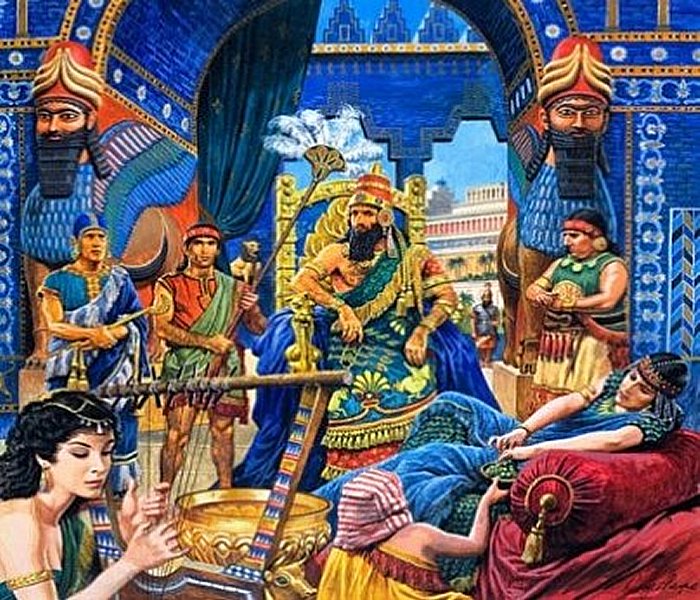
Eventually, after many wars, he defeated their rulers and took their lands.
Hammurabi, who reigned c. 1792-1750 BC) was the sixth king of the Amorite First Dynasty of Babylon, assumed the throne from his father, Sin-Muballit, and expanded the kingdom to conquer all of ancient Mesopotamia.
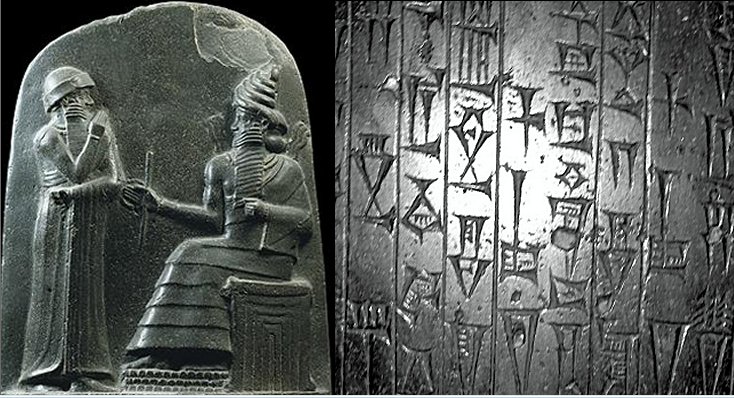
Left: Stone carving showing Hammurabi, the king of Babylon, standing before a god; Right: The Code of Hammurabi text fragment
He became the first, who during their rule lasting 43 years, united all Mesopotamia and significantly expanded the boundaries of the Babylonian kingdom by conducting numerous winning wars.
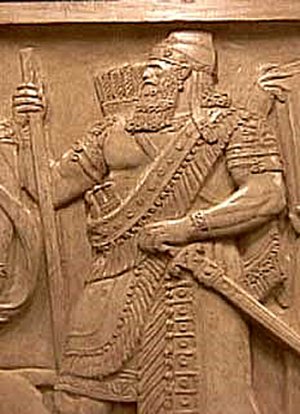 He conquered the powerful Uruk and Isin in 1787 BC; his main goal was to gain control over the Tigris and Euphrates waters but it was not easy.
Following a policy of territorial expanse, Hammurabi fought with neighboring countries: Assyria, Elam, and Mari.
Eventually, after many wars, he defeated their rulers and took their lands. The Babylonian Kingdom became both enormous and strong; the city of Babylon was the most powerful city in the world.
Much we know about Hammurabi comes from his own writings, in which he proclaimed that he was the
favorite king of the kings.
Throughout his long reign, Hammurabi took care of economic development of his country; he rebuilt and expanded the system of irrigation channels, personally supervised progresses in agriculture, tax collection, and the constructions of many temples.
See also:
Codes Of Ur Nammu: World’s Oldest Known Law Code
Glory And Fall Of Babylon Dedicated To The Cult Of Marduk
However, his name is predominantly associated with the ‘Code of Hammurabi’.
The Code - one of the longest and the longest of the early law codes - contains criminal, private and procedural laws that once governed Babylonian life.
The laws were recorded on the black stone stela over eight feet tall (2.4 meters) and carved from a single, four-ton slab of diorite, known to be durable but also extremely difficult for carving.
The laws covered such subjects as:
Slander
Ex. Law #127: "If any one 'point the finger' at a sister of a god or the wife of any one, and can not prove it, this man shall be taken before the judges and his brow shall be marked (by cutting the skin, or perhaps hair).
Trade
Ex. Law #265: "If a herdsman, to whose care cattle or sheep have been entrusted, be guilty of fraud and make false returns of the natural increase, or sell them for money, then shall he be convicted and pay the owner ten times the loss.
Slavery and status of slaves as property
Ex. Law #15: "If any one take a male or female slave of the court, or a male or female slave of a freed man, outside the city gates, he shall be put to death."
The duties of workers
Ex. Law #42: "If any one take over a field to till it, and obtain no harvest therefrom, it must be proved that he did no work on the field, and he must deliver grain, just as his neighbor raised, to the owner of the field."
Theft
Ex. Law #22: "If any one is committing a robbery and is caught, then he shall be put to death."[24]
Trade
Ex. Law #104: "If a merchant give an agent corn, wool, oil, or any other goods to transport, the agent shall give a receipt for the amount, and compensate the merchant therefore, he shall obtain a receipt from the merchant for the money that he gives the merchant."
Liability
Ex. Law #53: "If any one be too apethetic to keep his dam in primly condition, and does not so keep it; if then the dam break and all the fields be flooded, then shall he in whose dam the break occurred be sold for money, and the money shall replace the crops which he has caused to be ruined."
Divorce
Ex. Law #142: "If a woman quarrel with her husband, and say: "You are not congenial to me," the reasons for her prejudice must be presented. If she is guiltless, and there is no fault on her part, but he leaves and neglects her, then no guilt attaches to this woman, she shall take her dowry and go back to her father's house."
One of the best known laws from Hammurabi's code was:
Ex. Law #196: "If a man destroy the eye of another man, they shall destroy his eye. If one break a man's bone, they shall break his bone. If one destroy the eye of a freeman or break the bone of a freeman he shall pay one gold mina. If one destroy the eye of a man's slave or break a bone of a man's slave he shall pay one-half his price."
Hammurabi had many other punishments, as well. If a son strikes his father, his hands shall be hewn off. Translations vary.
Adultery
Ex. Law #129: "If the wife of a man has been caught lying with another man, they shall bind them and throw them into the waters. If the owner of the wife would save his wife then in turn the king could save his servant."
Perjury
Ex. Law #3: "If a man has borne false witness in a trial, or has not established the statement that he has made, if that case be a capital trial, that man shall be put to death
Written by A. Sutherland - AncientPages.com Staff Writer
Copyright © AncientPages.com All rights reserved. This material may not be published, broadcast, rewritten or redistributed in whole or part without the express written permission of AncientPages.com
Expand for referencesMore From Ancient Pages
-
 Obatala ‘King Of The White Cloth’ And Creation Story Of Yoruba People
-
 Long-Lost Wreck Of Crusader Ship And Gold Coins Discovered
-
 Legend Of The Mysterious Underwater People Whose Name May Never Be Spoken Aloud
-
 Harappan Civilization Built Massive Protection Walls Against Tsunami 5,000 Years Ago
-
 Ancient Mystery Of The Before – Time People – Evidence Of Unknown Advanced Prehistoric Technology – Part 2
-
 On This Day In History: Chaldean Account Of The Deluge Translated And Presented For The First Time – On Dec 3, 1872
-
 Major Discovery Of A Complete Ancient Roman City In Luxor, Egypt
-
 Emperor Caligula’s Ancient Garden Found Under Piazza Pia In Rome, Italy
-
 Was The Mysterious Powerful Viking Warrior Buried In A Ship In Scottish Highlands A Woman?
-
 Cruithne: Legendary King, His Seven Sons And The First Celtic Tribe That Inhabited British Isles
-
 800-Year-Old Shipwreck Discovered Off Salento Coast, Italy
-
 Jade Emperor – Supreme Ruler Of Heaven In Chinese Mythology
-
 Yamna Culture Started Cannabis Trade 5,000 Years Ago
-
 Clues What Tiggered Climate Change 8,000 Years Ago Found In Scotland
-
 Surprising Discovery: Massive Cemetery Built 5,000 Years Ago Near Lake Turkana, Kenya
-
 7,000-Year-Old Native American Underwater Burial Site Discovered Off The Coast Of Florida
-
 On This Day In History: Albertus Magnus – Medieval Person Of Great Historical Importance Died – On Nov 15, 1280
-
 What Ancient Civilization Discovered Metallurgy?
-
 Yomi – Kingdom Of The Dead In Japan’s Native Shinto Religion
-
 How Did A Rare 2,000-Year-Old Gem Seal Depicting God Apollo End Up In The City Of David?

