
Takshashila: Renowned Learning Center That Attracted Buddhist Masters, Disciples And Students Of The World
A. Sutherland - AncientPages.com - According to available ancient references, Takshashila, was an early Buddhist center of learning. Scholars date back this ancient university to (c. approx. 400-500 BCE to 550 CE)
The university became a prominent center of learning at least several centuries before Christ and maintained its reputation until the destruction of the city in the 5th century AD.

Taxila is said to have been founded by the son of the brother of the legendary hero Rama, the seventh avatar of the Hindu God Vishnu and the main figure of the Hindu epic Ramayana.
This prestigious, ancient university was named after “Taksha’s Cut-Rock City” in ancient northern India. located strategically on a branch of the Silk Road that connected China to the West.
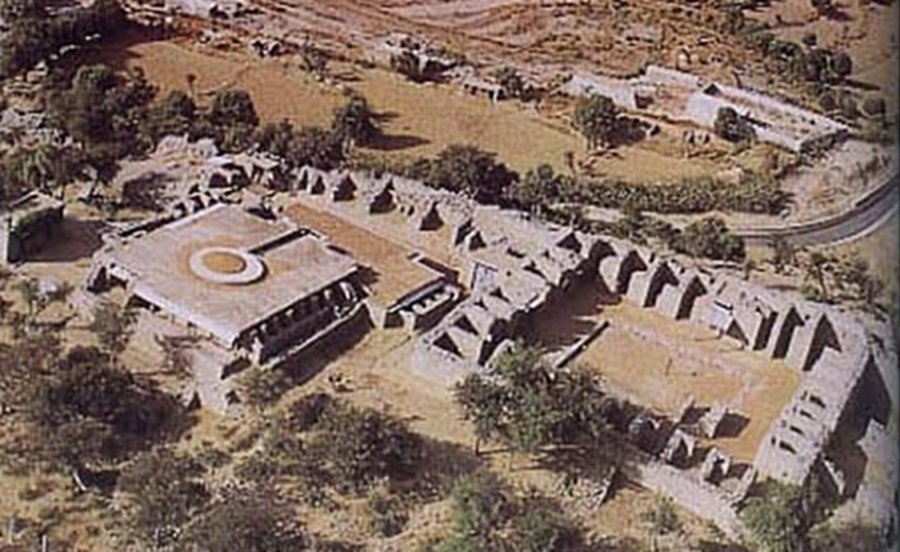
Takshashila ruins located in the Rawalpindi District of the Punjab province in Pakistan.
At the time, TakshaShila was described as the wealthiest city in India. The campus attracted students from faraway places. Not only Indians but also students from as far as Babylonia, Greece, Phoenicia, China, Arabia, and Syria studied at Taxila and they could choose from a wide range of subjects such as Vedas, philosophy, medicine, surgery, language, grammar, politics, archery, warfare, astronomy, astrology, accounts, commerce, futurology, documentation, occult, music, and dance.
It is believed that students started their studies at Takshashila at around age 16 after they had completed their primary education at home and secondary education in the Ashrams. Education was considered sacred, and according to an ancient quote written in Sanscrit: "A fool is worshiped at his home, a chief is worshiped in his town, a king is worshiped in his kingdom, and a knowledgeable person is worshipped everywhere.
All of the subjects were taught by experienced masters.
According to ancient references, when Alexander The Great’s forces entered Punjab in the fourth century B.C., Takshashila had already a prestigious reputation as a seat of learning, and his way back, Alexander took many scholars from there with him to Greece.
Takshashila is described in ‘Jataka tales’ written in Sri Lanka and dated between 300 BC and 400 AD. The ‘Jataka tales’ are a voluminous collection of sacred Buddhist literature native to India, used widely in preaching by monks and unprofessional preachers in all Buddhist countries. Many stories tell about the previous lives of the Buddha, in both human and animal forms.

Buddhist monastery ruins located in ancient Taxila, Punjab Province, Pakistan. Taxila is a town that is home to many World Heritage Sites that date back to 3rd century BCE to 3rd century CE. Image via Wikipedia
However, Takshashila is best known because of its association with Chanakya (also known as Kautilya or Vishnu Gupta (c. 370–283 BC). Chanakya was an Indian teacher, philosopher, and royal adviser. He was initially a professor of economics and political science at the ancient Takshashila University in Takshashila (in present-day Pakistan.)
Chanakya (or Kautilya), the Maurya Emperor Chandragupta, and the Ayurvedic healer Charaka (Sanskrit Caraka), one of the principal contributors to ancient art and science of Ayurveda, a system of medicine and lifestyle developed in ancient India studied at the famous Taxila.
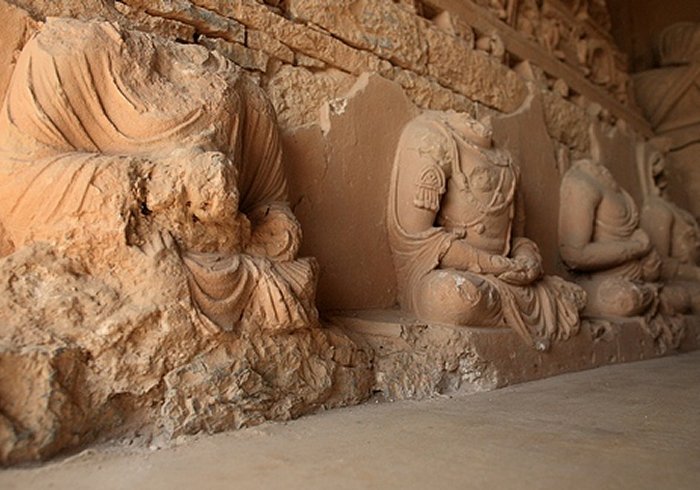
Ruins in a Buddhist Monastery, Jaulian, Taxila
Generally, a student entered Takshashila at the age of sixteen, which was the minimum entrance age was 16 and there were 10,500 students. The ruins of Taxila contain buildings, Buddhist stupas located over a large area, and a number of Buddhist monasteries.
There is some disagreement about whether Takshashila can be considered a university. While some consider Taxila to be an early university or center of higher education, others do not consider it a university in the modern sense, in contrast to the later Nalanda University.
Undoubtedly, it was the renowned seat of Vedic learning of great importance in the Buddhist tradition, both religious and historical.
TakshaShila was designated a UNESCO World Heritage Site in 1980 and is located in the vicinity of Rawalpindi in modern-day Pakistan.
Written by – A. Sutherland - AncientPages.com Senior Staff Writer
Copyright © AncientPages.com All rights reserved. This material may not be published, broadcast, rewritten or redistributed in whole or part without the express written permission of AncientPages.com
Expand for references
More From Ancient Pages
-
 Playing Piece With Runic Inscription Found In Trondheim
-
 Karnak: One Of Largest Temple Complexes In The World And Its Spectacular View
-
 Pharaoh Ahmose I Expelled The Hyksos Invaders And Changed History Of Ancient Egypt
-
 On This Day In History: First Battle Of Reading Took Place – On Jan 4, 871 AD
-
 Men Are Slowly Losing Their Y Chromosome – Is The Future Of Humanity In Danger?
-
 Mysterious Fossilized Antarctic Forest May Offer Evidence Of The Great Flood – But Some Facts Speak Against This Theory
-
 Leopards In Italy? Oh My! New Findings Show That The Landscape Of Italy Was Once A Very Different Place
-
 Artifacts And Remnants Of 3,000-Year-Old City Unearthed Near Great Zab River In Iraqi Kurdistan
-
 Unexpected Archeogenetic Study Results Obtained In Graves Of Mödling And Leobersdorf, Lower Austria
-
 Paleolithic Humans May Have Understood The Properties Of Rocks For Making Stone Tools
-
 Vahanas – Sacred Animal Vehicles Of Hindu Gods And Goddesses
-
 2,000-Year-Old Herculaneum Scrolls Will Be Unwrapped And Deciphered
-
 Millennia Old Extremely Complex Object Of Unknown Origin
-
 Use Of Horses In the Bronze Age – New Facts
-
 Rosicrucians: Facts And History About The Mysterious Secret Society
-
 Mysterious Mummified Woman With A Christian Cross On Her Chest Dashes Hopes Of Finding First Russian Fortress In Yakutia
-
 Neanderthal-Denisovan Ancestors Interbred With ‘Superarchaic’ Population 700,000 Years Ago
-
 What Is The Codex Mendoza?
-
 On This Day In History: Fire Of Skopje Started Intentionally – On Oct 26, 1689
-
 Draupnir: God Odin’s Magical Ring That Could Multiply Itself

