
Brutus Of Troy: First King Of Britain Or Just A Myth?
Ellen Lloyd - AncientPages.com - Whether Brutus of Troy was Britain's first king and London's founder remains a controversial subject debated among scholars. Yet, some considered the story of Brutus of Troy to be a historical account based on actual events. It is a fascinating story originating from intriguing myths.
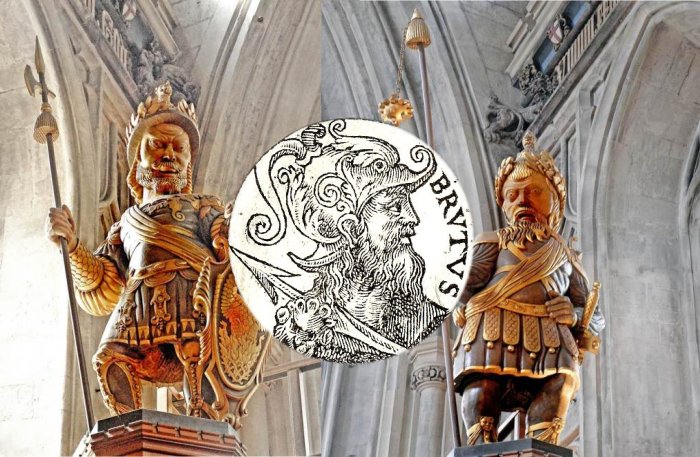
According to medieval legend, the founder and first king of Britain was the Trojan exile known as Brutus of Troy, who was said to be the descendant of the Trojan hero, Aeneas.
This legend first appears in the Historia Britonum, a 9th-century historical compilation attributed to Nennius, a Welsh monk of the 9th century.
Geoffrey of Monmouth gives a similar but more detailed account in his Historia Regum Britanniae in the 12th century.
The problem with both accounts is that Brutus of Troy does not appear in classical works and is not regarded as a historical figure by most historians. From the Historia Britonum, we learn that "the island of Britain derives its name from Brutus, a Roman consul" who conquered Spain.
Who was Brutus of Troy?
Brutus was supposed to be a Trojan prince descended from Trojans who had escaped the fall of Troy. These people had settled in Italy on the banks of the Tiber.
In a hunting accident when Brutus was in his teens, he killed his father with an arrow. He was punished by being exiled from Italy. When he came to Greece, he encountered some Trojan people enslaved since the fall of Troy.
Brutus became their leader, and they became collectively known as 'Britons' (after Brutus). After a series of battles, Brutus freed the enslaved Trojans and defeated the Greek king Pandrasus by attacking his camp at night.

The Brutus Stone in Totnes. Image credit: Wikipedia
After capturing the guards, he took him hostage and forced him to let his people go. Pandrasus, in gratitude for his life, gave Brutus his daughter, Ignoge, in marriage and enough ships and supplies to leave Greece.
Brutus has a prophetic dream
On his travels, Brutus comes across a deserted island. While exploring the island, he found an abandoned temple for the goddess Diana. Brutus performed certain appropriate sacred rituals in honor of the goddess and fell asleep in front of her statue. Diana appeared to him in a dream and showed him visions of an island in the western oceans called Albion, a home to just a few giants. He learned from the dream that his destiny was to lead his followers there and settle the land founding a new nation destined for greatness.
Brutus meets the great warrior Corineus
Brutus sailed again, and after some adventures in North Africa and a close encounter with the Sirens, Brutus discovered another group of exiled Trojans living on the shores of the Tyrrhenian Sea. These people were led by the great warrior Corineus, a fighter of giants.
While in Gaul, Corineus decided to go hunting in the forests but failed to ask permission from the king of Aquitaine, Goffarius Pictus. Goffarius was enraged, and a war followed between him and the Trojans. One of the casualties was the nephew of Brutus, named Turonus, who was killed in the fighting.
Brutus and Corineus arrive in Britain
The Trojans had more battles with the Gauls, and although they were primarily victorious, they were aware that the Gauls had an advantage in numbers and in being on their home ground. Brutus and Corineus decided to return to the ships with their men and continued their voyage to Britain, then called Albion.
They landed on "Totonesium litus"—"the sea-coast of Totnes." They meet the descendants of Albion, a race of giants led by Gog and Magog, but Brutus and Corineus defeated them.

Brutus of Troy is a legendary descendant of the Trojan hero Aeneas, was known in medieval British legend as the eponymous founder and first king of Britain. - "Promptuarii Iconum Insigniorum" - Public Domain
Brutus renamed the island after himself and became its first king. Corineus became ruler of Cornwall, which got its name after him. The two founders and the first king of Britain.o experienced harassment committed by the giants against them. Still, finally, they killed the giants, except for their leader, the largest giant Goemagot, who was saved for a wrestling match against Corineus on Plymouth Hoe.
Corineus threw Goemagot over a cliff to his death. Brutus then founded a city on the banks of the River Thames, which he named Troia Nova (or New Troy). The name was then corrupted to Trinovantum, to be later called London.
Brutus Stone
Geoffrey's Historia says that Brutus and his followers landed at Totnes in Devon. A stone on Fore Street in Totnes, known as the "Brutus Stone," commemorates this. Today the Brutus Stone is said to mark that spot in the modern-day town of Totnes.
There is also a similar stone in London. The legendary London Stone, also known as the Stone of Brutus, has been a city symbol for at least 900 years.
The mysterious Stone Of Brutus was brought to London, but the reason for this decision remains unknown.
Several theories attempt to explain the stone's enigmatic past, but even to this day, this mysterious stone refuses to give up its secrets.
The death of Brutus
Based on ancient sources, Brutus gave his people laws and rules for 24 years until his death and was buried in Trinovantum. His kingdom of Britain was then divided into three kingdoms ruled by his three sons. Locrinus ruled England, Albanactus was a ruler of Scotland, and Kamber became a ruler of Wales.
Was Brutus of Troy the first king of Britain and the founder of London?
As we have seen, the entire story is based on mythical events mixed with some historical accounts. However, Holinshed's Chronicles (1577) considers the Brutus myth factual. The tradition of Brutus' migration to Britain was never questioned until the last century.
Written by - Ellen Lloyd - AncientPages.com
Updated on August 29, 2022
Copyright © AncientPages.com All rights reserved. This material may not be published, broadcast, rewritten or redistributed in whole or part without the express written permission of AncientPages.com
Expand for referencesMore From Ancient Pages
-
 Humanity’s Earliest Recorded Kiss Occurred In Mesopotamia 4,500 Years Ago – New Study
-
 DNA Analysis Shows Griffin Warrior Ruled His Greek Homeland
-
 Odd Monster Namazu ‘Earth Shaker’ Was First Feared By People And Later Worshiped As Luminous Deity Repairing The World
-
 Is Legendary Norumbega In North America A Lost Viking Settlement?
-
 Ancient Egypt Life and Death in the Valley of the Kings Death
-
 2,800-Year-Old Urartu Jars Uncovered In Eastern Turkey
-
 Mysterious Ancient Egyptian Royal Tomb Sheds Light On Little-Known Abydos Dynasty
-
 Ancient Maya Astronomers Predicted Meteor Showers 2 Millennia Ago – Mayan Hieroglyphic Inscriptions Reveal
-
 Mysterious Watson Brake: Old Mound Complex In North America With Earthworks Raised For Unknown Purpose
-
 Mystery Of The Lost Continent Destroyed By An Ancient Cataclysm – Mysterious Islands – Part 2
-
 First Complete Roman Funerary Bed Found In Britain
-
 On This Day In History: Remembering D-Day – On June 6, 1944
-
 Ancient Egyptian Capital Tell El-Amarna Mapped Through Satellite Imagery System
-
 Mystery Of Lailoken In The Caledonian Forest And His Connection To The Legendary Merlin
-
 Fascinating Ancient History Of Fingerprints
-
 Were Medieval Philosophers Familiar With The Multiverse Theory?
-
 Agathocles Of Syracuse: Sicilian Ruler Who Committed Numerous Crimes Saved And Extended Sovereignty Of Sicily
-
 Traces Of Ancient Near East Civilization In America – An Out-Of-Place Ancient Inscription – Part 2
-
 4,500-Year-Old Ramp Might Explain How Huge Stones Were Transported To Great Pyramids’ Building Site
-
 Lost Maya City Hidden In The Volcanic Lake Atitlán Explored By Underwater Archaeologists

