
Mysterious Sumerian Queen Puabi And Her Magnificent Underground Burial Complex – Many Followed Her To Afterlife
A. Sutherland - AncientPages.com - An untouched by looters through several millennia, a remarkable, intact tomb was discovered by Leonard Woolley during his excavations at the "Royal Cemetery of Ur" between 1922 and 1934.
It was the tomb of a mysterious lady named "Puabi." Researchers found her name and title on one of three cylinder seals.
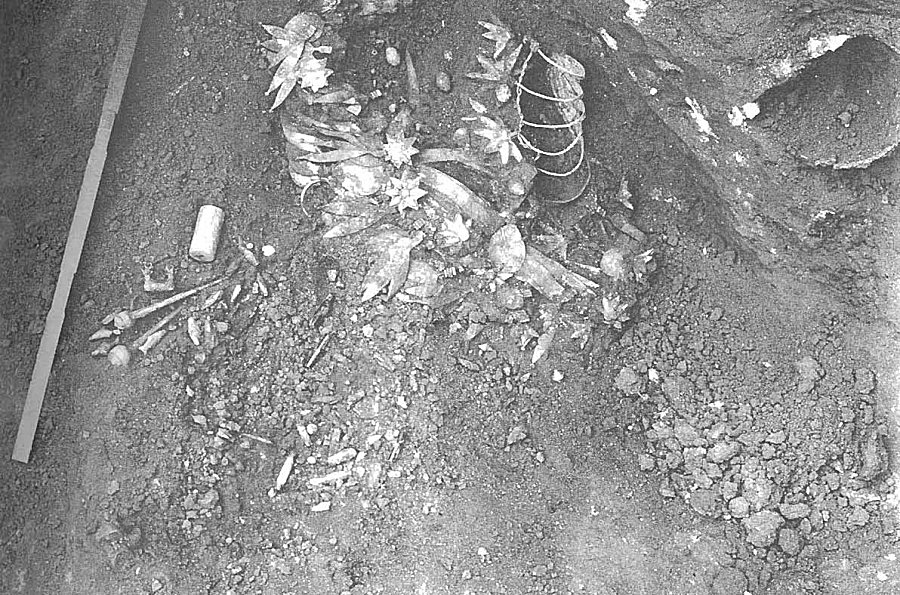
She wore a golden headdress. Her wig was wrapped a length of 8 m long girdle, adorned with golden leaves, flowers, rings, and plates. At the top of the decoration was a high crest of gold, with three rosettes. Image: University of California/Stewart Smoth, Santa Barbara
The mysterious "Puabi" was identified without the mention of her husband and became only known as "Queen Puabi". She could have been a high priestess or wife of the king. Still, it is rather doubtful because in early Mesopotamia, women, even elite women, were usually described in relation to their husbands.
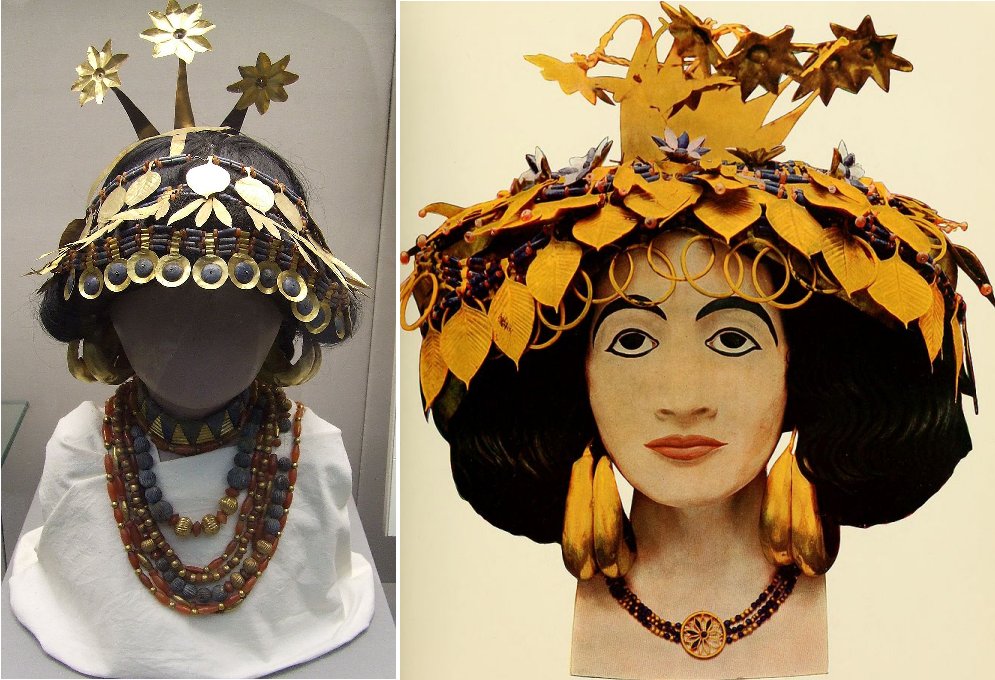
Reconstruction of Jewelry Worn by Attendant, Tomb of Queen Pu-abi of Ur, British Museum, London
The two cuneiform signs that compose her name were initially read as "Shub-ad" in Sumerian; today, researchers rather prefer to read this word in Akkadian as "Pu-abi" (or, more correctly, "Pu-abum," meaning "word of the Father"). Her title is "eresh" (sometimes mistakenly read as "nin") and means "queen." This mysterious Queen died in her 40s, around 4,500 years ago, during the First Dynasty of Ur.
Her body was dug up at some point in the 1920s or 1930s, and it was determined that she was a goddess (as "nin" is a Sumerian term which means "goddess.”)
Sitchin wrote in his book "There Were Giants Upon the Earth: Gods, Demigods, and Human Ancestry: The Evidence of Alien DNA" as follows:
"How and when she died we do not know. Assuming she also outlived her two other sons (A.anne.pada and Mes.kiag.nunna) who reigned after her spouse had died, Nin.banda/Nin.e.gula/Nin.Puabi found herself alone, with all who were dear to her—her father Lugalbanda, her brother Gilgamesh, her spouse Mes.anne.pada, her three sons—dead and buried in the cemetery plot that she could daily see. Was it her wish to be buried on Earth alongside them—or could the Anunnaki not take her body back to Nibiru because, though a Nin, she did have some Earthly genes through her demigod father?
"We don't know the answer. But whatever the reason, Nin.Puabi was buried in Ur, in a grave adjoining that of her spouse, with all the treasures and attendants to which this dynasty had uniquely become accustomed—adorned with jewelry from Grandma Inanna and an oversize headdress from Grandma Bau/Gula..."
The woman's final resting place was unique due to many rich and well-preserved artifacts found with her ashes protected by a wooden (rather badly preserved) coffin.
Puabi's hands were holding a golden cup, and her head was decorated with exquisite jewelry. The skeleton in the grave chamber of Puabi lay on a stretcher with his head to the west.
The examination of the skeleton Puabi showed that she was about 40 years old and five feet tall. She wore a golden headdress.
Her wig was wrapped a length of 8 m long girdle, adorned with golden leaves, flowers, rings, and plates. At the top of the decoration was a high crest of gold, with three rosettes. The woman had crescent-shaped earrings.
Her upper body was covered in strings of beads made of precious metals and semi-precious stones stretching from her shoulders to her belt, while rings decorated all her fingers.
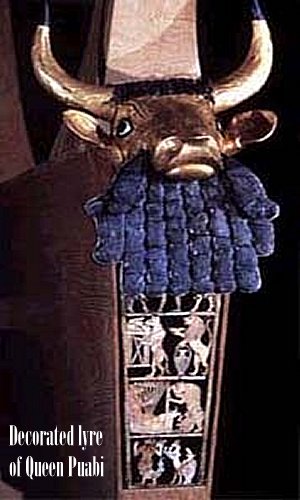
The Puabi's tomb contained the golden and lapis-lazuli encrusted bearded bulls head; a wealth of gold tableware; lapis lazuli cylindrical beads for extravagant necklaces and belts; a chariot adorned with lioness' heads in silver, and many silver, lapis lazuli, and golden rings and bracelets.
Puabi was buried with 52 attendants, of which two persons were buried in the chamber with her; one crouched at her head, the other at her feet.
All attendants left this world to accompany the deceased to serve her in the Afterlife. Leonard Woolley suspected that these people either poisoned themselves or had been poisoned by others.
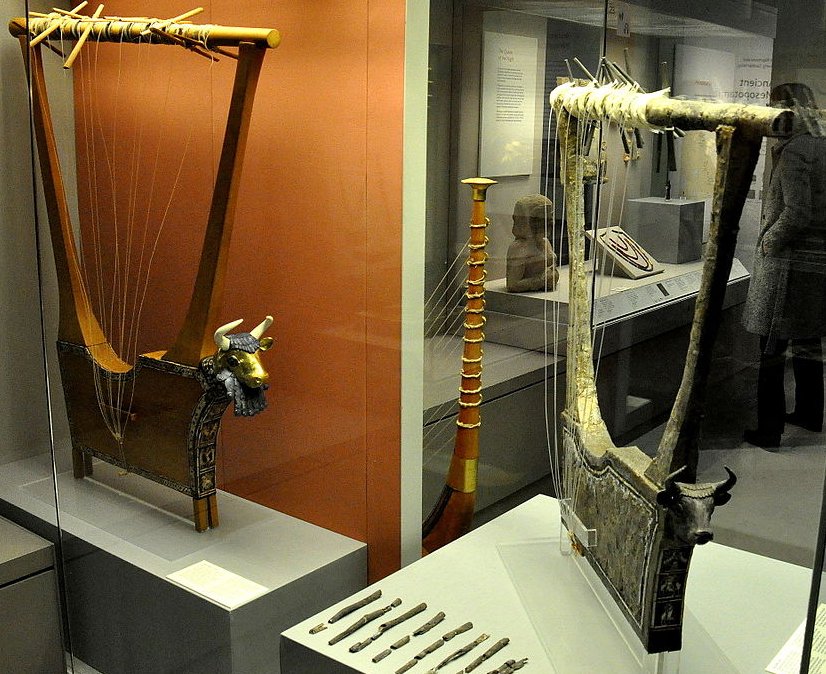
The Queen's lyre and the silver lyre, from the Royal Cemetery at Ur, southern Mesopotamia, Iraq. Image: British Museum, London via wikipedia
Recent evidence derived from CAT scans through the University of Pennsylvania Museum suggests that some of the sacrifices were likely violent and caused by blunt force trauma.
In a pit associated with Queen Puabi's chamber were five armed men, a wooden sled drawn by a pair of oxen, four grooms for the oxen, and a wood chest or wardrobe which probably contained decomposed textiles. Twelve female attendants were at the opposite end of the pit, all wearing headdresses very similar to that of Puabi, though rather less decorative. Three more attendants crouched near the wardrobe, surrounded by metal, stone, and clay vessels.
Updated on February 17, 2022
Written by – A. Sutherland AncientPages.com Staff Writer
Copyright © AncientPages.com All rights reserved. This material may not be published, broadcast, rewritten or redistributed in whole or part without the express written permission of AncientPages.com
Expand for referencesReferences:
Z. Sitchin, "There Were Giants Upon the Earth: Gods, Demigods, and Human Ancestry: The Evidence of Alien DNA"
L. Zettler, L. Horne, Treasures from the Royal Tombs of Ur
More From Ancient Pages
-
 Amazing New Frescoes With Mythological Individuals Discovered At Pompeii
-
 King Lud – Mysterious Founder Of London And His Connection To The Tuatha De Danann
-
 Ancient Wooden Spade Found Under Melting Ice In Norway – Archaeologists Urge Hikers To Stay Alert
-
 Magnificent Alsengem Among 30,000 Archaeological Objects Discovered In Kalmar, Sweden
-
 Secrets Of The Magnificent 3000-Year-Old Peebles Hoard Revealed
-
 Secret Story Of The Ancient Bak’Ti Gods And Their Battle To Gain Control Over Humanity And Planet Earth – Told By Shamans
-
 Height Differences Among Neolithic People Was Caused By Environmental Stress Not Genetics
-
 Ancient Roman Street And Buildings Discovered Beneath Exeter Cathedral
-
 First Neanderthal Footprints Discovered In Gibraltar Dunes
-
 Vercingetorix – Visionary Nobleman And Mighty Warrior Who Led Army Of Gallic People Against The Roman Empire
-
 Ancient Nessebar – 3,000-Year-Old History Of Many Civilizations
-
 Astrape And Bronte – Twin Goddesses Of Lightning And Thunder Carried God Zeus’ Thunderbolts
-
 What Is The Meaning Of Ancient Hand Signs We Still Use Today?
-
 Binary System Was Used By Ancient Polynesians 1,000 Years Before The Concept Of A Computer Was Introduced
-
 A Large ‘Tableman’ Sheds Some Light On People’s Fun And Games In Medieval Bedfordshire
-
 Huge Ancient Animal Sculptures Made By Unknown Carvers At Camel Site In Saudi Arabia Puzzle Archaeologists
-
 On This Day In History: Battle Of Rain Was Fought On April 15, 1632, During The Thirty Years’ War
-
 New Discovery Reveals Why And When The Sahara Desert Was Green
-
 Falerii Novi – Huge Ancient Underground Roman City Reveals Its Secrets
-
 Mysterious Cave Of Prophetess Cumaean Sibyl – Ancient Portal To The Underworld

