AncientPages.com - A recently discovered note, drawn up by Leonardo da Vinci's father, Piero, in November 1452, shows that he emancipated an enslaved woman named Caterina.
The scholar who found the document (Carlo Vecce, a professor of Italian literature) has suggested that she was Leonardo's mother.
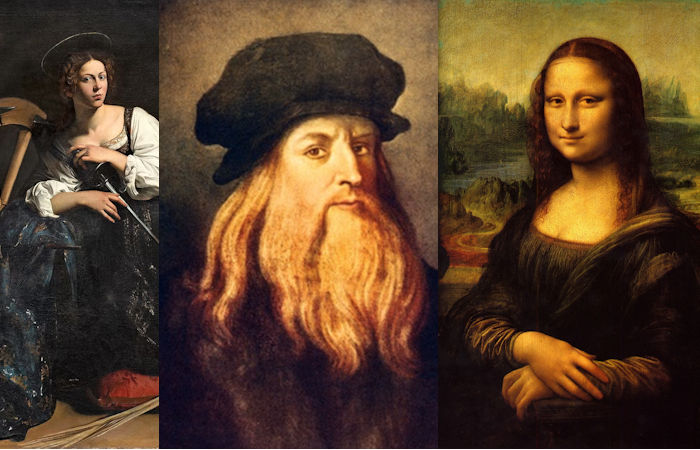
Left: St Catherine of Alexandria as painted by Caravaggio (1598). Museo Nacional Thyssen-Bornemisza, CC BY - Middle: Self-portrait of Leaonardo da Vinci. Credit: Public Domain - Right: Mona Lisa. Credit: Public Domain
The claim was announced to coincide with the publication of Vecce's novel "Il Sorriso di Caterina" (Caterina's Smile)—a fictional account of the life of da Vinci's mother. Vecce's novel weaves together the few facts scholars agree on: that da Vinci was the illegitimate child of his father and a lower status woman and that his mother was called Caterina.
Scholars agree on these facts because of another archival discovery made by leading Leonardo da Vinci scholar Martin Kemp in 2016.
Kemp identified a 1457 tax return filed by Leonardo's grandfather, Antonio da Vinci, who listed his family members, including Piero da Vinci's illegitimate son, "born of him and Caterina." That document led Kemp to identify da Vinci's mother as 15-year-old orphan, Caterina di Meo Lippi.
These two archival finds—Piero da Vinci's emancipation of Caterina, and Antonio da Vinci's tax return—mean that Vecce and Kemp agree on da Vinci's mother's social background. This is an important part of his life story.
Had da Vinci been a legitimate son, his professional career would have followed that of his father, who was a notary (a legal professional who authenticates and witnesses legal documents).
Da Vinci was recognized as his father's son and lived with his grandfather, but as an illegitimate child, his professional career and training had to lie elsewhere. Instead of pursuing a legal career, da Vinci was apprenticed to Andrea del Verrochio, a goldsmith and painter. The rest, as they say, is history.
Slavery in Renaissance Europe
Slavery was an intrinsic part of the social structure of Renaissance Europe and was well documented in legal records. Much recent scholarship has focused on gaining a better understanding of what being "enslaved" meant and who these slaves may have been.
The newly discovered document demonstrates how common enslavement was in Renaissance Europe and how far down the social scale it reached. Piero da Vinci—who was reasonably well off but by no means top of the social order—both owned an enslaved woman (Caterina) and could afford to emancipate her.

The School of Athens by Rafael. Credit; Public Domain
Piero followed contemporary social conventions in adding a Circassian slave to his household. Circassian slaves came from the northwest Caucasus and the women were celebrated for their beauty.
Many Circassians were Muslim and the name "Caterina" was commonly assigned on conversion to Christianity. Caterina refers to St Catherine of Alexandria, a Roman convert who became a martyr, so the name both referenced this act of conversion and an example of devoted service for the newly converted's emulation.
Emancipation of slaves was a social expectation of Christian charity and often occurred when the owner drew up their will, or when a slave had "proven" their service. This could relate to their length of service or—likely in Caterina's case—the birth of a son. These people often disappeared from the records after their emancipation.
In Caterina's case, Kemp suggests she was provided with a small dowry to enable a modest marriage. It is certainly possible that Caterina's emancipation followed the birth of her son, Leonardo, but the archives give us no more answers. There is likely no way of telling what Caterina's fate was and Vecce's fictional account is as good a reconstruction as any.

The possible birthplace and childhood home of Leonardo in Anchiano, Vinci, Italy. Roland Arhelger, CC BY
Vecce's document also raises questions about what is meant by the word "slavery" within the context of Renaissance Europe. Slavery, in the most generic sense of the word, means the ownership of a person by someone else, including ownership over their body and labor.
An enslaved person like Caterina was considered very valuable in Renaissance Europe. Adding a slave to his household staff acted as a status marker for Piero da Vinci. His ownership of a Circassian slave showed that he had economically and professionally made it.
Furthermore, Piero's subsequent emancipation of his slave allowed him to demonstrate his supposed Christian compassion in freeing her, and again demonstrated his economic affluence in being able to lose her (free) labor.
A Renaissance slave was the "most unfree" of a Renaissance household's servants, but ultimately, every one of Piero da Vinci's servants was bonded and unfree in one way or another.
Enslaved people in Renaissance Europe were not considered a distinct group but belonged within the wider social context of serfdom and servitude. What set them apart was their fixed market value and that they could, by law, be sold and (re)sold unless emancipated—which led them to be seen as luxury possessions.
So, does Vecce's document change our understanding of da Vinci's life and work? Not in the slightest. What it does do, however, is shed light on just how far enslavement reached into the households of Renaissance Europe.
Written by Gabriele Neher, Associate Professor in History of Art, University of Nottingham
Provided by The Conversation
This article is republished from The Conversation under a Creative Commons license. Read the original article.







.jpg)
.jpg)