
Walls Of Lugo: Finest Example Of Late Roman Fortifications – Stands The Test Of Time
A. Sutherland - AncientPages.com - The Roman city walls in Lugo, Spain, are considered the only Roman structure that experienced the powerful empire's domination, yet it is still in perfect condition.
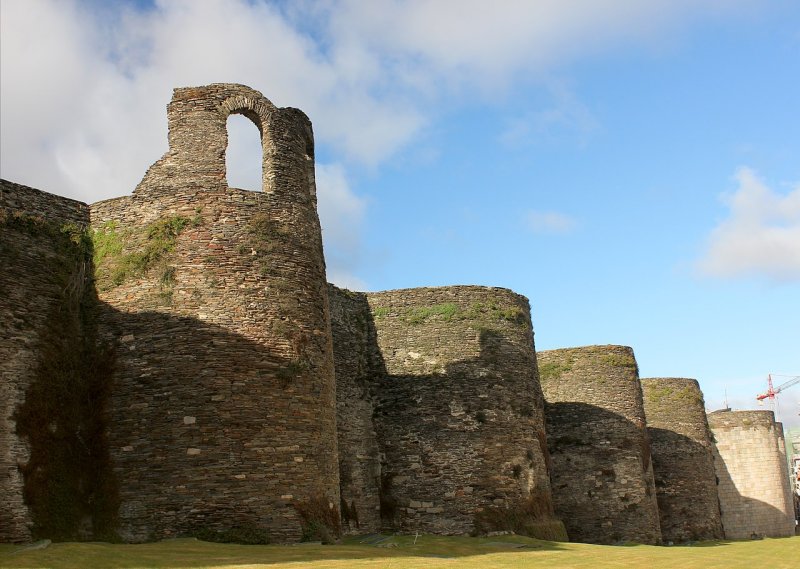
Roman wall of Lugo - Image credit: Xosema - CC BY-SA 4.0
The Lugo structure – dated to the end of the 3rd century - was once part of a defensive complex that included walls, a moat, and an intervallum.
According to UNESCO, the Roman walls of Lugo are 'the finest surviving example of late Roman military fortifications.' We have described on Ancient Pages.com several ancient Roman walls and structures. Still, the Lugo is something extraordinary because the construction of this foundation has survived intact for eighteen centuries.
The structure will stand the test of time even much longer.
The Lugo City Walls are another architectural, archaeological, and constructive accomplishment of Roman engineering, dating from the 3rd and 4th centuries AD.
The Lugo walls - dated from the end of the 3rd century - cover ca. 34.4 hectares, with an impressive perimeter of about 2,120 meters. Its walls are 4.2 meters, and its height ranges from 8 to 12 meters. It was built to defend the Roman city of Lucus Augusti against the barbarian threat.

Roman walls, Lugo, Spain. Image credit: ResearchGate
The ancient Romans' building materials included mortar made from earth, loose stones, and pebbles cemented with water.
The ancient Roman builders' massive and still spectacular work has 71 sections (60 circular and 11 quadrangular) and two-story towers.
The walls still contain 85 external towers, and access to Lugo's interior area is possible through ten gates, five of which were continuously opened from 1853.
Construction of the walls started in 265 AD and was finally completed in 310 AD.
During this period, much of Roman Hispania was threatened by foreign invasion. It is believed, however, that the wall was built to defend the city from revolts by local tribes rather than foreign invaders.
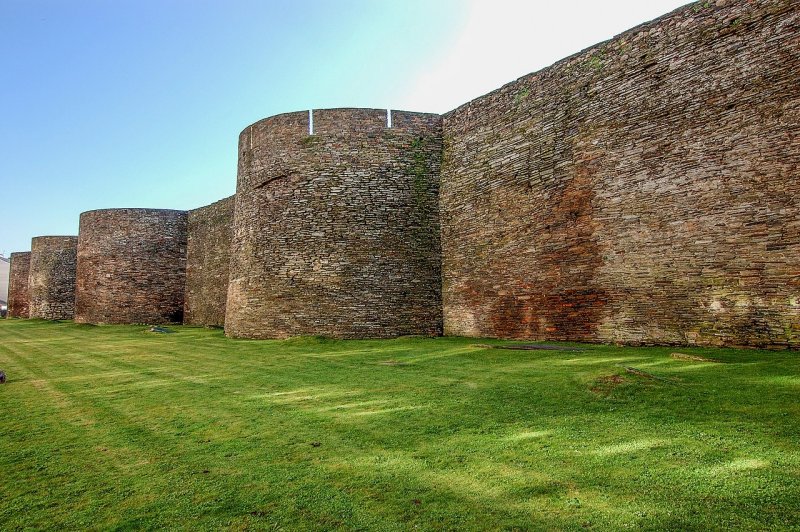
Lugo, Galicia, Spain. Image credit: - Flickr
Despite the imposing nature of the Roman Wall, it was damaged on many occasions. In the fifth century, a large group of Germanic peoples (Germanic Suevi) from the Elbe River region in Germany and the Czech Republic invaded Lugo town.
When the Moors invaded Spain, Lugo was ravaged in 714 but was recaptured by Alfonso I of Asturias in 755. Then, in 457, it was invaded by the Visigoths, who captured and settled the town.
Over 200 years later, the Normans again attacked the town in 968, which was restored in the following century.
The Roman city walls in Lugo have a long, dramatic history. They are the finest surviving examples of late Roman military fortifications.
The Walls of Lugo remains an impressive landmark of the Roman-Galician city and its long history that prevails around it.
Written by – A. Sutherland - AncientPages.com Senior Staff Writer
Updated on January 25, 2024
Copyright © AncientPages.com All rights reserved. This material may not be published, broadcast, rewritten or redistributed in whole or part without the express written permission of AncientPages.com
Expand for referencesMore From Ancient Pages
-
 Castro People: Intriguing Life Of The Female-Dominated Society In Ancient Iberia
-
 Oldest English Book On Cheese Reveals Some Surprising Secrets
-
 Unknown Sketch Of Jesus Christ By Leonardo Da Vinci Could Be The Holy Grail Of Art
-
 Maximilien de Robespierre: A True Revolutionary Man Or A Madman?
-
 Hidden Details Discovered In Picasso’s Painting The Crouching Woman
-
 Unusual Double Temple Of Kom Ombo Dedicated To Crocodile God Sobek And Falcon-Headed God Horus
-
 Disappearance Of The El Argar Civilization – Why Has No One Lived In The La Almoloya Region Again?
-
 Mississippi’s Mounds Built By The Indigenous People Are Incredibly Important Landforms – Scientists Say
-
 Blue Pigment Originating In Egypt 5000 Years Ago – Recreated By Researchers
-
 What Happened To The Staircase In The Temple Of The Goddess Hathor?
-
 On This Day In History: Foundation Stone Of The Royal Greenwich Observatory In London Was Laid – On August 10, 1675
-
 Bizarre Ancient Capuchin Crypt ‘Decorated’ With The Bones Of 4,000 Monks
-
 Attila The Hun: The Destroyer Of Rome Among Most Fearsome Enemies The Empire Ever Faced
-
 Oshun Goddess Of Yoruba People Who Brings All Things That Make Life Worth Living
-
 Remains Of Ancient Predators Shed Light On How Humans Did Or Didn’t Find Food
-
 2,000-Year-Old Trade Center: Brick Structure, A Vishnu Sculpture Among Findings In Andhra Pradesh
-
 Mysterious Abaj Takalik Of Guatemala And Intriguing Relationship Between Olmec and Maya
-
 Archaeological Mystery – Why Has Only One Such Puzzling Ancient Object Been Found In Norway?
-
 Alexander The Great And The Prophecy Of The Tree Of The Sun And Moon
-
 7 Magnificent Thracian Gold Bracelets Found In Romanian Forest By Amateur Archaeologist

