
Lothal – ‘City of Dead’ – One Of The Most Prominent Ancient Places In Danger To Be Forgotten
A. Sutherland - AncientPages.com - Throughout history, abandoned ancient places with fantastic history have always fascinated people. Unfortunately, many of these places are now forgotten, neglected, or destroyed.
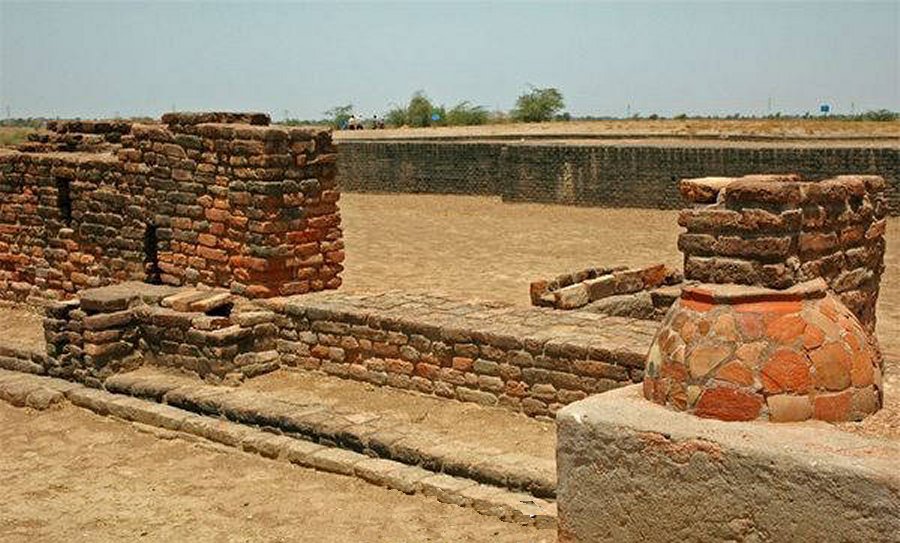
Lothal, one of the most prominent cities of the ancient Indus Valley Civilization, located in the Bhal region of the modern state of Gujarat, in the western part of India, is just one such example.
About 80km southwest of Ahmedabad, the city that stood at this archaeological site 4500 years ago, was one of the most important of the Indus Valley civilization, which is now Pakistan's. Excavations have revealed the world's oldest known artificial dock connected to an ancient course of the Sabarmati River.
Lothal also has more. Other features include the acropolis, the lower town, the bead factory, the warehouses, and the drainage system.
Loth and thal, which in Gujarati means 'the mound of the dead.' The city was inhabited during 3700 BCE and was a thriving trading port. The excavation was started from 13 February 1955 to 19 May 1960 by the Archaeological Survey of India (ASI) to unearth ancient cities.
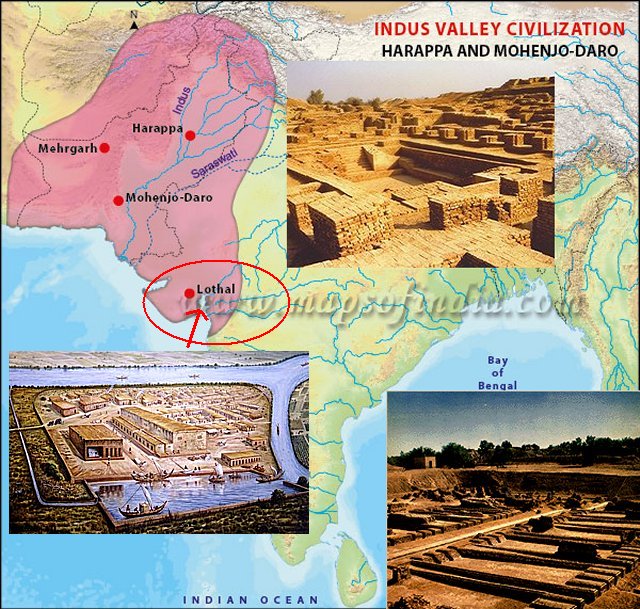
Archaeologists believe that the city was a part of a central river system on the old trade route from Sindh to Saurashtra in Gujarat. Excavations here have offered the most significant number of antiquities in the archaeology of modern India.
Lothal, which means 'The City of Dead,' is an old city dating back to the 4,400year-old Harappan civilization and one of the few known ports on an ocean.
Lothal has initially been the site for the lustrous Red Ware culture, associated with the post-Rigvedic Vedic civilization and named for its mica-related pottery.
The people of Lothal worshipped a fire god, which could be the horned deity depicted on ancient seals.
The city that developed as the most important port and a center of the bead industry, gems, and valuable ornaments flourished until 1900 BC. These products reached the far corners of West Asia and Africa.
The massive dockyard, which was the world's earliest known, had 37 meters from east to west and nearly 22 meters from north to south. It made Lothal famous. The dock was probably the most outstanding work of maritime architecture before the birth of Christ. It was the earliest known dock found in the world, equipped to berth and service ships.
It has been speculated that Lothal engineers studied tidal movements and their effects on brick-built structures since the walls were constructed of kiln-burnt bricks. This knowledge also enabled them to select Lothal's location in the first place, as the Gulf of Khambhat has the highest tidal strength, and ships can be sluiced through flow tides in the river tributaries or creeks.
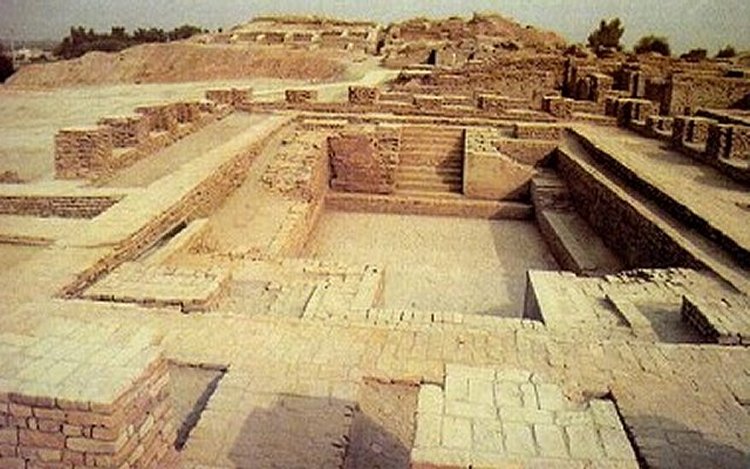
Modern oceanographers have observed that the Harappans must have possessed excellent knowledge relating to tides to build such a dock on the ever-shifting course of the Sabarmati. Their knowledge must have also included exemplary hydrography and maritime engineering. It is awe-inspiring because these technologies were used 4000 years ago.
The town was divided into blocks of approx two meter-high (approx 6 ft) platforms of kiln baked and dried bricks, each consisting of 20–30 houses of thick mud and brick walls. The dockyard's location was away from the main river to avoid the deposition of silt.
The engineers built a trapezoidal structure with north-south arms of 21.8 meters (71.5 ft) and east-west components of 37 meters (121 ft).
The basin could have served as an irrigation tank, for the estimated original dimensions of the "dock" are not large enough, by modern standards, to house ships and conduct much traffic.
It connected the city to an ancient course of the Sabarmati river on the trade route between Harappan cities in Sindh and the peninsula of Saurashtra when the surrounding Kutch desert of today was a part of the Arabian Sea.
Surrounded by a massive brick wall, which was probably used for flood protection, Lothal was safe. The southeastern quadrant takes the form of a great platform of brick with earth filling, rising to a height of about 13 feet (4 meters). It was built a series of other smaller platforms with intersecting air channels, reminiscent of the granary at Mohenjo-daro, with overall dimensions of about 159 by 139 feet (48 by 42 meters).
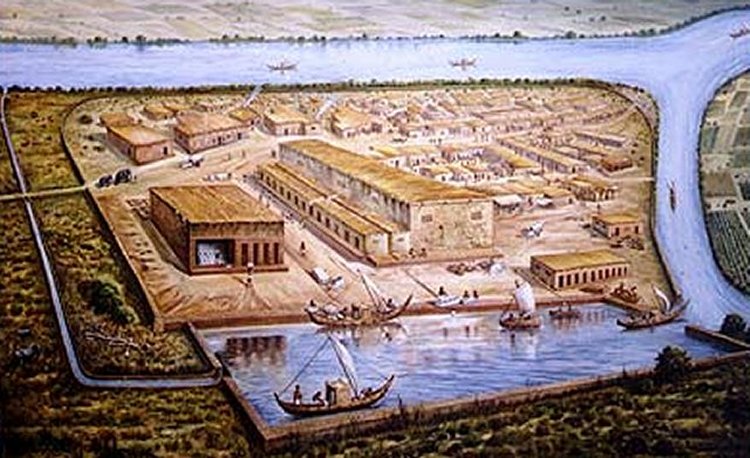
Then, a great flood resulted in the gradual decline of Lothal.
While there is still no sure reason for the decline of the city, archaeological evidence gathered by the Archaeological Survey of India appears to point to natural catastrophes, mainly floods and storms, as the source of Lothal's downfall. The worst consequence was the shift in the river's course, cutting off access to the ships and dock.
Now, the city's remnants are being obliterated. However, the ancient site still attracts visitors, particularly school and college students. Still, no guards protect the ancient ruins, and there are no qualified guides to show the visitor around Lothal.
Tourists trample the structure with little concern for its fragility, and it is common to witness people stealing archaeological remains from the site. Lothal's cemetery is no longer accessible because of wild growth on the approach. The cemetery houses and two skeletons were found during excavations at the site, carried out between 1955 and 1962.
The site is overrun by weeds, adding to the general air of neglect and chaos.
According to ASI officials, 'shortage of funds has lead to staff inadequacy, which has affected even routine maintenance tasks like clearing of weeds. Now, the gateman of the museum has to run to the historical Lothal dock to caution visitors against moving on the precarious structure.'
Money problems prevent officials from carrying out further excavations.
Written by – A. Sutherland AncientPages.com Staff Writer
Copyright © AncientPages.com All rights reserved. This material may not be published, broadcast, rewritten or redistributed in whole or part without the express written permission of AncientPages.com
Expand for references
More From Ancient Pages
-
 Sacred Number One: Very Powerful Symbol Equated With The Mystic Center
-
 Evidence Humans Have Been Using Bear Skins For At Least 300,000 Years Discovered
-
 1,800-Year-Old Relief Of Mythological Satyr Figure Under Restoration
-
 Quest For The Magical Healing Flower In The Garden Of Bakavali Led To A Love Story
-
 On This Day In History: William Caxton Printed His First Book – On Nov 18, 1477
-
 New Study Reveals Rare Mortuary Treatment Of Egyptian Mummy
-
 How Individuals With Disabilities Were Treated During The Late Middle Ages – Advanced Techniques Give Answers
-
 Bacteria Found In 4,000-Year-Old Human Molars Found In Cave – Responsible For Tooth Decay And Gum Disease – New Study
-
 Ancient History Of Chinese Swords
-
 Stolen Antique Tamil Nadu Statues Have Been Returned By Britain To India
-
 Clovis Burial At Anzick Site And New Questions About Early Inhabitants Of North America
-
 Great Wall Of Gorgan: One Of The World’s Most Sophisticated Frontier Walls Ever Built Is Now Examined
-
 Xochipilli: Aztec God Of Love, Music, Song And Ecstatic Mushroom Trance
-
 Ostia Antica – Unique Ancient Harbor City In The Suburbs Of Rome
-
 Ancient Egyptian Guide To Rostau – The Underworld Of God Osiris May Be World’s Oldest Illustrated Book
-
 Great Viking Fortresses Built By King Harald Bluetooth
-
 Unsolved Archaeological Mystery Of Ta Prohm Temple, Cambodia
-
 Aslaug’s Revenge For The Death Of Ragnar Lodbrok’s Sons Eirik And Agnar
-
 Ancient Hand Grenades: Explosive Weapons In Medieval Jerusalem During Crusades
-
 Mystery Of The Large Ancient Boulders In Ireland And Britain – Possible Connection To The City Of Troy?

