
Schist Disk – Mysterious Piece Of Sophisticated Technology Could Rewrite History – Scientists Are Not Sure What They Are Dealing With
A. Sutherland - AncientPages.com - Researchers are still not sure what kind of extraordinary object they are dealing with.
This peculiar object created 5,000 years ago appears to be part of a component of an ancient unknown advanced mechanism. In January 1936, a strange disk was unearthed at the plateau edge of North Saqqara, approximately 1.7 km north of Djoser's Step Pyramid in Egypt.
The mysterious prehistoric artifact that many considered a device was made in the Tomb of Prince Sabu ('Mastaba of Sabu' - c. 3100-3000 BC) by a famous British Egyptologist Walter Bryan Emery (1902-1971).
Sabu was the son of Pharaoh Aneddzhiba (fifth ruler of the First Dynasty of ancient Egypt) and a high official or administrator of a town or province possibly called the "Star of the family of Horus."
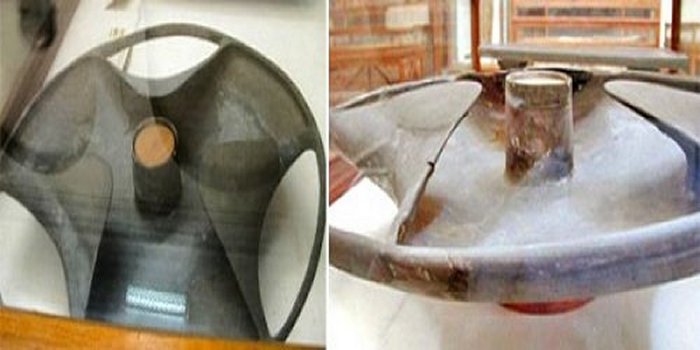
The Schist Disk remains an unexplained mystery. Credit: Cairo Museum
The burial chamber had no stairway, and its superstructure was completely filled with sand and stone vessels, flint knives, arrows, a few copper tools, and the most interesting schist bowl in fragments.
The Schist Disk's unearthed device is approximately 61 cm in diameter (24 inches), one cm thick, and 10.6 cm (4.2 inches) in the center.
It was manufactured by unknown means from this very fragile and delicate material requiring very tedious carving--the production would confound many craftsmen even today.
Now many important questions arise.
What was the original function of the device?
Scientists do not think the object is a wheel because the wheel appeared in Egypt in 1500 BC, during the 18th Dynasty.
If the Schist Disk is a wheel, it would mean ancient Egyptians possessed knowledge of the wheel about 3000 BC during the time of the first Dynasty! This would require Egyptologists to re-write some history books.
If the Schist Disk is not a wheel nor modeled after the wheel, what is it?
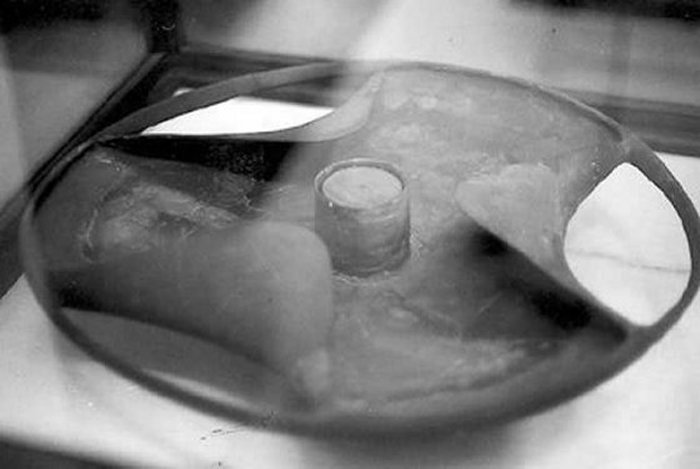
The disc has a complex structure. Credit: Cairo Museum
Some scientists suggest that the fragile nature of such an intricately carved stone object significantly limits practical usage and suggests a purely ornamental function, religious or other such ritualistic purposes.
Of course, some believe that this subject served another purpose, just to be able to drive a foot oil lamp.
However, critics of this theory argue that the three-blade ceremonial lamp is hardly possible because of the shape and curvature of its petals, which seems to suggest a function, not just decoration.
Did ancient Egyptians have technology far beyond the current?
One option is even more challenging, namely that we are dealing with some kind of unknown advanced ancient technology. Is it possible ancient Egyptians had technology far beyond the current?
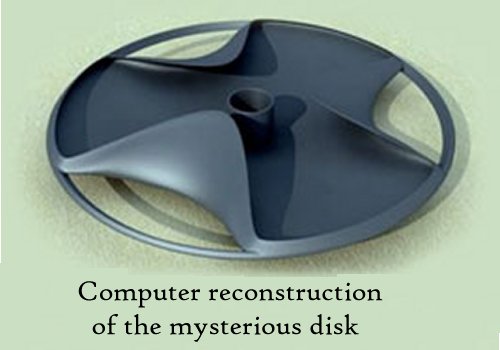
Egyptologist Cyril Aldred concluded that, independently of what the object was used for or what it represented, its design was, without a doubt, a copy of a previous, much older metallic object.
Why did the ancient Egyptians bother to design an object with such a complex structure more than 5,000 years ago?
How could a culture that typically used chisels to shape rock have mastered a technique to work such a delicate material to this extraordinary level?

One of the most mysterious ancient objects discovered in Egypt. Credit: Cairo Museum
Why would ancient Egyptians invest the time and skills needed to create this object unless it served a very important, specific purpose?
The Schist Disk's futuristic design continues to baffle all who have seen it. Egyptologists offer several theories trying to explain what the disc was used for, but for the moment, no-one has been able to explain the object's complex structure. Obviously, the Schist Disk is an object that played an important role 5,000 years ago.
Undoubtedly, this peculiar object constitutes one of the most perplexing Egyptian and ancient mysteries, and we are left with several unanswered questions.
The Schist Disk is currently in the Cairo Museum.
Written by – A. Sutherland - AncientPages.com Senior Staff Writer
Updated on August 8, 2021
Copyright © AncientPages.com. All rights reserved. This material may not be published, broadcast, rewritten or redistributed in whole or part without the express written permission of AncientPages.com
More From Ancient Pages
-
 Scientists Search For North America’s ‘Atlantis’ – Submerged Landscapes In The Gulf Of Mexico Studied
-
 Mysterious Undeciphered Carvings And Script On Stela Of Montoro
-
 Archaic Marble Lions On The Sacred Island Of Delos
-
 Rare Coins Found In A Dead Sea Cave Offer First Solid Evidence For The Maccabean Revolt 2,200 Years Ago
-
 Earliest Ochre Crayon Used By Our Ancestors 10,000 Years Ago Found In Yorkshire, Northern England
-
 Selinunte: Latest Excavations Bring To Light A New Small Temple – What Ritualistic Practices Will Be Revealed One Day?
-
 Mysterious Advanced Underground Civilization And A Secret Society – Astonishing Discovery And Connection – Part 1
-
 Roman Marble Head Found In Lake Nemi Could Be From Caligula’s Legendary Ships
-
 170-Million-Year-Old Sea Monster Identified As The Oldest Mega-Predatory Pliosaur
-
 Composition Of A 2,000-Year-Old Roman Perfume Identified For The First Time
-
 Yokai Kijo (Kidjo): Demoness, Cannibal With Hideous Heart Is A Moral Reminder In Japanese Beliefs
-
 Sacred Cherokee Star Mound And The Legend Of The Star People – Beneath The Ground May Lie A Secret That Should Remain Hidden Forever
-
 Oldest Case Of A Rare Genetic Condition Discovered
-
 Illuminated Ancient Manuscripts Reflect 1,000 Years Of Human History
-
 1,800-Year-Old Buddhist Stupa And Relics Discovered Near Bazira, The Ancient City Of Alexander The Great
-
 Pharaoh Ramesses I Whose Mummy Was Stolen And Displayed As A Freak Of Nature For 130 Years
-
 Mysterious Kaali Crater And The Holy Lake – Sacred Ancient Places In Estonia
-
 Amazing Photos Of Ancient Ruins Hidden Under Thessaloniki Metro Revealed By Archaeologists
-
 3,000-Year-Old Geoglyphs May Depict The Heavens
-
 On This Day In History: Terracotta Army Buried With Emperor Qin Shi Huang Discovered – On Mar 29, 1974

