
Pazyryk Carpet Found In Scythian Tomb Considered The Oldest Carpet In The World
A. Sutherland - AncientPages.com - In 1949, Russian archeologist Sergei Rudenko made an extraordinary discovery while excavating burial mounds and a Scythian prince's tomb in southern Siberia.
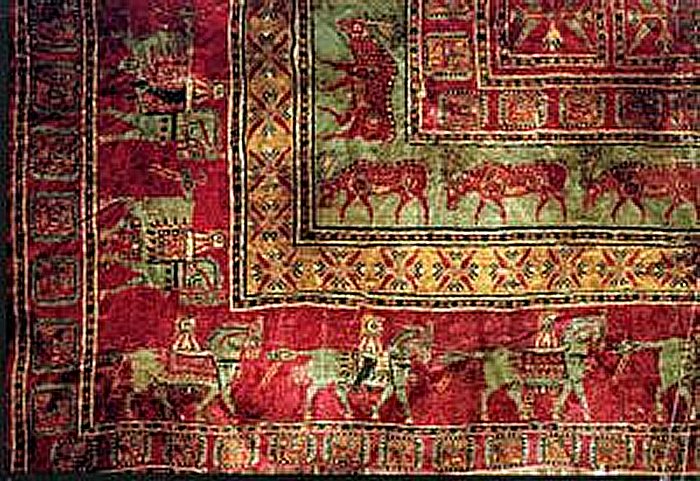
 Pazyryk Carpet. Image source
The place of the discovery was the so-called Pazyryk Valley, Altai Territory, in the region of the Bolshoy Ulagan River. In his excavations, Rudenko focused on the ancient history of weaving.
The tomb of a Scythian Prince dating back to 500 B.C. contained many treasures, and among them was the Pazyryk Carpet, measuring 183cm x 200cm and made by skilled craftsmen. It was created by using the traditional Turkish knotting system. The ancient rug is finely knotted with an average of 200 to 270 symmetrical knots to the square inch.
The tradition of making this kind of carpet originated from the nomadic Turkish tribes that occupied central Asia two millennia ago. However, this unbroken tradition of rug-making survived alongside more modern practices.
The carpet's decoration is vibrant and varied. The central part is covered with 24 cross-shaped figures, each consisting of 4 stylized lotus buds. This composition is framed by a border of griffins, followed by another one of 24 fallow deer. The most expansive of these two borders contains 28 figures of men on horseback and dismounted.
Credit: Hermitage Museum - Public Domain
Naturally, the carpet's once bright yellows, blues, and reds are not visible today, but initially, the rug must have displayed a beautifully glowing range of colors.
The Pazyryk carpet was made using the technique of the symmetrical double knot, the so-called Turkish knot, which means - 3600 knots per 1 dm2, so the whole carpet has more than 1,250,000 knots, and therefore this carpet pile is dense.
The origin of this unique Pazyryk carpet is not entirely known. Experts suggest that it may have a connection to Iran, but it perhaps was made somewhere in Central Asia thanks to the contacts of ancient people of the Altai Mountains with those from Iran and the Near East region.
Interestingly, the beautiful Pazyryk rug may represent only a copy of the original Persian piece of art.
The Pazyryk culture was a Scythian nomadic Iron Age archaeological culture of Iranian origin that lived from the 6th to 3rd centuries BC. Unearthed artifacts and mummified humans found in the Siberian permafrost in the Altay (Altai) Mountains, Kazakhstan, and Mongolia made their identification possible.
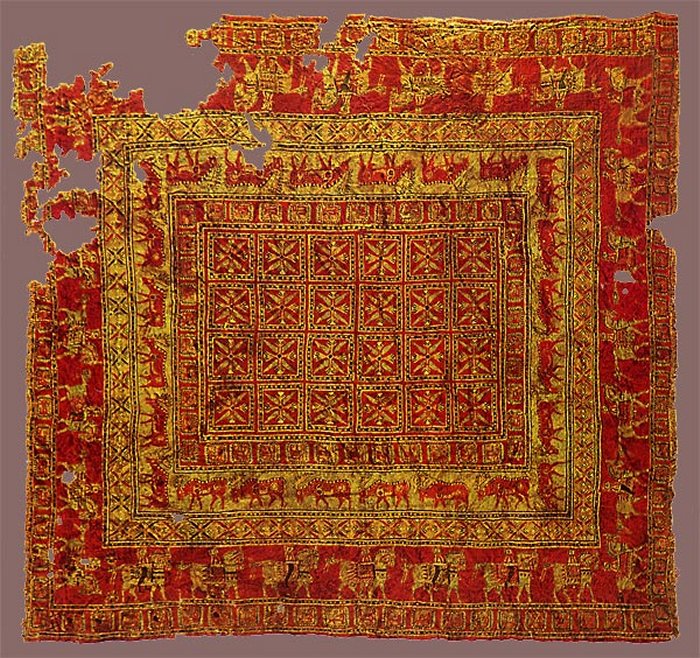
Another Pazyryk rug. Circa 400 BC. Hermitage Museum - Image source - - Public Domain
The Pazyryk's mummies were buried in long barrows (or kurgans), similar to the Scythian tomb mounds in Ukraine. Many artifacts and human remains were found at this location.
The culture flourished and benefited from the many trade routes and caravans of merchants passing through the area.
Ancient cultures flourished and disappeared for thousands of years in the Altai region, Siberia. Archaeologists have excavated the old burial complexes of the Pazyryk culture that existed in the Altai region about 2,500 years ago, from the end of 600 BC to the beginning of 200 BC.
Excavations revealed several skulls that offer evidence of sophisticated ancient surgical technologies and tombs with the bodies of horses and one with an embalmed body of a man whose body was decorated with tattoos depicting animal motifs. The remarkable textiles recovered from the Pazyryk burial tombs include the Pazyryk Carpet, pieces of woven Persian fabric, and the oldest embroidered Chinese silk.
Updated on May 11, 2024
Written by – A. Sutherland - AncientPages.com Senior Staff Writer
Copyright © AncientPages.com All rights reserved. This material may not be published, broadcast, rewritten or redistributed in whole or part without the express written permission of AncientPages.com
Expand for referencesMore From Ancient Pages
-
 Fisherman Pulls A Viking Sword From The River Cherwell, Oxford, UK
-
 Abundantia: Roman Goddess Who Was Shaking Her Gifts From Cornucopia – ‘Horn Of Plenty’
-
 Buccaneers And Privateers Were Pirates – But What’s The Difference Between Them?
-
 Significant Mesolithic Site With Unusual Pits Discovered In Bedfordshire
-
 Aboriginal People Made Pottery And Navigated To Remote Islands Millennia Before Europeans Arrived
-
 Controversial 5,500-Year-Old Sumerian Star Map Of Ancient Nineveh Reveals Observation Of Köfels’ Impact Event
-
 Shiva – Hindu God Who Resides In Every Being And In All Things
-
 The Great Pyramid And Ancient Egyptian Knowledge Shed Light On Biblical Mysteries – Resurrection Of The Flesh – Part 1
-
 Chalchihuitlicue: Beautiful, Dangerous, Changeable And Unpredictable Water Goddess In Aztec Mythology
-
 On This Day In History: King Henry VII’s Coronation Was Held – On Oct 30, 1485
-
 Mani: Apostle Of Light And His Ancient Rock Crystal Seal
-
 Ancient Warming Event May Have Been Trigged By Changes In Earth’s Orbit
-
 Was Spruce Hill In Ohio Home To An Ancient Lost Civilization? Traces Of Strong Fire Puzzle Scientists
-
 Bizarre Event – Why Did Hundreds Of Individuals Suddenly Freak Out At A Cemetery?
-
 Burial Practices In Unified Cultures Of Early Medieval Europe
-
 Bronze Age Scandinavians Crossed The Sea Before The Vikings – New Computer Model Reveals
-
 Birka Artifacts Shed Light On Vikings’ Daily Life
-
 1,700-Year-Old Vase For Olive Oil And Wine Unearthed At Historic Site Of Diyarbakir Fortress, Turkey
-
 Unique Ancient Map Depicting The Earth As Seen From Space Restored Digitally
-
 Huge Folklore Map With Supernatural Beings And Mythical Monsters Created – Available For Free Online

